
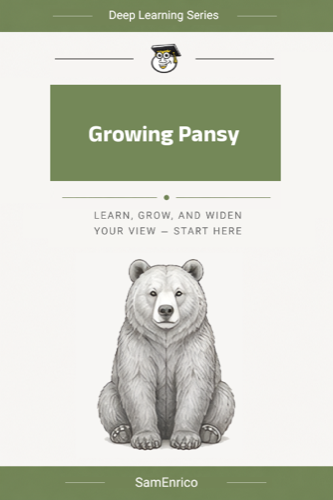
Non-FictionInformativeEducational
Growing Pansy eBook
This publication, published by SamEnrico, covers G
by Cobb Dallas
This publication, published by SamEnrico, covers Growing Pansy
Formats
Free sample
Chapter 1: The Smile in Winter...--–- The first time I saw a pansy bloom in January, I was standing in a Vermont garden with snow piled two feet high against the fence, my breath fogging the air, my fingers numb inside inadequate gloves. The plant was growing in a cracked terracotta pot that someone had forgotten to bring inside the previous autumn. It should have been dead. By every rule of horticulture I thought I understood, that pansy had no business being alive, let alone flowering. And yet there it was: a single purple-and-yellow face, no larger than a thumbnail, turned directly toward the gray winter sky as if daring the cold to do its worst.
That moment changed how I thought about gardening. It was not the triumph of skill or the result of careful planning. It was simply a plant refusing to read the same books I had read.That stubborn little flower was a pansy — specifically a member of the species Viola wittrockiana, though I did not know that name at the time. What I knew was that it was beautiful, it was alive in a season when most things were not, and it had arrived without my permission or participation. That last part stung a little, if I am honest.
I had been gardening for several years by then, carefully following seed packets, measuring fertilizer, constructing elaborate watering schedules. And here was a volunteer plant, growing in neglect, outperforming everything I had intentionally cultivated the previous summer. The lesson was humbling: pansies are not demanding divas that require constant pampering. They are resilient survivors that simply happen to have exquisite taste in weather.This book is the one I wished I had owned that January afternoon. It is not a collection of vague encouragements or Pinterest-perfect photographs that bear no relation to the reality of muddy knees and aphid infestations.
It is a practical, comprehensive, occasionally obsessive guide to understanding, growing, and truly mastering Viola wittrockiana — the plant that botanists call a hybrid and gardeners call a miracle. By the time you finish these twelve chapters, you will know how to start pansies from seed, coax them through freezing winters, diagnose every spot and curl and discoloration, design landscapes that make neighbors stop mid-stride, and even hybridize your own unique varieties. But first, we must answer a more fundamental question: what exactly is a pansy, and why does it behave so differently from almost every other flower in your garden?The Botanical Identity of a Hybrid Hero Let us begin with taxonomy, because names matter and confusion is common. The pansy you buy at a nursery or grow from a seed packet is not a wild species that evolved naturally over millions of years. It is a deliberate human creation, a hybrid produced by crossing several different Viola species, most notably Viola tricolor (the wild pansy or heartsease) and Viola lutea (the mountain pansy).
The work was done by plant breeders in the early nineteenth century, most famously Lord Gambier and his gardener William Thompson in England, who spent decades selecting for larger flowers, clearer colors, and that distinctive "face" pattern that makes pansies so instantly recognizable. The name Viola wittrockiana honors the Swedish botanist Veit Brecher Wittrock, who studied the genus extensively. But the common name "pansy" comes from the French word pensée, meaning "thought" — a reference to the flower's resemblance to a human face bowed in contemplation. In Victorian flower language, giving someone a pansy meant "I am thinking of you," which is considerably more romantic than the modern equivalent of a text message.What distinguishes a pansy from its close relatives? The average gardener uses the terms "pansy," "viola," and "violet" interchangeably, but they are not the same.
True pansies (Viola wittrockiana) produce large flowers, typically two to four inches across, with overlapping petals and the characteristic face pattern of dark blotches or veins. They are the showboats of the genus. Violas (often Viola cornuta or Viola × williamsii) produce smaller flowers, usually one to one and a half inches across, but they bloom more profusely and tolerate heat better. Horned violets (Viola cornuta) are a specific type of viola with a distinctive spur on the back of the flower. And the common violet (Viola sororia and related species) is a perennial wildflower that rarely appears in garden centers.
For the purposes of this book, when I say "pansy," I mean the large-flowered hybrid that dominates garden center displays from September to May. When you see a smaller, more delicate flower that seems to bloom continuously without complaint, that is a viola — and if you are gardening in a hot climate, you might want to grow those instead. More on that in Chapter 2, where we survey the top twenty cultivars.The Anatomy of a Face Let us look more closely at what makes a pansy a pansy. The most obvious feature is the flower's structure: five petals arranged in a roughly circular form, with two upper petals, two side petals, and one lower petal that is often broader and more rounded. The famous "face" is produced by dark pigmentation at the base of the petals, forming blotches, lines, or veining that radiate outward from the flower's center.
These markings are not decorative accidents. They are nectar guides — visual signals that evolved to direct pollinating insects toward the flower's reproductive organs. From a bee's perspective, the dark lines on a pansy petal function like runway lights, pointing the way to the landing strip where nectar waits. The fact that humans find these markings beautiful is a happy coincidence. Our aesthetic preferences and a bee's navigation needs align more often than you might expect.Beneath the petals lie the reproductive structures: the anthers (male, producing pollen) and the stigma (female, receiving pollen).
Pansies are hermaphroditic, meaning each flower contains both male and female parts, but they are not reliably self-pollinating. The anthers are arranged in a cone around the style, and the flower typically requires an external trigger — a bee buzzing at the right frequency, wind shaking the stem, or a human finger brushing against the bloom — to release pollen onto the stigma. This is why hand-pollinating pansies for hybridization (see Chapter 12) requires careful technique and a small brush or toothpick.Below the flower, a slender stem called a peduncle connects the bloom to the main plant. The peduncle's length varies by cultivar, ranging from two to six inches, which matters if you intend to grow pansies for cut flowers (see Chapter 11). Longer stems are better for bouquets but more prone to flopping.
Shorter stems keep the flowers closer to the foliage, creating a denser, more compact display.The vegetative parts of the pansy — leaves, stems, and roots — are equally important. Pansy leaves are oval to heart-shaped, with scalloped (crenate) edges, and they grow in a basal rosette or alternately along the stem, depending on the plant's habit. The two main growth habits are mounding (compact, rounded plants that stay relatively low and wide) and trailing (plants that send out long, flexible stems that spill over the edges of containers). Mounding pansies are ideal for garden beds, borders, and mass plantings. Trailing pansies…
This is the end of the free sample. Get the eBook to keep going. Buy now
About this book
Details
- Author
- Cobb Dallas
- Publisher
- SamEnrico
- Language
- English
- Genre
- Non-Fiction, Informative, Educational
- Released
- 2026-05-11
- Pages (approx.)
- 151
- Available as
- eBook, Audiobook

Read better in the ZLOADR app
Your eBooks on your phone or tablet. Sign in with your SamEnrico account and start reading.
More by Cobb Dallas
 Pandemic Preparedness Kit GuideCobb Dallas$11.99
 RLS And Multiple Sclerosis ManagementCobb Dallas$11.99
 Cleopatra's Mercenary Recruitment GuideCobb Dallas$11.99
 Doctor On Call Sleep MeditationCobb Dallas$11.99
 Student Burnout PreventionCobb Dallas$11.99
 Del Toro Monster HeartCobb Dallas$11.99
 Anger Management for Creative FieldsCobb Dallas$11.99
 Memory Palace For StudentsCobb Dallas$11.99
 ESG and Distressed Asset PricingCobb Dallas$11.99
 The Iron Discipline: Frederick the Great and Prussia's Military MachineCobb Dallas$11.99
 The Great Moon Hoax: How a 19th-Century Newspaper Fooled the WorldCobb Dallas$11.99
 Whispers of the First Dawn: The Lost Songs of the Sumerian HymnsCobb Dallas$11.99
You may also like
 Hong Kong Handover 1997Dunn Johnnie$11.99
 Zumba For Postnatal Recovery CourseNeal Christian$11.99
 Zumba for BeginnersLadner Nikia$11.99
 YouTube Comment Mining GuideHumes Pandora$12.99
 Worry Box MeditationCarlin Rudy$11.99
 Workplace Stress MeditationNguyen Lynn$11.99
 Workplace Stress and Sleep RepairHawley Ivory$11.99
 Workplace Perfectionism CureDelaney Jeffry$11.99
 Workplace Injustice Anger GuideWallen Isabelle$11.99
 Work Addiction and Burnout LinkGreenwood Ester$11.99
 Women in Yoga and WellnessBeattie Galina$11.99
 Women in Stand Up ComedyChun Evangeline$11.99