
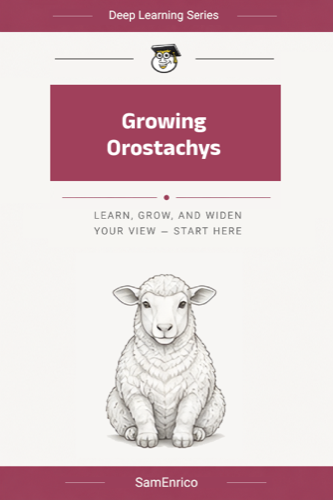
Non-FictionInformativeEducational
Growing Orostachys
This publication, published by SamEnrico, covers G
This publication, published by SamEnrico, covers Growing Orostachys
Formats
About this book
Free sample
Chapter 1: The Forgotten Mountain Jewel...--The first time I saw an Orostachys in the wild, I nearly stepped on it.I was hiking the limestone scree slopes of Mount Ibuki in central Japan, a region famous for its ancient alpine flora. My guide, a botanist in his seventies who had been studying these mountains for fifty years, pointed down at a crack between two weathered rocks. "There," he said. "Your Dunce Cap."What I saw was not a plant, at least not as I understood plants. It was a constellation of perfect, silver-green spirals, each no larger than a ping-pong ball, hugging the rock so tightly that they seemed to be part of the stone itself.
The summer sun had baked the slope to 95 degrees that day, yet these little rosettes looked crisp, healthy, entirely unbothered. I touched one. Its leaves were firm, cool, slightly spiny at the tips. When I looked closer, I noticed that the rosettes were connected by thin, pale runners—like umbilical cords—stretching across the rock, sending out new colonies inches away from the mother.I had been growing succulents for fifteen years. I had written articles about Echeveria, Lithops, and Adenium.
I had a greenhouse full of plants that required obsessive humidity control, grow lights on timers, and soil mixes that cost more than good whiskey. And yet here was a plant I had never heard of, growing in a crack, surviving months of summer drought and winter snow, reproducing without any help from anyone.That moment changed me.Orostachys is the genus that horticulture forgot. While its cousin Sempervivum (Hens and Chicks) became a staple of every garden center in North America and Europe, Orostachys remained an obscure treasure, known only to alpine plant society members and a handful of collectors in Japan, Korea, and Russia. This is a tragedy, because Orostachys is, in many ways, a superior plant. It is more sculptural.
It is more surprising. And it has one feature that Sempervivum lacks: a death bloom so dramatic, so architectural, that it transforms a humble rosette into a twelve-inch spire of…
This is the end of the free sample. Get the eBook to keep going. Buy now
Contents
- Chapter 1
- Chapter 2
- Chapter 3
- Chapter 4
- Chapter 5
- Chapter 6
- Chapter 7
- Chapter 8
- Chapter 9
- Chapter 10
- Chapter 11
- Chapter 12
Details
- Author
- Lyon Camellia
- Publisher
- SamEnrico
- Language
- English
- Genre
- Non-Fiction, Informative, Educational
- Released
- 2026-06-02
- Pages (approx.)
- 146
- Available as
- eBook, Audiobook

Read better in the ZLOADR app
Your eBooks on your phone or tablet. Sign in with your SamEnrico account and start reading.
More by Lyon Camellia
 The Interruption MVP MethodLyon Camellia$11.99
 The Workaholic's Exercise RebootLyon Camellia$11.99
 NVC For Guilt GuideLyon Camellia$11.99
 Hillary Everest Trash CleanupLyon Camellia$11.99
 Behavioral Experiment AngerLyon Camellia$11.99
 The Koresh Messiah ComplexLyon Camellia$11.99
 Cash Flow for DistributorsLyon Camellia$11.99
 Teresa and John of CrossLyon Camellia$11.99
 Blair New LabourLyon Camellia$11.99
 The Serpent’s Gambit: What If Cleopatra Defeated Rome?Lyon Camellia$11.99
 The Unseen Maestro: The Secret Life of Quincy JonesLyon Camellia$11.99
 Whispers of the Silk Road: The Lost Caravan of the Celestial AtlasLyon Camellia$11.99
You may also like
 Hong Kong Handover 1997Dunn Johnnie$11.99
 Zumba For Postnatal Recovery CourseNeal Christian$11.99
 Zumba for BeginnersLadner Nikia$11.99
 YouTube Comment Mining GuideHumes Pandora$12.99
 Worry Box MeditationCarlin Rudy$11.99
 Workplace Stress MeditationNguyen Lynn$11.99
 Workplace Stress and Sleep RepairHawley Ivory$11.99
 Workplace Perfectionism CureDelaney Jeffry$11.99
 Workplace Injustice Anger GuideWallen Isabelle$11.99
 Work Addiction and Burnout LinkGreenwood Ester$11.99
 Women in Yoga and WellnessBeattie Galina$11.99
 Women in Stand Up ComedyChun Evangeline$11.99