
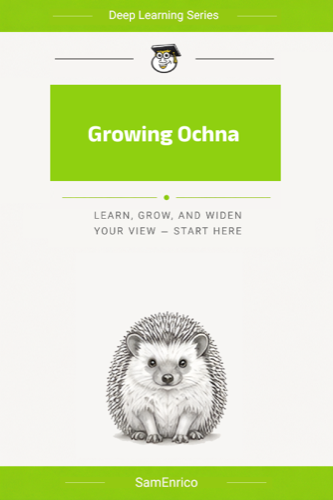
Non-FictionInformativeEducational
Growing Ochna eBook
This publication, published by SamEnrico, covers G
by Mclean Kyoko
This publication, published by SamEnrico, covers Growing Ochna
Formats
Free sample
Chapter 1: The Two-Faced Beauty...--–- It began, as so many gardening disasters do, with a single photograph.The image appeared in my social media feed on a quiet Sunday morning in early spring. A friend in Brisbane had posted a picture of her backyard shrub, and I stopped scrolling immediately. The plant was covered in brilliant yellow flowers—five petals each, delicate and fragrant-looking—but that wasn’t what caught my attention. Beneath the flowers, still forming, were clusters of glossy black berries. And holding those berries like tiny chalices were sepals of the most astonishing shade of red I had ever seen on a living plant.
Not the dusty red of autumn leaves or the deep crimson of a rose. This was a saturated, almost fluorescent scarlet, the color of candy apples and sports cars.She had captioned the photo with three words: “Mickey Mouse plant.”I had never heard of it. I immediately wanted one.That single moment of aesthetic desire—perfectly reasonable, entirely human, utterly innocent—set in motion a two-year journey that would teach me more about gardening, ecology, and humility than the previous twenty years combined. I would learn that the plant I coveted had another name, one that land managers in three countries whispered with something close to dread. I would learn that my friend’s charming backyard shrub was, in the eyes of the Queensland government, a Class 3 declared pest plant whose sale carried fines in the thousands of dollars.
I would learn that the same biological traits that made the plant so stunning—its profligate flowering, its efficient seed dispersal, its stubborn resilience—made it a nightmare once it escaped cultivation.And I would learn, eventually, that there was a right way and a wrong way to love this plant. The wrong way had already begun.The Seduction of the Unfamiliar Every gardener knows the feeling. You see something you have never seen before—something that doesn’t look like the hydrangeas and boxwoods and rose bushes that populate every suburban landscape—and something in your brain clicks into acquisition mode. The unfamiliar is exotic. The exotic is desirable.
And desire, when it comes to plants, is a remarkably poor advisor.Ochna, in all its forms, is exceptionally good at triggering this response. The genus contains roughly 85 species of evergreen shrubs and small trees distributed across tropical Africa, Southeast Asia, and South America. But only a handful have made their way into cultivation, and fewer still have escaped it. The two species most relevant to gardeners are Ochna serrulata (the true “Mickey Mouse plant”) and Ochna integerrima (the “Yellow Mai” or “Mai Vang” of Vietnamese Lunar New Year fame). They are close relatives but very different characters, a fact that will become essential to remember as this book progresses.Ochna serrulata is the species my friend in Brisbane was growing.
It is a small shrub, rarely exceeding two to three meters in cultivation, with narrow, serrated leaves that resemble those of a willow in miniature. Its flowers are a soft, buttery yellow, roughly two centimeters across, and they arrive in prodigious quantities during mid to late spring. The fragrance is subtle but pleasant—honeyed, with a hint of lemon. Within weeks of flowering, the petals drop, and the sepals begin their transformation from pale green to the intense, irresistible red that gives the plant its common name. The black berries develop shortly after, each one a tiny, glossy sphere containing a single seed.All of this is beautiful.
All of this is effective. The red sepals are not merely decorative; they are an evolutionary masterpiece. They persist for weeks after the fruit has ripened, acting as a signal to birds that a meal is available. Birds eat the berries, fly away, and deposit the seeds in new locations, often kilometers from the parent plant. The seeds germinate readily in disturbed soil, and the seedlings grow quickly, their aggressive taproots anchoring them deep into the ground.This is not a flaw in the plant.
This is the plant succeeding at what evolution designed it to do. The problem is not Ochna. The problem is Ochna in places where it does not belong.A Weed By Any Other Name The term “weed” is a human invention. Plants do not conspire to annoy us. They do not strategize about how to disrupt agricultural systems or crowd out native species.
They simply grow where conditions allow, reproduce according to their biological programming, and compete for resources with whatever other organisms share their space. When we call a plant a weed, we are not describing an intrinsic property of the plant. We are describing a relationship of inconvenience between the plant and ourselves.That said, Ochna serrulata has earned its designation as a weed in multiple countries through sheer, undeniable success.The plant’s journey from ornamental curiosity to environmental villain followed a familiar pattern. It was introduced to Australia in the early twentieth century as a garden plant, valued for its unusual appearance and reliability in a range of conditions. For decades, it remained confined to cultivated landscapes, admired by the few gardeners who knew about it.
Then, sometime in the 1960s or 1970s, it began to escape.The mechanism of escape was almost certainly avian. Birds that had fed on Ochna berries in suburban gardens flew into adjacent bushland and deposited seeds in areas of disturbed soil—along creek beds, at the edges of walking trails, in clearings created by fire or logging. The seeds germinated. The seedlings grew. And because Ochna faced none of the natural predators or competitors that kept it in check in its native range, it thrived.By the 1990s, Ochna serrulata had established itself as a significant environmental weed in New South Wales and Queensland.
It formed dense thickets that shaded out native groundcovers and prevented the regeneration of trees. It invaded rainforest margins, riparian zones, and wet sclerophyll forests. Land managers began to notice that where Ochna appeared, native plant diversity declined. Birds continued to spread the seeds. The problem compounded itself.Today, Ochna serrulata is declared a Class 3 pest plant in Queensland (meaning it cannot be sold or distributed), a Weed of National Significance in Australia, and a banned species in New Zealand.
It is also listed as an invasive species in Hawaii, where it has established populations on multiple islands. South Africa, ironically the native range of several Ochna species, has its own struggles with O. serrulata in areas where it was introduced as an ornamental.I want to be very clear about something: none of this makes the plant evil. It makes the plant successful. And our frustration with its success should not blind us to the fact that we were the ones who moved it.The Other Face: Ochna integerrima Not all Ochna species are created equal in the eyes of regulators or gardeners.
Ochna integerrima, the Yellow Mai, occupies a completely different cultural and ecological position.This species is native to Vietnam, Cambodia, Laos, and parts of southern China. Unlike its cousin O. serrulata, O. integerrima has larger leaves (hence the species name, meaning “unbroken” or “entire,” referring to the smooth leaf margins), larger…
This is the end of the free sample. Get the eBook to keep going. Buy now
About this book
Details
- Author
- Mclean Kyoko
- Publisher
- SamEnrico
- Language
- English
- Genre
- Non-Fiction, Informative, Educational
- Released
- 2026-06-03
- Pages (approx.)
- 146
- Available as
- eBook, Audiobook

Read better in the ZLOADR app
Your eBooks on your phone or tablet. Sign in with your SamEnrico account and start reading.
More by Mclean Kyoko
 RLS Sleep Hygiene Improvement HandbookMclean Kyoko$11.99
 Hillary Antarctic ExpeditionMclean Kyoko$11.99
 Emotional Intelligence for JournalistsMclean Kyoko$11.99
 Chiropractic for FibromyalgiaMclean Kyoko$11.99
 The Second Brain CaptureMclean Kyoko$11.99
 Underrepresented in Tech GuideMclean Kyoko$12.99
 Twelve Step for SeniorsMclean Kyoko$11.99
 Trance For Speed ReadingMclean Kyoko$11.99
 Inventory Cash Flow OptimizationMclean Kyoko$11.99
 Abraham Joshua Heschel TheologyMclean Kyoko$11.99
 The Ghost of Stalingrad: One Soldier’s War Against the Red ArmyMclean Kyoko$11.99
 The Feast of the Nobel: A Culinary Celebration of Black Scientific GeniusMclean Kyoko$11.99
You may also like
 Hong Kong Handover 1997Dunn Johnnie$11.99
 Zumba For Postnatal Recovery CourseNeal Christian$11.99
 Zumba for BeginnersLadner Nikia$11.99
 YouTube Comment Mining GuideHumes Pandora$12.99
 Worry Box MeditationCarlin Rudy$11.99
 Workplace Stress MeditationNguyen Lynn$11.99
 Workplace Stress and Sleep RepairHawley Ivory$11.99
 Workplace Perfectionism CureDelaney Jeffry$11.99
 Workplace Injustice Anger GuideWallen Isabelle$11.99
 Work Addiction and Burnout LinkGreenwood Ester$11.99
 Women in Yoga and WellnessBeattie Galina$11.99
 Women in Stand Up ComedyChun Evangeline$11.99