
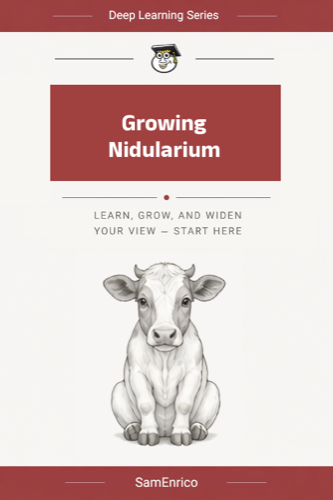
Non-FictionInformativeEducational
Growing Nidularium eBook
This publication, published by SamEnrico, covers G
This publication, published by SamEnrico, covers Growing Nidularium
Formats
Free sample
Chapter 1: The Nest That Waters Itself--The first time I killed a cactus, I knew I had a problem.Not because cacti are difficult—they are famously forgiving—but because I managed to drown one in a pot with no drainage holes. I was twenty-three, living in a basement apartment with one small window that faced a brick wall, and I had decided that houseplants would fix my loneliness. They did not. They died. One after another.
Succulents turned to mush. Ferns became crispy brown skeletons. A peace lily that a friend assured me was "unkillable" gave up after three weeks.I tell you this not to embarrass myself—though I am, slightly—but to establish credibility. I am not a natural gardener. I have no inherited green thumb, no childhood memories of helping grandmothers in lush greenhouses.
I am the person who kills plants by caring too much, by watering when I'm anxious, by moving them into sun when I'm hopeful. For years, I believed that certain people were simply "plant people" and I was not.Then I found the bird's nest bromeliad.Specifically, I found Nidularium 'Fireball' at a grocery store clearance rack. It was shoved between discounted wrapping paper and stale candy canes in January. The plant looked terrible—lime green leaves that had faded to a sickly yellow, a central cup filled with dust and what I hoped was dried coffee but suspected was something worse. The tag said "Assorted Bromeliad" and nothing else.
Price: two dollars.I bought it because I felt sorry for it. Also because two dollars.What happened next changed how I think about plants entirely. I took it home, filled its central cup with water because that seemed right (the leaves formed a natural bowl, after all), and put it on my brick-wall windowsill. Then I forgot about it for two weeks. When I remembered, I expected a corpse.
Instead, the yellow had faded to green. New leaves had emerged from the center. The plant looked... happy. Not surviving.
Thriving.That was the moment I realized I had been doing everything wrong with every other plant I owned. Not because I was incapable, but because I was treating all plants the same. I was watering soil. I was ignoring the cup. I was fighting against nature instead of working with it.Nidularium taught me a different way.What This Chapter Will Do For You By the end of this chapter, you will understand exactly what Nidularium is, why it is fundamentally different from almost every other houseplant you have ever grown, and—most importantly—why this difference makes it the perfect plant for people who have given up on keeping things alive.
You will learn:The single biological feature that makes Nidularium nearly impossible to kill by neglect Why the "bird's nest" name is not just cute marketing but a literal description of how the plant survives The three mistakes every beginner makes (and how to avoid them before you even buy your first plant)A simple self-assessment to determine whether you should start with a hybrid or a species No prior knowledge is assumed. If you have never grown anything more demanding than mold in the back of your refrigerator, you are in the right place.The Genus That Confuses Everyone Let us start with clarity. Nidularium (pronounced nid-yoo-LAIR-ee-um) is a genus of flowering plants in the bromeliad family. It is native to eastern Brazil, specifically the Atlantic Forest biome—a biodiversity hotspot that has been reduced to about twelve percent of its original coverage. In the wild, Nidularium grows on the forest floor, in the dappled shade beneath larger trees, often in leaf litter that stays damp but never waterlogged.That last detail matters more than almost anything else in this book.
On the forest floor, Nidularium does not sit in mud. It sits in moving water—rain that falls, collects briefly in the central cup, and then evaporates or overflows. The ground beneath it stays moist but never saturated. Replicating this condition in your home is the entire secret to success.Now, here is where confusion enters. You may have heard of Neoregelia, another bromeliad genus that looks similar.
Or Vriesea. Or Guzmania. These are all cousins. But Nidularium has a distinguishing feature that no other bromeliad shares: its flowers are hidden.I will say that again because it is remarkable. The flowers of Nidularium are buried deep inside the central cup.
They do not rise above the leaves on a tall stalk. They do not advertise themselves to the world. Instead, the plant blushes—the inner leaves turn bright red, pink, or orange—and this color attracts hummingbirds. The hummingbird hovers above the cup, inserts its beak, and pollinates the hidden flowers without ever seeing them.This is called a "hidden inflorescence," and it is the botanical equivalent of a secret handshake. If you see a bromeliad with a tall, showy flower spike, it is not Nidularium.
If you see a bromeliad with colorful inner leaves and no obvious flower, you are likely looking at Nidularium or its close relative Neoregelia. (We will distinguish between the two in Chapter 2.)Why the Name Matters The name Nidularium comes from the Latin nidus, meaning "nest." The suffix -arium means "a place for." So Nidularium translates roughly to "a place for a nest" or "nest-like container."This is not poetic abstraction. It is literal. The rosette of leaves forms a central tank—a cup—that holds water. In the wild, this tank collects rainwater, fallen leaves, insect debris, and the occasional tree frog.
The plant absorbs water and dissolved nutrients through specialized scales called trichomes that line the inside of the cup. The roots, meanwhile, serve primarily as anchors, holding the plant to the forest floor or to rocks.Think of Nidularium as a living birdbath that also happens to be a plant. It creates its own reservoir. It drinks from that reservoir. It does not need you to water the soil.
It does not need constant misting. It needs one thing: a clean, filled cup.This is why Nidularium is the perfect plant for neglectful or anxious plant parents. Most houseplants die because their owners either water too much (root rot) or too little (desiccation). Nidularium bypasses both failure modes. If you forget to water it, the cup still holds moisture for several days.
If you overwater it, the cup simply overflows—the excess drains away. The plant has evolved over millions of years to handle precisely this variability.The Three Mistakes Every Beginner Makes (And How to Avoid Them)Before you buy your first Nidularium, let me save you from the mistakes I made and the mistakes I have watched hundreds of others make. These are not theoretical. They are the three most common failure points, and they are all preventable.Mistake #1: Watering the Soil Instead of the Cup This is the number one killer. By a wide margin.
New owners see a pot with soil and assume the plant works like a philodendron or a pothos. They pour water onto the soil until it runs out the bottom. The roots, which are adapted to dry, airy conditions, sit…
This is the end of the free sample. Get the eBook to keep going. Buy now
About this book
Details
- Author
- Pannell Garret
- Publisher
- SamEnrico
- Language
- English
- Genre
- Non-Fiction, Informative, Educational
- Released
- 2026-06-02
- Pages (approx.)
- 149
- Available as
- eBook, Audiobook

Read better in the ZLOADR app
Your eBooks on your phone or tablet. Sign in with your SamEnrico account and start reading.
More by Pannell Garret
 MBSR Complete Home CoursePannell Garret$11.99
 Daily Doodle Habit GuidePannell Garret$11.99
 Michelle ObamaPannell Garret$11.99
 LinkedIn Profile Optimization GuidePannell Garret$11.99
 Chiropractic for SciaticaPannell Garret$11.99
 The EQ for Customer ServicePannell Garret$11.99
 Focus Mate Pairing GuidePannell Garret$11.99
 The Spiritual Awakening StepPannell Garret$11.99
 Forgiveness Trance WorkPannell Garret$11.99
 The Storm from the Steppe: Subutai's Unstoppable Campaigns (1236-1242)Pannell Garret$11.99
 Whispers in the Wild: The Octopus Who Outsmarted the LabPannell Garret$11.99
 The Dragon’s Apprentice: A Knight’s Forgotten MentorPannell Garret$11.99
You may also like
 Hong Kong Handover 1997Dunn Johnnie$11.99
 Zumba For Postnatal Recovery CourseNeal Christian$11.99
 Zumba for BeginnersLadner Nikia$11.99
 YouTube Comment Mining GuideHumes Pandora$12.99
 Worry Box MeditationCarlin Rudy$11.99
 Workplace Stress MeditationNguyen Lynn$11.99
 Workplace Stress and Sleep RepairHawley Ivory$11.99
 Workplace Perfectionism CureDelaney Jeffry$11.99
 Workplace Injustice Anger GuideWallen Isabelle$11.99
 Work Addiction and Burnout LinkGreenwood Ester$11.99
 Women in Yoga and WellnessBeattie Galina$11.99
 Women in Stand Up ComedyChun Evangeline$11.99