
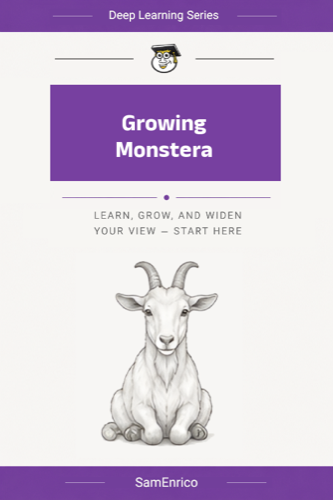
Growing Monstera eBook
This publication, published by SamEnrico, covers G
This publication, published by SamEnrico, covers Growing Monstera
Formats
Free sample
Chapter 1: The Hidden Language...--–- Every Monstera owner remembers the moment. You saw it in a friend’s apartment, its colossal sculptural leaves casting dramatic shadows across a white wall. Or perhaps you scrolled past a photograph online—a perfect Swiss cheese plant, each leaf a masterpiece of holes and splits, climbing a moss pole like it owned the room. Something stirred. Not just admiration, but a quiet voice that whispered: I want that.So you bought one.
A small one, probably, in a plastic nursery pot from a big-box store or a local plant shop. You brought it home, placed it near a window, and watered it when you remembered. Maybe you even named it. And for a while, it was fine. It didn’t grow much, but it didn’t die either.
It just… existed.Then the questions started. Why aren’t the leaves getting any bigger? Why are there no holes? Why is it leaning? Why does it look sad?
You searched online and found conflicting advice: “Bright indirect light” (what does that even mean?), “Water when the top inch is dry” (which finger? my pinky or my thumb?), “They love humidity” (should I buy a rainforest?). You joined plant groups, watched You Tube videos, and read blog posts. Each source contradicted the last. Your Monstera still looked the same—alive, but not thriving.This book exists because that moment of confusion is universal, and the answers are rarely explained in a way that actually makes sense.Most plant care guides tell you what to do.
Water on Sunday. Fertilize in spring. Wipe the leaves. They hand you a checklist and send you on your way. But checklists fail when something goes wrong.
When the leaves turn yellow, the checklist doesn’t tell you why. When the stems get leggy, the checklist has no emergency protocol. When your expensive variegated Monstera starts turning green, the checklist simply shrugs.This book does something different. It teaches you why.By the time you finish these pages, you will not merely know how to keep your Monstera alive. You will understand its hidden language—the signals it sends through every leaf, root, and aerial tendril.
You will look at your plant and see not a decoration, but a living organism engaged in a constant conversation with its environment. And you will finally be able to answer its most urgent question: Will you help me climb?The Monstera Moment: Why This Plant, Why Now The Monstera deliciosa—affectionately known as the Swiss cheese plant, though that name does it a disservice—has become the unofficial mascot of the modern houseplant renaissance. In 2020 alone, searches for “Monstera” increased by over 400 percent globally. Social media platforms exploded with images of perfect specimens framing bohemian living rooms, minimalist bedrooms, and jungle-inspired bathrooms. At the height of the pandemic, rooted cuttings of rare variegated Monsteras sold for thousands of dollars, with single leaves trading online like cryptocurrency for plant people.But the Monstera is not a trend.
It has been cultivated in Western homes since the 1950s, when mid-century modern designers embraced its graphic leaf shape as the perfect counterpoint to clean lines and organic textures. Photographs from that era show Monsteras in the corners of Palm Springs living rooms, their leaves reaching toward floor-to-ceiling windows. The plant never really left—it simply waited for its moment to return.What makes the Monstera different from every other houseplant? The answer lies in its leaves. A Monstera does not just grow; it transforms.
A juvenile plant produces small, solid, heart-shaped leaves that look nothing like the mature specimen you fell in love with. Then, under the right conditions, something magical happens. The leaves begin to split along their edges—first one cut, then two, then a dozen. Holes appear near the central vein. The leaf size doubles, then triples.
The plant goes from cute to commanding.This transformation is not random. It is not a matter of luck or genetics alone. It is a direct response to care. Every split, every hole, every new leaf is a message from the plant about its environment. Learning to read those messages is the first step toward mastery.The Split-Leaf Lie: Settling the Philodendron Confusion Once and For All Before we go any further, we must address a lingering confusion that has caused more misguided care than almost any other single error.
You have seen the labels. You have heard the phrase. Perhaps you have even used it yourself.The Split-Leaf Philodendron.This name is a lie. And it has sent countless Monstera owners down the wrong path.The plant sold as “Split-Leaf Philodendron” is almost always a Monstera deliciosa. Sometimes it is a Thaumatophyllum bipinnatifidum (formerly known as Philodendron selloum).
Neither is a true Philodendron. The confusion originated in the mid-20th century when plant labels were less precise and nurseries grouped any large-leafed aroid under the Philodendron umbrella. The name stuck, even though it is botanically incorrect.Why does this matter? Because Philodendrons and Monsteras have different care requirements. Philodendrons are generally more forgiving of low light and inconsistent watering.
Monsteras are more demanding—and more rewarding—when given proper conditions. Treating a Monstera like a Philodendron leads to disappointment. The plant survives, but it never thrives. The leaves stay small. The fenestrations (the holes and splits) never appear.
The owner assumes they have a “dud” plant when in fact they have simply been following the wrong instructions.From this moment forward, you will never call your Monstera a Split-Leaf Philodendron again. You will call it by its true name: Monstera deliciosa. And you will treat it as the unique, climbing, fenestration-seeking creature that it is.Taxonomy for the Curious: Which Monstera Do You Actually Own?Not all Monsteras are created equal. The genus Monstera contains approximately fifty recognized species, though only a handful are common in cultivation. Knowing which species you own is essential because their growth habits, leaf sizes, and care requirements differ significantly.Monstera deliciosa: The Classic Giant This is the plant most people picture when they hear “Monstera.” Native to the tropical rainforests of southern Mexico and Panama, M.
deliciosa produces enormous leaves that can exceed two feet in length under optimal conditions. The leaves are deep green, leathery in texture, and develop both deep splits (called pinnae) and internal holes (called fenestrations) as they mature. The stems are thick and sturdy, capable of supporting the plant’s weight as it climbs. Indoors, with proper care, a deliciosa will eventually need a moss pole, a trellis, or a wall to climb. Without support, it becomes a sprawling, chaotic mess of downward-drooping stems and increasingly smaller leaves.How to identify: Look for leaves with both splits along the edges and oval or oblong holes near the central vein.
Mature leaves have a distinct heart shape when fully opened, before fenestrations develop. The stem nodes are spaced approximately two to four inches apart on a healthy, well-lit plant.Monstera adansonii: The Swiss Cheese Vine This species has gained enormous popularity in recent years, often sold under the name “Swiss Cheese Vine” or “Monkey Mask Monstera.” Native to Central and South America, M. adansonii produces smaller…
This is the end of the free sample. Get the eBook to keep going. Buy now
About this book
Details
- Author
- Forney Frankie
- Publisher
- SamEnrico
- Language
- English
- Genre
- Non-Fiction, Informative, Educational
- Released
- 2026-05-18
- Pages (approx.)
- 152
- Available as
- eBook, Audiobook

Read better in the ZLOADR app
Your eBooks on your phone or tablet. Sign in with your SamEnrico account and start reading.
More by Forney Frankie
 Religious Difference TalksForney Frankie$11.99
 Loneliness Hospital VolunteeringForney Frankie$11.99
 Recurring Dreams in Teens GuideForney Frankie$11.99
 Elder Exercise ConfidenceForney Frankie$11.99
 The Prevention JournalForney Frankie$11.99
 Stress Tinnitus ConnectionForney Frankie$11.99
 The Couple Who Never ArguedForney Frankie$11.99
 Needle Phobia HypnosisForney Frankie$11.99
 Antwerp Heist LegacyForney Frankie$11.99
 Ashen Echoes: The Last Song of TheraForney Frankie$11.99
 The Last Broadcast: How a Single Radio Transmission Halted the Cold WarForney Frankie$11.99
 The Day the Skywheel Fell: The Tragic Collapse of the London EyeForney Frankie$11.99