
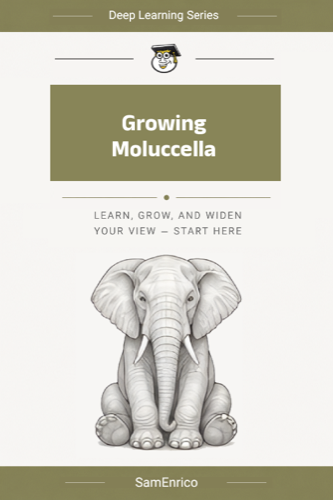
Non-FictionInformativeEducational
Growing Moluccella eBook
This publication, published by SamEnrico, covers G
This publication, published by SamEnrico, covers Growing Moluccella
Formats
Free sample
Chapter 1: The Lucky Lie...–- Every spring, thousands of gardeners plant seeds they believe will bring them good fortune. They water, they wait, they weed, and then they stare at empty soil, wondering what crime they have committed against the gardening gods. The seed packet promised them Bells of Ireland, a name that conjures images of misty green hillsides and ancient Celtic luck. The packet lied about the name, but not about the luck—though perhaps not in the way anyone expects.The plant we call Bells of Ireland is not Irish. It has never been Irish.
It did not drift across the Atlantic in a peat-bottomed boat, nor did it spring from the heel of some wandering Celtic saint. Its true homeland stretches across Western Asia—the rocky hillsides of Turkey, the sun-baked plains of Syria, the craggy slopes of the Caucasus Mountains. Somewhere along the winding path of botanical history, Moluccella laevis acquired a geographic identity that has nothing to do with its origins and everything to do with the power of a good story.This book is about growing that plant. But before we talk about soil temperatures and cold stratification and the precise moment to cut a stem for a ten-day vase life, we need to talk about why anyone would bother. Why would a gardener—already managing tomatoes that won't ripen, roses that won't bloom, and a lawn that refuses to stay green—choose to wrestle with a plant that is famously difficult to germinate, oddly susceptible to rot, and named after a country it has never seen?The answer is simple, and it is the same answer that has kept this plant in cultivation for centuries despite its challenges: when you get it right, nothing else looks like it.The Architecture of Envy Walk through any cut-flower garden in high summer, and you will see the usual suspects: zinnias in electric pinks and oranges, sunflowers nodding their heavy heads, dahlias the size of dinner plates, and snapdragons marching in orderly columns of pink and white.
These are reliable plants. They germinate without drama, they grow with modest encouragement, and they reward even mediocre care with passable blooms. They are the workhorses of the flower garden, and they deserve their place.Then you see the Bells of Ireland.They rise from the green chaos like spires in a cathedral—straight, tall, and impossibly architectural. The stems, square and sturdy like all members of the mint family, support a column of green bells that seem to glow from within. Each bell is actually a calyx, a leafy structure that protects the true flower hidden inside.
And the true flower, when you bother to look for it, is a tiny white bloom no larger than a grain of rice, fragrant in a way that surprises everyone who bends close enough to smell.The effect is not subtle. A row of Bells of Ireland in full growth commands attention not through the usual floral tricks of bright color or overwhelming fragrance, but through pure structure. They are the modernist building in a neighborhood of Victorian houses. They are the black turtleneck among the Hawaiian shirts. They make everything around them look slightly more deliberate, slightly more designed, as if the gardener who grew them possesses a sophistication that the zinnia-grower can only envy.That envy is part of the appeal, and any honest gardener will admit it.
Growing Bells of Ireland well is a flex. It announces to anyone walking past your garden that you know what you are doing. Because everyone knows, or thinks they know, that these plants are difficult. They have heard the stories—the seeds that sit in the soil like tiny green stones, refusing to wake up; the seedlings that collapse overnight for reasons that seem capricious; the mature plants that flop over in the first summer thunderstorm, their architectural perfection reduced to a tangle of broken stems.The stories are true. But they are also incomplete.What This Book Actually Is I am writing this book for the gardener who has tried and failed, for the gardener who is afraid to try, and for the gardener who succeeded once by accident and wants to know how to do it again on purpose.
I am writing it for the floral designer who pays too much for Bells of Ireland at the wholesale market, convinced that growing them is somehow beyond reach. I am writing it for the cut-flower farmer who needs a reliable crop for mid-summer bouquets but cannot afford the germination gamble every spring.This is not a coffee table book of beautiful photographs, though beauty matters and photographs will appear where they help. This is not a botanical monograph for professional horticulturists, though the science will be accurate and you will learn more about seed dormancy than you probably expected. This is a working guide. It assumes you have dirt under your fingernails or want to have dirt under your fingernails.
It assumes you are willing to make mistakes and learn from them. It assumes you understand that the best gardening advice comes not from theory but from practice, and that every chapter in this book has been tested in real gardens—my own gardens, the gardens of friends and strangers, the demonstration plots of agricultural extension offices, and the backyard experiments of stubborn growers who refused to accept that a plant this beautiful could be this difficult.I have grown Bells of Ireland in nine different gardens across five states. I have grown them in heavy clay that cracked like pottery in July. I have grown them in sandy loam that drained so fast you could watch the water disappear. I have grown them under shade cloth in the desert heat of Arizona and without any protection in the wet humidity of coastal Georgia.
I have succeeded more often than I have failed, but I have failed memorably, catastrophically, and in ways that taught me more than any success ever could.The first time I tried to grow Bells of Ireland, I planted seeds directly in the garden in early May, following the instructions on the packet. The packet said "direct sow after last frost." It did not mention cold stratification. It did not mention soil temperature. It did not mention that the seeds have a physical dormancy mechanism that requires specific conditions to break. I watered those seeds every day for six weeks.
Nothing happened. I assumed I had received a bad batch. I threw the rest of the packet in the trash and did not try again for three years.The second time, I started seeds indoors in peat pots, six weeks before the last frost. I had read a blog post that mentioned something about "cool treatment" and had put the seed tray in the refrigerator for two weeks before moving it under grow lights. Twenty percent of the seeds germinated.
I felt like a genius. I transplanted the seedlings carefully into the garden, watched them grow to three feet tall, harvested dozens of stems, and spent the entire summer telling anyone who would listen that Bells of Ireland were easy if you just knew the trick.The…
This is the end of the free sample. Get the eBook to keep going. Buy now
About this book
Details
- Author
- Renteria Angle
- Publisher
- SamEnrico
- Language
- English
- Genre
- Non-Fiction, Informative, Educational
- Released
- 2026-05-11
- Pages (approx.)
- 134
- Available as
- eBook, Audiobook

Read better in the ZLOADR app
Your eBooks on your phone or tablet. Sign in with your SamEnrico account and start reading.
More by Renteria Angle
 The Academic to Corporate GuideRenteria Angle$11.99
 Vendor Negotiation TalksRenteria Angle$11.99
 Senior Care Facility EsteemRenteria Angle$11.99
 Celebrity Recurring Dream MeaningRenteria Angle$11.99
 White Noise Distraction ShieldRenteria Angle$11.99
 Performance Hypnosis GuideRenteria Angle$11.99
 Burnout Recovery for Remote WorkersRenteria Angle$11.99
 Belgian Diamond Vault HistoryRenteria Angle$11.99
 The Last Call RecordingRenteria Angle$11.99
 The Cailleach’s Winter Crown: How the Hag of Beara Shaped the SeasonsRenteria Angle$11.99
 The Billion-Dollar Blueprint: How One Family Built a Property Empire from ScratchRenteria Angle$11.99
 The Empress Who Wrote Her Own Destiny: Wu Zetian’s Rise to PowerRenteria Angle$11.99
You may also like
 Hong Kong Handover 1997Dunn Johnnie$11.99
 Zumba For Postnatal Recovery CourseNeal Christian$11.99
 Zumba for BeginnersLadner Nikia$11.99
 YouTube Comment Mining GuideHumes Pandora$12.99
 Worry Box MeditationCarlin Rudy$11.99
 Workplace Stress MeditationNguyen Lynn$11.99
 Workplace Stress and Sleep RepairHawley Ivory$11.99
 Workplace Perfectionism CureDelaney Jeffry$11.99
 Workplace Injustice Anger GuideWallen Isabelle$11.99
 Work Addiction and Burnout LinkGreenwood Ester$11.99
 Women in Yoga and WellnessBeattie Galina$11.99
 Women in Stand Up ComedyChun Evangeline$11.99