
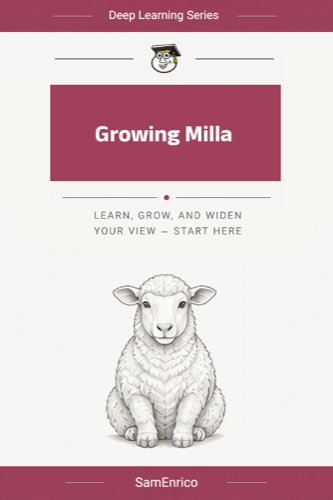
Non-FictionInformativeEducational
Growing Milla eBook
This publication, published by SamEnrico, covers G
by Grossman Ami
This publication, published by SamEnrico, covers Growing Milla
Formats
Free sample
Chapter 1: Before the First Hello...--Before Milla ever takes her first breath, before she blinks at the harsh light of a delivery room, before she cries her first cry—she is already listening. She is already feeling. She is already becoming.This is a truth that most parenting books gloss over, perhaps because it is inconvenient, perhaps because it is invisible, or perhaps because it asks something uncomfortable of the reader. The truth is this: parenting does not begin at birth. It begins in the quiet, dark months before.
And if you want to grow a Milla who is resilient, curious, and deeply connected, you must understand that her story starts long before she can hold a rattle, smile at your face, or reach for your finger.Sam Enrico opens this first chapter with a radical reframing: you are not preparing for a baby. You are already parenting one.The research is unequivocal. A fetus can recognize its mother’s voice by the third trimester. Newborns prefer the smell of their own amniotic fluid. They will turn toward a story that was read aloud repeatedly during pregnancy.
They are born knowing the rhythm and cadence of their mother tongue, not because they understand words, but because they have been marinating in the music of your voice for months. What you eat, what you feel, what you say, what you fear—it all becomes water for the growing child.This is not meant to induce guilt. On the contrary, it is meant to induce awe. And with that awe, a gentle, powerful invitation: you have already begun. So let us begin well.The Myth of the Blank Slate For generations, popular culture has sold parents a convenient fiction: that a baby arrives as a blank slate, a perfect cipher, waiting to be written upon by the careful hand of parental instruction.
This myth is comforting because it suggests that every mistake can be erased, every omission corrected, and every misstep smoothed over by the right parenting technique applied at the right time.It is also, in almost every way, wrong.A baby is not a blank slate. A baby is a person who has been under construction for nearly forty weeks. By the time Milla arrives in your arms, she has already developed preferences, dislikes, and a distinct temperament. She has learned to recognize your heartbeat as distinct from her own. She has practiced breathing movements.
She has sucked her thumb, turned away from bright light filtered through your abdomen, and startled at loud noises. She is not a stranger visiting your world for the first time. She is a native who has been living inside your body, learning your rhythms, and preparing for the moment she would finally meet you face to face.This reframing carries profound implications for how we approach the first six months of life. If Milla arrives already knowing you, then your job is not to introduce yourself as a stranger. Your job is to continue the relationship that has already begun.
This is the foundation upon which every subsequent chapter of this book will build.Consider the research of psychologist Dr. Tiffany Field at the University of Miami Medical School. Her studies on premature infants found that those who received regular gentle massage and skin-to-skin contact gained weight nearly fifty percent faster than those who remained in incubators without such contact. They were more alert, more responsive, and were discharged from the hospital an average of six days earlier. The mechanism was not magical.
It was biological. Touch triggers the release of oxytocin, the bonding hormone, in both parent and child. It lowers cortisol, the stress hormone. It regulates heartbeat and breathing. It tells the infant’s nervous system: you are safe, you are held, you are not alone.Milla does not need to be taught that she is loved.
She needs to feel it. And feeling begins long before understanding.Serve and Return: The Architecture of Attachment If there is a single concept that every parent of an infant must internalize, it is the concept of serve and return. This is not a new-age philosophy. It is a neurobiological fact, established by decades of research from Harvard University’s Center on the Developing Child.Here is how it works. Milla makes a sound.
Perhaps it is a coo, a gurgle, or the beginning of a cry. That is the serve. You, the caregiver, respond. You look at her, mimic her sound, pick her up, or speak to her. That is the return.
In the space between the serve and the return, neural connections are being formed. Not metaphorically. Literally. Each responsive interaction strengthens the synaptic pathways that will become Milla’s capacity for emotional regulation, language, and trust.When serves go unreturned—when Milla cries and no one comes, when she coos and receives silence—the developing brain adapts to a hostile world. It builds pathways for hypervigilance, for anxiety, for the conviction that her needs do not matter.
This is not a moral failing on the part of exhausted parents. It is simply biology. But it is biology that we have the power to shape.The good news is that serve and return does not require perfection. It does not require that you respond instantly to every whimper or rush to Milla’s side before she can finish a cry. The research is clear: what matters is consistency and responsiveness, not speed.
A parent who returns serves eighty percent of the time is building secure attachment. A parent who returns serves thirty percent of the time is not. The threshold is surprisingly achievable, and it is forgiving of the inevitable moments when you are in the shower, finishing a sentence, or simply exhausted beyond reason.What matters is that the pattern, over time, is one of reliability. Milla learns that when she reaches out—through sound, through gaze, through gesture—someone reaches back. That lesson becomes the template for every relationship she will ever have.The Neurology of Security Let us look under the hood.
The infant brain contains approximately one hundred billion neurons at birth. That is roughly the same number as an adult brain. The difference is not quantity but connectivity. A newborn’s brain is a dense forest of potential pathways, most of which have not yet been traveled. Over the first months and years of life, the pathways that are used repeatedly become superhighways.
The pathways that are ignored are pruned away.This is where parental presence becomes architecture.When Milla is distressed and you comfort her, you are not spoiling her. You are teaching her nervous system that distress is followed by relief. You are strengthening the pathway that connects the amygdala (the brain’s alarm system) to the prefrontal cortex (the brain’s calming center). Over time, this connection allows Milla to self-soothe—not because you have abandoned her to cry, but because you have shown her, again and again, that safety exists at the end of fear.The opposite is also true. When Milla is left to cry for extended periods without response, her body floods with cortisol.
Cortisol is toxic to developing neural tissue. It damages the very pathways that will eventually allow her to regulate her…
This is the end of the free sample. Get the eBook to keep going. Buy now
About this book
Details
- Author
- Grossman Ami
- Publisher
- SamEnrico
- Language
- English
- Genre
- Non-Fiction, Informative, Educational
- Released
- 2026-05-11
- Pages (approx.)
- 142
- Available as
- eBook, Audiobook

Read better in the ZLOADR app
Your eBooks on your phone or tablet. Sign in with your SamEnrico account and start reading.
More by Grossman Ami
 Giving Value Networking ApproachGrossman Ami$11.99
 Loneliness Video Call SkillsGrossman Ami$11.99
 EdTech Growth Capital ForecastGrossman Ami$11.99
 Wholesaling Open House GuideGrossman Ami$11.99Wholesaling Open House GuideGrossman Ami$11.99
 Facing Conflict Head OnGrossman Ami$11.99
 Driving School Rage CourseGrossman Ami$11.99
 Unrecovered Antwerp DiamondsGrossman Ami$11.99
 The Algorithm of DoomGrossman Ami$11.99
 Spin Cross Training for RunnersGrossman Ami$11.99
 The Unlikely Comeback: How a Forgotten Songtopia Rose from the AshesGrossman Ami$11.99
 The Silent Depths: Portugal's Secret Oceanic Survey of the Mid-20th CenturyGrossman Ami$11.99
You may also like
 Hong Kong Handover 1997Dunn Johnnie$11.99
 Zumba For Postnatal Recovery CourseNeal Christian$11.99
 Zumba for BeginnersLadner Nikia$11.99
 YouTube Comment Mining GuideHumes Pandora$12.99
 Worry Box MeditationCarlin Rudy$11.99
 Workplace Stress MeditationNguyen Lynn$11.99
 Workplace Stress and Sleep RepairHawley Ivory$11.99
 Workplace Perfectionism CureDelaney Jeffry$11.99
 Workplace Injustice Anger GuideWallen Isabelle$11.99
 Work Addiction and Burnout LinkGreenwood Ester$11.99
 Women in Yoga and WellnessBeattie Galina$11.99
 Women in Stand Up ComedyChun Evangeline$11.99