
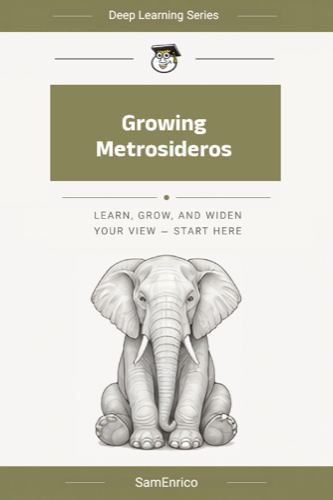
Non-FictionInformativeEducational
Growing Metrosideros eBook
This publication, published by SamEnrico, covers G
This publication, published by SamEnrico, covers Growing Metrosideros
Formats
Free sample
Chapter 1: The Iron Revelation...--The first time I saw a mature Pōhutukawa in full bloom, I almost drove off the road. It was December on the Coromandel Peninsula of New Zealand’s North Island, and the tree clung to a cliff edge overlooking the Pacific Ocean. From a distance, the canopy appeared to be on fire—a massive, spreading dome of crimson so intense that it seemed to glow against the grey-blue water. As I pulled over and walked closer, I realized that every branch tip was covered in what looked like bottlebrushes made of red silk, each flower packed with hundreds of stamens tipped with bright yellow pollen. The trunk, gnarled and ancient, twisted out of solid volcanic rock as if the stone had given birth to the wood.
A plaque nearby identified the tree as Te Waha o Rerekohu—the oldest known Pōhutukawa in New Zealand, estimated to be over one thousand years old.Standing beneath that canopy, I understood something that no photograph had ever conveyed: Metrosideros is not merely a tree. It is a statement of survival. It grows where other trees cannot—on sea cliffs lashed by salt spray, in lava fields with no soil, against winds that would flatten an oak. Its roots snake through cracks in basalt, prying the rock apart over centuries. Its branches lean away from the prevailing wind, shaped by decades of gales into forms that resemble dancers frozen mid-motion.
And every December, without fail, it erupts into a display of flowers that has earned it the name "New Zealand Christmas Tree."But here is the truth that no travelogue will tell you: for every thousand-year-old giant clinging to a cliff, there are ten thousand failed attempts by well-meaning gardeners who bought a Metrosideros from a nursery, planted it with hope, and watched it dwindle, refuse to bloom, or die outright within two years. The tree that seems invincible in its native habitat becomes, in the wrong hands, a source of profound frustration.This book exists to close that gap.I wrote The Metrosideros Grower's Bible because I spent five years failing to grow Pōhutukawa before I succeeded. I killed seedlings by overwatering them. I watched cuttings rot for nine months before giving up. I waited eight years for a tree to flower, only to learn that I had been feeding it the wrong fertilizer the entire time.
Along the way, I discovered that most gardening books treat Metrosideros as an afterthought—a brief entry in a "tropicals and exotics" chapter, with generic advice like "plant in well-drained soil and water regularly." That advice, while technically correct, is about as useful as telling someone to "breathe air and eat food" when they ask how to climb Mount Everest.This chapter is your first real lesson in understanding Metrosideros not as a plant, but as a living system with specific, non-negotiable needs. By the time you finish reading, you will know exactly which species or cultivar is right for your site, your climate, and your patience level. You will understand why some Metrosideros grow into 80-foot giants while others stay shrub-sized. And most importantly, you will learn the single most common mistake that kills more Metrosideros than all diseases and pests combined—and how to avoid it before you ever put a shovel in the ground.What You Are Actually Growing: The Genus Defined Before we talk about how to grow Metrosideros, we need to talk about what Metrosideros actually is. The name comes from two Greek words: metra, meaning "heartwood" (referring to the dense, dark red timber at the core of mature trees), and sideron, meaning "iron." The name is apt.
The wood of old-growth Metrosideros is so dense that it sinks in water. Māori traditionally used it for weapons and tools that needed to withstand repeated impacts. Early European settlers cursed it because it blunted their saw blades.The genus Metrosideros belongs to the myrtle family (Myrtaceae), which includes eucalyptus, guava, clove, and the common myrtle. There are approximately 50 to 60 recognized species within the genus, ranging from prostrate groundcovers that never exceed 30 centimeters (12 inches) in height to emergent forest giants that reach 25 meters (82 feet) or more. They are native to New Zealand, New Caledonia, New Guinea, the Solomon Islands, the Philippines, Fiji, and French Polynesia, with the greatest diversity centered in New Zealand and New Caledonia.For the home gardener, however, the genus effectively narrows to five species that are widely available in cultivation, plus a handful of notable cultivars.
Let me introduce them to you in order of importance.Metrosideros excelsa – The Pōhutukawa This is the species that most people picture when they hear "New Zealand Christmas Tree." M. excelsa is a coastal tree that grows naturally only in the North Island of New Zealand, from the northern tip down to a line roughly at Taranaki and Gisborne. It is the most cold-hardy of the large Metrosideros species, tolerating light frosts once established, and the most adaptable to garden conditions.In the wild, M. excelsa develops a spreading, multi-trunked form with branches that can extend horizontally for 15 meters (50 feet) or more. The leaves are dark green on top, covered with dense white fuzz (technically called tomentum) underneath.
The flowers are typically deep crimson, produced in dense clusters at the branch tips from late spring to early summer—November to December in the Southern Hemisphere, May to June in the Northern Hemisphere.The critical thing to understand about M. excelsa is the difference between wild-type trees and selected cultivars. A wild-type M. excelsa grown from seed will eventually reach 9 to 15 meters (30 to 50 feet) in height, with a spread equal to or greater than its height. It will take 8 to 12 years to produce its first flowers, and it will continue to grow slowly for decades.
If you plant a wild-type M. excelsa in a small garden, you will eventually have a problem. I have seen Victorian-era houses in Auckland completely swallowed by hundred-year-old Pōhutukawa, their roofs lifted by roots and their walls cracked by branches. The tree does not care about your property lines.This is why cultivars exist. A cultivar is a cultivated variety—a plant that has been selected, bred, and propagated for specific traits that differ from the wild type.
For M. excelsa, breeders have produced cultivars that are smaller, earlier-flowering, and more predictable than their wild ancestors. The most important of these for home gardeners is 'Vibrance', a selection from the Coromandel Peninsula that reaches only 4.5 meters (15 feet) at maturity and produces its first flowers at three to four years instead of eight to twelve. If you want the glory of Pōhutukawa without the long wait or the oversized footprint, 'Vibrance' is your answer.Other notable M. excelsa cultivars include 'Aurea', which produces rare yellow flowers (a genetic mutation that occurs naturally in a few wild populations), and 'Crimson Glory', which has darker, more intensely colored flowers than the species average.
All of these are propagated by cuttings or grafting, not by seed, because seed-grown plants revert to wild-type characteristics. If you buy a named cultivar from a reputable nursery, you are getting a clone of a specific parent…
This is the end of the free sample. Get the eBook to keep going. Buy now
About this book
Details
- Author
- Mcmillan Robbi
- Publisher
- SamEnrico
- Language
- English
- Genre
- Non-Fiction, Informative, Educational
- Released
- 2026-05-09
- Pages (approx.)
- 145
- Available as
- eBook, Audiobook

Read better in the ZLOADR app
Your eBooks on your phone or tablet. Sign in with your SamEnrico account and start reading.
More by Mcmillan Robbi
 Ecommerce Growth Capital StrategyMcmillan Robbi$11.99
 Recurring Dream Archetypes GuideMcmillan Robbi$11.99
 Seasonal Loneliness ManagementMcmillan Robbi$11.99
 Wholesaling Referral ProgramMcmillan Robbi$11.99
 Wholesaling Lead Tracking GuideMcmillan Robbi$11.99
 Toll Booth Rage GuideMcmillan Robbi$11.99
 Spin Power Output TrainingMcmillan Robbi$11.99
 The Ranger Who Knew Too MuchMcmillan Robbi$11.99
 Breath for Social Media ScrollMcmillan Robbi$11.99
 The Last Whale Singer: The Mysterious Song of 52 BlueMcmillan Robbi$11.99
 The Whispering Woods: The Lost Campers of AlgonquinMcmillan Robbi$11.99
 The Silent Bids: How a Secret Auction Almost Broke the NFLMcmillan Robbi$11.99
You may also like
 Hong Kong Handover 1997Dunn Johnnie$11.99
 Zumba For Postnatal Recovery CourseNeal Christian$11.99
 Zumba for BeginnersLadner Nikia$11.99
 YouTube Comment Mining GuideHumes Pandora$12.99
 Worry Box MeditationCarlin Rudy$11.99
 Workplace Stress MeditationNguyen Lynn$11.99
 Workplace Stress and Sleep RepairHawley Ivory$11.99
 Workplace Perfectionism CureDelaney Jeffry$11.99
 Workplace Injustice Anger GuideWallen Isabelle$11.99
 Work Addiction and Burnout LinkGreenwood Ester$11.99
 Women in Yoga and WellnessBeattie Galina$11.99
 Women in Stand Up ComedyChun Evangeline$11.99