
Non-FictionInformativeEducational
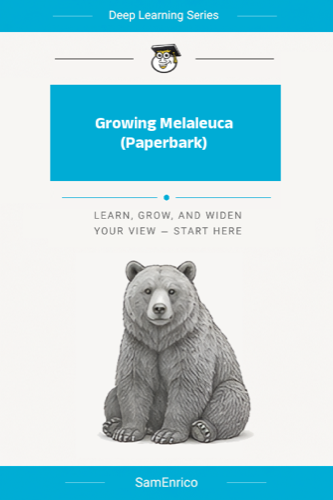
Growing Melaleuca (Paperbark)
This publication, published by SamEnrico, covers G
by Berlin Dolly
This publication, published by SamEnrico, covers Growing Melaleuca (Paperbark)
Formats
About this book
Free sample
Chapter 1: The Survivor’s Blueprint...--–- The first thing you notice about a paperbark tree is not its flowers, though they are spectacular, nor its height, though it can be formidable. It is the trunk. Standing before a mature Melaleuca, you are confronted with what looks like layers of peeling parchment, each sheet curling away from the one beneath it, creating a texture that is simultaneously ancient and alive. Run your fingers over it, and you feel the spongy give of multiple layers—insulating, protective, and strangely soft for something that can withstand fire, flood, and drought. This bark is the paperbark’s signature, its most recognizable feature, and the reason for its common name.
But beneath that remarkable exterior lies a suite of adaptations that make this genus one of the most resilient and controversial plants on earth.Understanding the anatomy and taxonomy of Melaleuca is not an academic exercise. It is the foundation upon which every successful cultivation decision rests. When you know why the leaves produce certain oils, why the bark peels in sheets rather than cracking into plates, and how the flowers have evolved to feed specific pollinators, you move from being a casual planter to an intentional steward. This chapter provides that blueprint. By the end, you will see the paperbark not as a single entity but as a complex organism whose every structure serves a purpose—and whose every chemical compound carries both opportunity and risk.The Myrtaceae Family: Distinguished Relatives Before we examine Melaleuca in isolation, we must place it within its botanical family.
Melaleuca belongs to the Myrtaceae, a large and economically significant family that includes approximately 150 genera and more than 5,000 species. The family’s stronghold is the Southern Hemisphere, particularly Australia, Southeast Asia, and South America, though members have naturalized across the globe. If you have ever grown eucalyptus, brushed against a bottlebrush (Callistemon), or brewed a cup of tea from leptospermum, you have already encountered the family traits that define Melaleuca.The most distinctive shared characteristic of the Myrtaceae is the presence of oil glands embedded within the leaves.…
This is the end of the free sample. Get the eBook to keep going. Buy now
Contents
- Chapter 1
- Chapter 2
- Chapter 3
- Chapter 4
- Chapter 5
- Chapter 6
- Chapter 7
- Chapter 8
- Chapter 9
- Chapter 10
- Chapter 11
- Chapter 12
Details
- Author
- Berlin Dolly
- Publisher
- SamEnrico
- Language
- English
- Genre
- Non-Fiction, Informative, Educational
- Released
- 2026-06-02
- Pages (approx.)
- 149
- Available as
- eBook, Audiobook

Read better in the ZLOADR app
Your eBooks on your phone or tablet. Sign in with your SamEnrico account and start reading.
More by Berlin Dolly
 Falling Dream Meaning ExplainedBerlin Dolly$11.99
 Covid Recovery Breath PracticeBerlin Dolly$11.99
 Cloud Infrastructure Investment OutlookBerlin Dolly$11.99
 The Retirement Identity GuideBerlin Dolly$11.99
 Zumba Cumbia and ReggaetonBerlin Dolly$11.99
 Wholesaling Seller Financing GuideBerlin Dolly$11.99
 Parallel Parking PatienceBerlin Dolly$11.99
 Wholesaling Bookkeeping GuideBerlin Dolly$11.99
 Ursula Burns XeroxBerlin Dolly$11.99
 The Great Train Heist: A 19th-Century Robbery That Shocked the WorldBerlin Dolly$11.99
 The Last Oracle of Delphi: A Prophecy That Split an EmpireBerlin Dolly$11.99
 The Hollow Echo: The Unsolved Mystery of the Dyatlov Pass IncidentBerlin Dolly$11.99
You may also like
 Hong Kong Handover 1997Dunn Johnnie$11.99
 Zumba For Postnatal Recovery CourseNeal Christian$11.99
 Zumba for BeginnersLadner Nikia$11.99
 YouTube Comment Mining GuideHumes Pandora$12.99
 Worry Box MeditationCarlin Rudy$11.99
 Workplace Stress MeditationNguyen Lynn$11.99
 Workplace Stress and Sleep RepairHawley Ivory$11.99
 Workplace Perfectionism CureDelaney Jeffry$11.99
 Workplace Injustice Anger GuideWallen Isabelle$11.99
 Work Addiction and Burnout LinkGreenwood Ester$11.99
 Women in Yoga and WellnessBeattie Galina$11.99
 Women in Stand Up ComedyChun Evangeline$11.99