
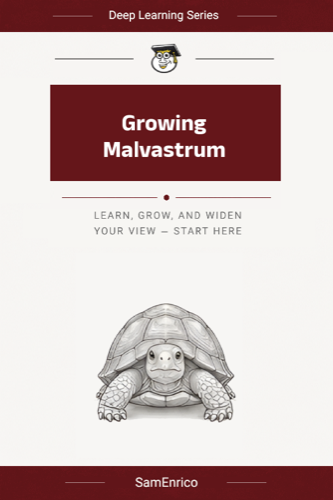
Non-FictionInformativeEducational
Growing Malvastrum eBook
This publication, published by SamEnrico, covers G
by Lowery Elmo
This publication, published by SamEnrico, covers Growing Malvastrum
Formats
Free sample
Chapter 1: The Accidental Discovery...–- It began, as most worthwhile things do, with a failure.The gardener stood in the late afternoon light, hose in hand, surveying yet another patch of brown, withered stems where a hundred dollars' worth of nursery perennials had been planted just six weeks earlier. The south-facing slope behind the garage had claimed another victim—this time a collection of so-called "drought-tolerant" lavenders that had turned crisp and gray despite meticulous watering. The soil was the problem, of course. Compacted, hungry, and shallow, it baked to the hardness of terracotta by mid-July. Nothing wanted to live there.
Nothing, that is, except a single uninvited guest.Tucked against the garage foundation, where a crack in the concrete allowed a trickle of roof runoff to escape, grew a plant the gardener did not recognize. It was low to the ground, spreading outward in a casual, unapologetic manner that suggested it had no idea it was supposed to be struggling. Its leaves were a soft, slightly hairy green, and scattered across its trailing stems were dozens of small, salmon-pink flowers that seemed to glow against the gray concrete. The gardener knelt, touched a leaf, and frowned. How had this plant survived when everything else had died?
When had it even arrived?That moment of puzzled curiosity—the accidental discovery of a plant that thrived where others failed—is the entry point for nearly every gardener who eventually falls in love with Malvastrum. No one goes looking for this genus. You do not see a glossy photograph in a mail-order catalog and decide to build a garden around it. You do not read a breathless article in a lifestyle magazine declaring it the "next big thing" in horticulture. Instead, you find it.
You find it growing out of a crack in the sidewalk, or spilling over a crumbling retaining wall, or colonizing the hellstrip between the street and the curb that you had long since abandoned to crabgrass and despair. And you stop, because something about this plant refuses to be ignored.The Genus That Refuses to Introduce Itself Let us begin with what Malvastrum is not. It is not a showstopper in the traditional sense. It does not produce dinner-plate-sized blooms like its cousin the hibiscus. It does not send up towering spires of color like the hollyhock.
Its flowers, charming though they are, rarely exceed an inch in diameter. Its foliage, while pleasant, does not scream for attention. By all conventional measures of garden worthiness, Malvastrum should be an afterthought, a footnote, the botanical equivalent of wallpaper.And yet.And yet, the plant possesses a quality that commercial horticulture has spent decades trying to breed out of ornamental species: it refuses to die. Not in a dramatic, attention-seeking way, like a succulent that collapses into mush at the first sign of overwatering. Not in a stoic, martyr-like way, like a cactus that survives but never seems to thrive.
Malvastrum lives with a kind of cheerful, almost insulting ease. Give it poor soil, and it flowers. Give it neglect, and it spreads. Give it the worst, hottest, most compacted corner of your property, and it will reward you with a ground-hugging carpet of peachy-pink blooms that lasts from late spring until the first hard frost.This is the plant's secret, and it is the reason this book exists. Malvastrum occupies a unique space in the gardening world: it is simultaneously a weed and a wonder, a problem and a solution, a plant that can escape cultivation and become invasive in sensitive ecosystems and a plant that can transform impossible growing sites into thriving, pollinator-friendly habitats.
The same traits that make it a nuisance in a carefully manicured perennial border make it a hero on a sunny, erosion-prone slope. The same adaptability that allows it to colonize roadsides and overgrazed pastures allows it to thrive in a terracotta pot on a baking hot patio where no other plant would survive a single summer.A Brief Note on What This Chapter Covers Before we go any further, let me be clear about the scope of this chapter and the book as a whole. This is not a botanical monograph intended for academic readers. You will not find exhaustive descriptions of stamen column morphology or detailed keys for distinguishing between subspecies. Those resources exist elsewhere, and for the tiny fraction of readers who need them, the appendix provides references to the primary literature.Instead, this chapter—and this book—is written for the gardener who has encountered Malvastrum growing somewhere it "shouldn't" be and wants to understand what they have found.
It is written for the homeowner with an ugly, sun-baked side yard where nothing else will grow. It is written for the permaculture designer looking for a dynamic accumulator and pollinator support plant that requires no irrigation after establishment. And it is written for the curious, the frustrated, and the delightfully lazy—the gardeners who have realized that fighting nature is a losing battle and have decided, instead, to learn how to work with it.The Taxonomy Trap (Or, Why Names Matter More Than You Think)Every gardener who discovers Malvastrum eventually asks the same question: "What is this thing called?" The answer is more complicated than it should be, and understanding that complication is essential to understanding the plant itself.Malvastrum belongs to the Malvaceae family, the mallow family, which includes familiar genera such as Malva (common mallow), Alcea (hollyhock), Hibiscus (hibiscus), and Abutilon (flowering maple). Within this family, the genus Malvastrum sits in a taxonomic no-man's-land, sharing characteristics with both Malva and Sida. In fact, the name Malvastrum literally means "resembling Malva"—a linguistic acknowledgment that even the botanists who first described the genus weren't entirely sure what to do with it.The taxonomic confusion runs deeper than nomenclature.
Over the years, various Malvastrum species have been reclassified, moved to other genera, and then sometimes moved back. The plant you know as Malvastrum lateritium might appear in older references as Malva lateritia or Sida lateritia. The weedy Malvastrum coromandelianum has accumulated no fewer than seven synonyms over its taxonomic history. This shuffling matters because it reflects a deeper truth about the genus: Malvastrum is defined by its adaptability and its willingness to blur boundaries. It is not a fussy, specialized genus with narrow ecological requirements.
It is a survivor, a generalist, a plant that makes itself at home in disturbed soils across six continents precisely because it refuses to be boxed in.For the home gardener, the practical implication is simple: do not get too attached to the name on the plant tag. What matters is not the precise species you are growing but the traits they share. All Malvastrum species prefer full sun, tolerate poor soil, require excellent drainage, and produce charming flowers that attract pollinators. The differences between species—growth habit, flower color, cold hardiness, and invasive potential—are important and will be covered in detail later in this book. But the core cultivation principles remain consistent across the genus.The Species You Are Most Likely to Encounter Before we dive into the cultivation specifics that will occupy the rest of this book, let me introduce the Malvastrum species you are…
This is the end of the free sample. Get the eBook to keep going. Buy now
About this book
Details
- Author
- Lowery Elmo
- Publisher
- SamEnrico
- Language
- English
- Genre
- Non-Fiction, Informative, Educational
- Released
- 2026-06-02
- Pages (approx.)
- 152
- Available as
- eBook, Audiobook

Read better in the ZLOADR app
Your eBooks on your phone or tablet. Sign in with your SamEnrico account and start reading.
More by Lowery Elmo
 Mindful Stress Reduction for ExecutivesLowery Elmo$11.99
 Volleyball Jumpers Knee PreventionLowery Elmo$11.99
 Active Listening For DepressionLowery Elmo$11.99
 Creative Block for DepressionLowery Elmo$11.99
 Mentorship for Second CareersLowery Elmo$11.99
 The Pillow BiterLowery Elmo$11.99
 Night Driving Anxiety GuideLowery Elmo$11.99
 Body Scan Breath IntegrationLowery Elmo$11.99
 Assertiveness With ContractorsLowery Elmo$11.99
 The Divine Artisan: Antonio Vivaldi and the Birth of Baroque BrillianceLowery Elmo$11.99
 Melbourne 1956: The Olympics That Defied the OddsLowery Elmo$11.99
 The Crown’s Wild Child: The Untold Story of Prince Harry’s Rebel YearsLowery Elmo$11.99
You may also like
 Hong Kong Handover 1997Dunn Johnnie$11.99
 Zumba For Postnatal Recovery CourseNeal Christian$11.99
 Zumba for BeginnersLadner Nikia$11.99
 YouTube Comment Mining GuideHumes Pandora$12.99
 Worry Box MeditationCarlin Rudy$11.99
 Workplace Stress MeditationNguyen Lynn$11.99
 Workplace Stress and Sleep RepairHawley Ivory$11.99
 Workplace Perfectionism CureDelaney Jeffry$11.99
 Workplace Injustice Anger GuideWallen Isabelle$11.99
 Work Addiction and Burnout LinkGreenwood Ester$11.99
 Women in Yoga and WellnessBeattie Galina$11.99
 Women in Stand Up ComedyChun Evangeline$11.99