
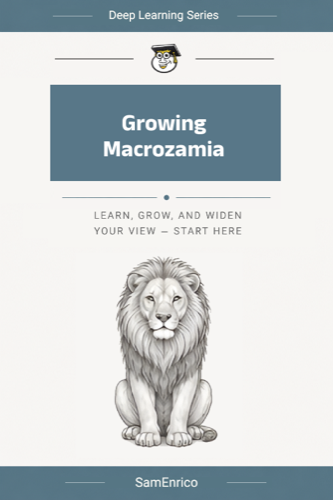
Non-FictionInformativeEducational
Growing Macrozamia eBook
This publication, published by SamEnrico, covers G
This publication, published by SamEnrico, covers Growing Macrozamia
Formats
Free sample
Chapter 1: The Last Dinosaurs--When you hold a Macrozamia seed in your palm, you are holding something that predates almost everything you recognize as a modern plant. The smooth, often brightly colored kernel—red, orange, or yellow depending on the species—is not a fruit in the way an apple is a fruit. It is a botanical time capsule, a living piece of the Mesozoic era that has somehow survived two hundred million years of planetary upheaval. Dinosaurs grazed on the ancestors of this plant. Ice ages came and went, continents drifted apart, and through it all, the cycad lineage persisted.
Today, the genus Macrozamia—exclusively Australian, staggeringly ancient, and utterly unlike anything else you can grow in a garden—awaits your attention.This book is not a dry botanical treatise. It is not a collection of academic papers repackaged for gardeners. It is a practical, opinionated, and deeply researched guide to cultivating one of the most rewarding and misunderstood plant groups on Earth. If you have never grown a cycad, you are about to discover a world of architectural leaves, prehistoric cones, and growth habits that defy everything you thought you knew about plants. If you have already killed a Macrozamia—and many people have—this book will tell you exactly why and how to never make that mistake again.Welcome to the burrawang.
Welcome to the last dinosaurs.What This Chapter Will Teach You Before we dive into the soil mixes, watering schedules, and propagation techniques that fill the later chapters, we need to establish a foundation. This chapter answers three essential questions:First, why should you grow Macrozamia at all? What makes these plants worth the space in your garden, the weight in your shopping cart, and the attention in your weekend routine?Second, what exactly is a Macrozamia? How do you tell it apart from a palm, a fern, or other cycads? Why does that distinction matter for your success as a grower?Third, where do these plants come from, and what does their origin story tell you about how to treat them at home?By the end of this chapter, you will understand not just the what of Macrozamia, but the why.
And that why will carry you through the challenging moments—the seed that takes a year to germinate, the frond that refuses to unfurl, the winter when you are certain you have killed it—until you emerge on the other side as a confident, successful cycad cultivator.The Premise: Living Fossils in Modern Gardens There is a reason paleontologists get excited about cycads. When you examine the fossil record, you find cycad-like plants appearing in the Permian period, over 250 million years ago. By the Jurassic period—the age of the great sauropods and the first birds—cycads had diversified into forms that would look familiar to any modern gardener. The leaves had the same tough, leathery texture. The cones had the same distinctive structure.
The seeds, protected by that bright sarcotesta, had the same basic design.Consider what has changed since then. The continents have rearranged themselves multiple times. The atmosphere has shifted from high-oxygen to modern levels. Flowering plants—angiosperms—have evolved, diversified, and come to dominate most terrestrial ecosystems. Mammals have gone from tiny nocturnal insectivores to the dominant land animals on every continent.
Human civilization has risen from nothing to reshape the entire planet.Through all of that, Macrozamia and its cycad relatives have simply... continued. Not unchanged—evolution never stops—but recognizable. A Macrozamia frond from the Cretaceous period would look at home in a modern botanical garden. That is not true of almost any other plant group.
The ferns that grew alongside the dinosaurs are different from modern ferns. The conifers have changed dramatically. The flowering plants did not even exist.This persistence is not merely a curiosity. It is a testament to an extraordinarily successful evolutionary strategy. Cycads are slow-growing, long-lived, and incredibly resilient.
They invest heavily in each leaf, each root, each seed because they plan to be around for a very long time. They do not waste energy on rapid growth that might be killed back by drought or fire. They do not produce abundant, cheap seeds that germinate anywhere. They produce a small number of highly protected, nutrient-dense seeds and wait for the right conditions.When you grow a Macrozamia, you are not growing a houseplant. You are not growing a shrub.
You are hosting an ancient life form that expects to outlive you. And if you treat it correctly, it will.The Emotional Hook: What Growing Macrozamia Feels Like Let us be honest about something that most gardening books dance around. Growing a Macrozamia is not like growing tomatoes or petunias. It does not offer instant gratification. A Macrozamia seed can take six months to two years to germinate.
A seedling may produce only one or two leaves per year for its first decade. A mature plant might flush—produce a new set of leaves—only once annually, and if you damage that flush, you have lost a full year of growth.Why would anyone choose this? Why not grow something faster, showier, more forgiving?The answer is that Macrozamia offers something no fast-growing plant can: permanence. When you plant a Macrozamia in the ground, you are making a statement that you intend to be in that place for a very long time. You are investing in a relationship with a living being that will not be rushed.
You are learning patience in an era that has forgotten what patience feels like.And then there is the moment when it all pays off. The day you notice the first crack in a seed coat after eleven months of waiting. The morning you walk outside and see a perfect new flush of leaves, still soft and bright green, before they harden into their mature form. The autumn when your female plant produces its first cone, a structure so alien and beautiful that visitors will ask if it is real.These moments are not guaranteed. They are earned.
And that is precisely why they matter so much.I have grown Macrozamia for over twenty years. I have killed my share—overwatered seedlings, sun-scorched transplants, plants lost to a sudden freeze that I thought would not reach them. I have also watched a M. moorei that I started from seed in 2008 grow from a buried caudex the size of a walnut into a plant with two feet of trunk and leaves that brush my shoulder. That plant will outlive me.
My children will inherit it. Their children may inherit it from them.There is no tomato that can offer that.What Is a Cycad? Distinguishing Macrozamia from Palms, Ferns, and Other Cycads Now that you are emotionally invested, let us get technical. The term "cycad" refers to an entire order of plants, Cycadales, which is divided into three families and roughly a dozen genera. Macrozamia is one of those genera, and it is exclusively Australian.
Every single Macrozamia species—over forty of them, depending on which taxonomist you consult—is native to Australia. You will not find a wild Macrozamia in Africa, Asia, or the Americas. That is the…
This is the end of the free sample. Get the eBook to keep going. Buy now
About this book
Details
- Author
- Crandall Branda
- Publisher
- SamEnrico
- Language
- English
- Genre
- Non-Fiction, Informative, Educational
- Released
- 2026-06-02
- Pages (approx.)
- 135
- Available as
- eBook, Audiobook

Read better in the ZLOADR app
Your eBooks on your phone or tablet. Sign in with your SamEnrico account and start reading.
More by Crandall Branda
 Cut Off Response PlanCrandall Branda$11.99
 Mindful Evenings Stress ResetCrandall Branda$11.99
 The Mother Who Never YelledCrandall Branda$11.99
 Medical Active Listening GuideCrandall Branda$11.99
 Creative Cross TrainingCrandall Branda$11.99
 Strength Training for Injury PreventionCrandall Branda$11.99
 Mentorship for FreelancersCrandall Branda$11.99
 Huston DynastyCrandall Branda$11.99
 Assertiveness For DiplomatsCrandall Branda$11.99
 The Alchemist and the Jungle: Tin’s Hidden Secret in Southeast AsiaCrandall Branda$11.99
 Love and Loyalty in the Bush: The Romance of the East African CampaignCrandall Branda$11.99
 The Great Pacific Puzzle: How a 12-Year-Old Solved a 200-Year-Old Ocean MysteryCrandall Branda$11.99
You may also like
 Hong Kong Handover 1997Dunn Johnnie$11.99
 Zumba For Postnatal Recovery CourseNeal Christian$11.99
 Zumba for BeginnersLadner Nikia$11.99
 YouTube Comment Mining GuideHumes Pandora$12.99
 Worry Box MeditationCarlin Rudy$11.99
 Workplace Stress MeditationNguyen Lynn$11.99
 Workplace Stress and Sleep RepairHawley Ivory$11.99
 Workplace Perfectionism CureDelaney Jeffry$11.99
 Workplace Injustice Anger GuideWallen Isabelle$11.99
 Work Addiction and Burnout LinkGreenwood Ester$11.99
 Women in Yoga and WellnessBeattie Galina$11.99
 Women in Stand Up ComedyChun Evangeline$11.99