
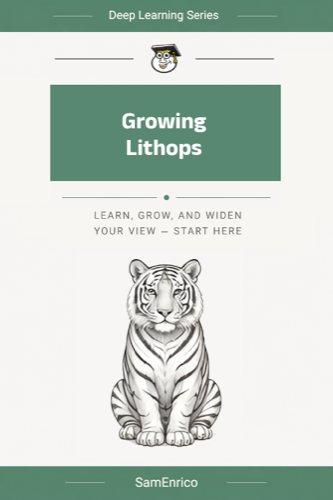
Growing Lithops
This publication, published by SamEnrico, covers G
This publication, published by SamEnrico, covers Growing Lithops
Formats
About this book
Free sample
Chapter 1: The Pebble That Blooms--–- On a dusty morning in September 1811, a British botanist named John Burchell was traveling through the arid plains of the Northern Cape province in what is now South Africa. He had been walking for hours under a sun that felt like a hammer, collecting specimens, noting the strange and hardy plants that somehow survived in this landscape of stone and thirst. At his feet lay a scattering of pebbles—grey and brown, flecked with patterns of rust and cream, indistinguishable from the cracked earth around them. Burchell bent down to pick up one particularly interesting stone, and as his fingers closed around it, he froze. The pebble was soft.
It was alive. And when he turned it over, he saw that what he had mistaken for a crack in the stone was actually a fissure from which a yellow flower would soon emerge.Burchell had discovered Lithops. He called them "living stones," a name so perfectly apt that it has never been improved upon. But what Burchell could not have known, as he stood there in the veld holding a plant that had spent millions of years perfecting the art of looking like a rock, was that he had also discovered one of the most misunderstood, most killed, and most obsessively collected succulents in the history of horticulture.Two centuries later, Lithops remain a paradox. They are simultaneously the easiest plants to keep alive—if you understand their rhythm—and the easiest plants to kill—if you treat them like normal houseplants.
The great succulent scholar Steven Hammer, whose book Lithops: Treasures of the Veld remains the gold standard for collectors, once observed that most people do not kill Lithops out of malice or neglect. They kill them out of kindness. They water when they should withhold. They repot when they should leave alone. They fertilize when they should starve.
And then, bewildered, they watch as their living stone turns to mush.This book exists to ensure that does not happen to you.But before we dive into soil recipes and watering schedules and the arcane…
This is the end of the free sample. Get the eBook to keep going. Buy now
Contents
- Chapter 1
- Chapter 2
- Chapter 3
- Chapter 4
- Chapter 5
- Chapter 6
- Chapter 7
- Chapter 8
- Chapter 9
- Chapter 10
- Chapter 11
- Chapter 12
Details
- Author
- Troutman Celine
- Publisher
- SamEnrico
- Language
- English
- Genre
- Non-Fiction, Informative, Educational
- Released
- 2026-06-02
- Pages (approx.)
- 137
- Available as
- eBook, Audiobook

Read better in the ZLOADR app
Your eBooks on your phone or tablet. Sign in with your SamEnrico account and start reading.
More by Troutman Celine
 Metta For All Beings GuideTroutman Celine$11.99
 Immigrant Beauty Brand Founder StoriesTroutman Celine$11.99
 Storm Before the CalmTroutman Celine$11.99
 African Independence SummaryTroutman Celine$11.99
 Empathy for Postpartum DepressionTroutman Celine$11.99
 Double Close Wholesaling MethodTroutman Celine$11.99
 Height Insecurity Self-EsteemTroutman Celine$11.99
 British Casualty FiguresTroutman Celine$11.99
 Conditional Love Fallout GuideTroutman Celine$11.99
 The Iron Kings of Meroë: Forging the Golden Age of KushTroutman Celine$11.99
 The Last Verdict: The Judge Who Ruled the Internet AgeTroutman Celine$11.99
 Into the Abyss: The Kayak Explorers of Europe’s Hidden UnderworldTroutman Celine$11.99