
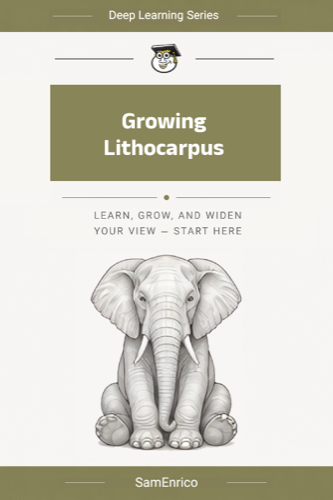
Non-FictionInformativeEducational
Growing Lithocarpus Audiobook
This publication, published by SamEnrico, covers G
This publication, published by SamEnrico, covers Growing Lithocarpus
Formats
Free sample
Chapter 1: The Forgotten Giants...--It began with a failure.In the autumn of 2011, I stood in a small nursery in western Oregon, staring at forty-eight empty one-gallon pots. Each pot contained a single nut I had collected three months earlier from a magnificent Tanbark Oak—Lithocarpus densiflorus—growing in the coastal mountains. I had followed every instruction I could find. I had dried the nuts on newspaper for two weeks, just as the old books said to do with acorns. I had stored them in paper bags in a cool shed.
I had planted them in standard potting mix at a depth of five centimeters.Not a single one had germinated.Forty-eight nuts. Zero seedlings. One hundred percent failure.That night, sitting at my kitchen table with the empty pots lined up like tiny grave markers, I made a decision that would change the next decade of my life. I was not going to let this genus defeat me. I was going to learn everything there was to know about growing Lithocarpus—and then I was going to write the book I wished I had owned before I ever collected that first nut.This is that book.The Tree That Time Forgot Before we dive into propagation protocols, soil chemistry, and the precise temperature at which to store recalcitrant seeds—details that will fill the chapters ahead—we need to answer a more fundamental question.
What is Lithocarpus, and why should anyone who is not a botanist or a rare plant collector care about it?The name itself is intimidating. Lithocarpus comes from the Greek words lithos (stone) and karpos (fruit). Stone fruit. This refers to the hard, dense nuts that characterize the genus. In English, the common name is "stone oak," which is both accurate and misleading.
Accurate because the trees produce acorn-like nuts. Misleading because Lithocarpus is not a true oak.Let me clarify that distinction immediately because it matters for everything that follows.True oaks belong to the genus Quercus. Stone oaks belong to Lithocarpus. Both are members of the beech family, Fagaceae, which also includes beeches (Fagus) and chinkapins (Castanopsis and Castanea). Within this family, the different genera are distinguished primarily by their fruit structures.A true oak acorn sits in a scaly cup that covers only the base of the nut.
The cup scales overlap each other like shingles on a roof. When you pick up an acorn, you see the…
This is the end of the free sample. Get the Audiobook to keep going. Buy now
About this book
Details
- Author
- Marchand Wilber
- Publisher
- SamEnrico
- Language
- English
- Genre
- Non-Fiction, Informative, Educational
- Released
- 2026-05-11
- Pages (approx.)
- 140
- Available as
- eBook, Audiobook

Listen in the VoxFlicks app
Audiobooks and audio dramas wherever you go. Sign in with your SamEnrico account and press play.
More by Marchand Wilber
 Handling Silent Treatment AssertivelyMarchand Wilber$11.99
 Chennai Madras Army GuideMarchand Wilber$11.99
 Validation for Financial ShameMarchand Wilber$11.99
 Metta For Grief ProcessingMarchand Wilber$11.99
 Immigrant Fintech Founder BreakthroughsMarchand Wilber$11.99
 African Borders ProblemMarchand Wilber$11.99
 The Broken PlateMarchand Wilber$11.99
 Perfectionism Childhood RootsMarchand Wilber$11.99
 Authority Bias ApplicationsMarchand Wilber$11.99
 Thomas Lawrence: Painting the Soul of an EmpireMarchand Wilber$11.99
 Phantom of the Underground: The Hunt for the London Tube KillerMarchand Wilber$11.99
 Galen of Pergamon: The Architect of Medical ScienceMarchand Wilber$11.99
You may also like
 Hong Kong Handover 1997Dunn Johnnie$11.99
 Zumba For Postnatal Recovery CourseNeal Christian$11.99
 Zumba for BeginnersLadner Nikia$11.99
 YouTube Comment Mining GuideHumes Pandora$12.99
 Worry Box MeditationCarlin Rudy$11.99
 Workplace Stress MeditationNguyen Lynn$11.99
 Workplace Stress and Sleep RepairHawley Ivory$11.99
 Workplace Perfectionism CureDelaney Jeffry$11.99
 Workplace Injustice Anger GuideWallen Isabelle$11.99
 Work Addiction and Burnout LinkGreenwood Ester$11.99
 Women in Yoga and WellnessBeattie Galina$11.99
 Women in Stand Up ComedyChun Evangeline$11.99