
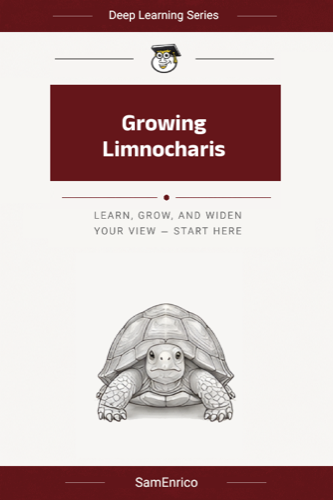
Non-FictionInformativeEducational
Growing Limnocharis eBook
This publication, published by SamEnrico, covers G
This publication, published by SamEnrico, covers Growing Limnocharis
Formats
Free sample
Chapter 1: The $6 Weed...--It was a humid Tuesday morning in a suburban Atlanta grocery store when I first paid six dollars for a weed.Not a metaphor. Not an organic, artisanal, small-batch microgreen. A literal weed—the same plant that farmers in Queensland, Australia are legally required to eradicate from their waterways, the same plant that clogged irrigation canals in Florida throughout the 1990s, the same plant that agricultural extension offices from Texas to Thailand have spent millions trying to control.I held a small bundle of dark green leaves, still dripping from the produce misters, and stared at the price tag: $5.99 per pound. The label read "Genjer – Sawah Lettuce – Imported." Next to it, organic spinach was $4.99 per pound. Kale was $3.49.
This unassuming aquatic vegetable, this plant that most Western gardeners would call an invasive nuisance, was commanding a twenty percent premium over spinach.I bought it. I took it home. I cooked it.And that meal changed everything I thought I knew about gardening, food security, and the strange economics of the plants we choose to cultivate versus the plants we choose to ignore.What I ate that night was not bitter, not fibrous, not "an acquired taste" like so many foraged greens. The young leaves, blanched for forty-five seconds and then shocked in ice water, had the gentle nuttiness of spinach with none of the chalky finish. The flower stalks, sliced diagonally and steamed, crunched like asparagus but tasted closer to water chestnuts.
And the immature flower buds—tiny yellow pearls no larger than a caper—popped with a mild, almost peppery warmth that my dinner guests could not identify."Is this some new superfood from Whole Foods?" one asked."No," I said. "It's a weed. And you can grow it in a bucket on your patio."That was the moment I realized I had stumbled onto something larger than a recipe. I had discovered a plant that sits at the intersection of three of the most urgent conversations in modern agriculture: how do we produce more protein on less land? How do we adapt our food systems to a warming, flooding, drought-prone planet?
And how do we see the abundance that has been growing beneath our feet—or floating in our ditches—the entire time?This book is the result of five years of trial, error, research, and eventually, obsession. What follows is not a theoretical treatise on permaculture or a nostalgic paean to "grandma's gardening ways." It is a practical, data-driven, sometimes irreverent guide to growing Limnocharis flava—a plant with no common English name that actually does it justice. "Sawah lettuce" (the Indonesian term genjer is more accurate) hints at its culinary uses but buries its agricultural potential. "Yellow velvetleaf" describes its flowers but ignores its utility. "The double insurance plant"—a term I will explain in detail in Chapter 2—comes closest to capturing what makes this species extraordinary.But before we dig our hands into the mud (or mix our hydroponic nutrients, for the tech-forward among you), we need to answer a more fundamental question: why grow this plant at all?
What makes Limnocharis worth your time, your water, and your garden space?The Contradiction That Started Everything Let me show you the two faces of Limnocharis flava.Face One: The Government Enemy Number One.In the state of Queensland, Australia, this plant is classified as a "Class 1 Noxious Weed." That is not a casual designation. Class 1 means it is a target for eradication. Landowners are legally required to notify authorities if they find it on their property. It cannot be sold, traded, or given away. It cannot be composted.
It cannot be transported. The official Queensland government website warns that Limnocharis "forms dense floating mats that block waterways, reduce water quality, and displace native aquatic plants." Similar warnings appear in Florida, Hawaii, and parts of Southeast Asia where it has naturalized outside its native range.Face Two: The Daily Vegetable for Millions.In Indonesia, genjer is a staple. It appears in sayur genjer (a coconut milk soup with shrimp and turmeric), in tumis genjer (stir-fried with garlic and chili), and in countless home kitchens from Jakarta to Bali. In Thailand, bonn is sold in every wet market, bundled with morning glory and water mimosa. In Vietnam, it is cù nèo, a common sight in vegetarian soups.
According to the Food and Agriculture Organization (FAO), Limnocharis is one of the most widely consumed semi-aquatic vegetables in the Mekong Delta region, where it provides dietary diversity during the rainy season when other greens are scarce.One plant. Two completely opposite realities.This contradiction is not merely academic. It reveals something fundamental about how we value plants. The same biological traits that make Limnocharis a nightmare in an uncontrolled environment—rapid growth, dual reproductive strategies, tolerance of poor water quality—make it a dream in a managed one. The plant does not know it is a weed or a vegetable.
It simply grows. We are the ones who decide whether that growth is a problem or a solution.The argument of this book is simple: Limnocharis is too useful to ignore and too vigorous to release carelessly. The answer is not to ban it or to unleash it. The answer is to contain it and cultivate it. This is the Sam Enrico Philosophy, which you will see referenced throughout these pages: harness the plant's invasive vigor inside closed-loop systems where it cannot escape, and you gain access to biomass yields that shame almost every other leafy green on the market.The Numbers That Demand Attention Let me give you three numbers that changed my mind about this plant.Number One: 31.6.That is the percentage of protein in Limnocharis leaves on a dry weight basis, according to a 2019 nutritional analysis published in the Journal of Aquatic Food Studies.
For comparison, spinach (dry weight) comes in at approximately 23 percent. Kale at 26 percent. Romaine lettuce at 17 percent. Even moringa—the much-hyped "miracle tree"—only reaches about 28 percent.Now, before you run out to replace your chicken breast with pond greens, a caveat: dry weight protein percentage is not the same as protein per serving. Fresh Limnocharis leaves are about 92 percent water, so you would need to eat a large volume to get significant protein.
But as a source of plant-based protein in a diversified diet, particularly in regions where animal protein is expensive or unavailable, this plant punches far above its weight class.Number Two: 3.7.That is the ratio of calcium to phosphorus in Limnocharis leaves, a balance that nutritionists consider ideal for bone health. Most leafy greens are calcium-rich but also high in oxalates, which bind to calcium and prevent absorption. Limnocharis contains oxalates (which is why we blanch it—more on that in Chapter 9), but the calcium-to-phosphorus ratio remains favorable. More importantly, the plant accumulates calcium from the water column, meaning that growers using calcium-rich water or supplements can directly influence the nutritional density of their harvest.Number Three: 14.That is the number of days between harvests under the Seven Harvest Model I will detail in Chapter 11. After an initial establishment period of five weeks, a mature Limnocharis planting can be cut back every two weeks, producing…
This is the end of the free sample. Get the eBook to keep going. Buy now
About this book
Details
- Author
- Shook Santina
- Publisher
- SamEnrico
- Language
- English
- Genre
- Non-Fiction, Informative, Educational
- Released
- 2026-06-02
- Pages (approx.)
- 137
- Available as
- eBook, Audiobook

Read better in the ZLOADR app
Your eBooks on your phone or tablet. Sign in with your SamEnrico account and start reading.
More by Shook Santina
 Autism Partner Relationship GuideShook Santina$11.99
 Eisenhower For Side HustlesShook Santina$11.99
 Campbell's Winter CampaignShook Santina$11.99
 Immigrant Women Entrepreneurs Success GuideShook Santina$11.99
 The Assertiveness for Freelancers GuideShook Santina$11.99
 Hospitality Emotion GuideShook Santina$11.99
 Anger And Child Anxiety TransferShook Santina$11.99
 Doctor Weight Bias NavigationShook Santina$11.99
 Reparenting Your Self EsteemShook Santina$11.99
 Fentanyl’s Shadow: The Silent Killer in Your Medicine CabinetShook Santina$11.99
 The Silk Road Tycoon: The Rise of Biyaa the Great of the SahelShook Santina$11.99
 The Clockmaker of Strasbourg: The Timekeeper Who Defied the UniverseShook Santina$11.99
You may also like
 Hong Kong Handover 1997Dunn Johnnie$11.99
 Zumba For Postnatal Recovery CourseNeal Christian$11.99
 Zumba for BeginnersLadner Nikia$11.99
 YouTube Comment Mining GuideHumes Pandora$12.99
 Worry Box MeditationCarlin Rudy$11.99
 Workplace Stress MeditationNguyen Lynn$11.99
 Workplace Stress and Sleep RepairHawley Ivory$11.99
 Workplace Perfectionism CureDelaney Jeffry$11.99
 Workplace Injustice Anger GuideWallen Isabelle$11.99
 Work Addiction and Burnout LinkGreenwood Ester$11.99
 Women in Yoga and WellnessBeattie Galina$11.99
 Women in Stand Up ComedyChun Evangeline$11.99