
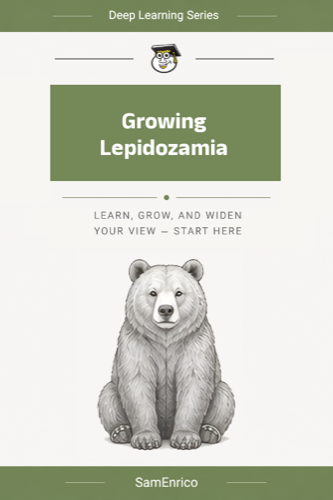
Non-FictionInformativeEducational
Growing Lepidozamia eBook
This publication, published by SamEnrico, covers G
This publication, published by SamEnrico, covers Growing Lepidozamia
Formats
Free sample
Chapter 1: The Living Relic...--Every so often, a gardener encounters a plant that refuses to be rushed. In an age of instant gratification, where social media promises blooming houseplants in thirty days and vegetables harvested in weeks, the Lepidozamia stands as a quiet, dignified rebellion. This is not a plant for the impatient. This is not a plant for those who measure success in centimeters per month or who need constant validation from new leaves unfurling. This is a plant that asks you to slow down, to think in decades rather than seasons, and to accept that some of the most beautiful things in life are simply not in a hurry.Welcome to the world of Lepidozamia—a genus of cycads so ancient that they watched dinosaurs come and go, so resilient that they survived the asteroid impact that ended the Cretaceous period, and so perfectly adapted that they have changed remarkably little in over 200 million years.
If you are holding this book, you have likely already been captivated by their architectural grandeur: the glossy, arching fronds that spiral outward from a stout, armored trunk; the prehistoric presence that transforms any garden or living room into a scene from another era. Or perhaps you have simply heard the whispers among plant collectors—that these cycads are rare, valuable, and mysteriously difficult to find. The truth is more nuanced. Lepidozamia are not difficult to grow once you understand them. But they do require you to unlearn everything you think you know about gardening.The Ancient Lineage You Now Steward Before we discuss soil mixes or watering schedules or the precise angle of morning light, we must first understand what we are dealing with.
Lepidozamia belongs to the Zamiaceae family, one of three surviving cycad families on Earth. Cycads as a whole are gymnosperms—"naked seed" plants—meaning they reproduce via cones rather than flowers. Their closest living relatives are conifers and ginkgoes, not palms or ferns, though they are tragically misidentified as "ferns" or "palms" by the unwary. This misunderstanding has led to countless horticultural failures, because palms and ferns have very different needs than cycads.The genus Lepidozamia contains only two living species: Lepidozamia peroffskyana (commonly called the Scaly Zamia or Pineapple Cycad) and Lepidozamia hopei (Hope's Cycad, named after the botanist J. L.
Hope). Both are endemic to eastern Australia, restricted to a narrow band of subtropical and tropical rainforest stretching from the New South Wales north coast up to the wet tropics of Queensland. In the wild, these plants are living fossils, occupying ancient niches that have remained stable for millions of years. And here is where your responsibility begins: these are not ordinary garden center commodities. They are irreplaceable components of a shrinking ecosystem.Fossil evidence places cycads as far back as the early Permian period, approximately 280 million years ago.
To put that in perspective: the first dinosaurs appeared around 230 million years ago. Cycads were already ancient when the first Plateosaurus took its clumsy steps. They survived the Permian-Triassic extinction event, known as the Great Dying, which eliminated 96% of all marine species and 70% of terrestrial vertebrate species. They survived the Triassic-Jurassic extinction and the Cretaceous-Paleogene extinction that ended the non-avian dinosaurs. When an asteroid struck the Yucatán Peninsula sixty-six million years ago, plunging the world into a nuclear winter, cycads persisted.
They are survivors in the most literal sense of the word.But survival in the wild does not guarantee survival in your garden. The traits that made Lepidozamia successful for millions of years—slow growth, conservative resource use, specialized root associations, and precise environmental tolerances—also make them vulnerable to the well-intentioned mistakes of novice growers. You cannot simply dig a hole, drop in a Lepidozamia, and hope for the best. You must become a student of their ancient ways.The Two Living Species: A Tale of Two Cycads One of the most common errors among new growers is assuming that L. peroffskyana and L.
hopei are interchangeable. They are not. They are as different as a domestic cat and a tiger—similar in basic form, wildly divergent in scale and requirements.Lepidozamia peroffskyana is the more adaptable of the two, which is why it is the species most commonly encountered in cultivation. In its natural habitat, it grows along the New South Wales and southern Queensland coasts, from the Richmond River north to about Gympie. This region experiences warm, humid summers and mild, frost-free winters—but "mild" is relative.
L. peroffskyana can tolerate light frosts down to approximately -4°C (25°F), though foliage damage becomes likely below -2°C. It can handle summer temperatures exceeding 40°C (104°F) provided it has adequate water and afternoon shade. Mature specimens in cultivation reach heights of 5-7 meters (16-23 feet), though this takes decades. The trunk is typically 30-50cm in diameter, covered in the persistent diamond-shaped bases of old fronds—hence the common name "Scaly Zamia." The fronds are dark green, glossy, and arching, reaching 1.5-2.5 meters in length.Lepidozamia hopei, by contrast, is a true giant and a genuine tropical specialist.
It is restricted to the wet tropics of northern Queensland, from about Cooktown south to Townsville, growing along streams and on shaded slopes in rainforest that receives over 2,000mm of rain annually. This species demands consistently warm, humid conditions year-round. It cannot tolerate frost under any circumstances. It cannot tolerate dry seasons longer than a few weeks. It cannot tolerate full sun, especially afternoon sun.
But if you can provide these conditions—and few gardeners outside the tropics can—L. hopei rewards you with a plant that can reach 20 meters (65 feet) in height, with a trunk up to 1 meter in diameter and individual fronds stretching 3 meters or more. It is, by any measure, one of the most spectacular cycads on Earth. It is also one of the rarest in cultivation, partly because of its demanding nature and partly because wild populations have been heavily impacted by land clearing and illegal collection.Throughout this book, we will distinguish clearly between the two species. When a recommendation applies only to one species, it will be explicitly stated.
When a recommendation applies to both, it will be marked as "both species." Never assume that what works for L. peroffskyana will work for L. hopei. This single mistake has killed more L. hopei in cultivation than any disease or pest.Why You Should Grow Lepidozamia (And Why You Should Think Twice)Before we go further, let me be honest with you: Lepidozamia are not for everyone.
If you are a gardener who thrives on rapid growth, constant change, and the ability to move plants around every season, this is not your plant. If you are the type of person who forgets to water for weeks at a time but expects plants to forgive you, this is not your plant. If you live in an apartment with a dark north-facing window (in the northern hemisphere) or a south-facing window (in the southern hemisphere), and you refuse to supplement with grow lights, this is not your plant.But if you are willing to commit to a plant for decades, if you find beauty in slow, deliberate growth, if you appreciate the sculptural…
This is the end of the free sample. Get the eBook to keep going. Buy now
About this book
Details
- Author
- Lorenz Gregorio
- Publisher
- SamEnrico
- Language
- English
- Genre
- Non-Fiction, Informative, Educational
- Released
- 2026-06-02
- Pages (approx.)
- 131
- Available as
- eBook, Audiobook

Read better in the ZLOADR app
Your eBooks on your phone or tablet. Sign in with your SamEnrico account and start reading.
More by Lorenz Gregorio
 Siege of Delhi 1857Lorenz Gregorio$11.99
 Persuasive Equipment PurchaseLorenz Gregorio$11.99
 The Assertive Refusal WorkbookLorenz Gregorio$11.99
 Melatonin Circadian GuideLorenz Gregorio$11.99
 Mozambique Liberation FrontLorenz Gregorio$11.99
 PTSD And Parental RageLorenz Gregorio$11.99
 Teen Emotion RecognitionLorenz Gregorio$11.99
 Narcissist Body LanguageLorenz Gregorio$11.99
 Harvard Extension Career OutcomesLorenz Gregorio$12.99
 Availability Heuristic GuideLorenz Gregorio$11.99
 The Last Trade: How a 19th-Century Shipwreck Reshaped Global CommerceLorenz Gregorio$11.99
 The Blockbuster Blunder: How One Trade Deadline Deal Changed the NBA ForeverLorenz Gregorio$11.99
You may also like
 Hong Kong Handover 1997Dunn Johnnie$11.99
 Zumba For Postnatal Recovery CourseNeal Christian$11.99
 Zumba for BeginnersLadner Nikia$11.99
 YouTube Comment Mining GuideHumes Pandora$12.99
 Worry Box MeditationCarlin Rudy$11.99
 Workplace Stress MeditationNguyen Lynn$11.99
 Workplace Stress and Sleep RepairHawley Ivory$11.99
 Workplace Perfectionism CureDelaney Jeffry$11.99
 Workplace Injustice Anger GuideWallen Isabelle$11.99
 Work Addiction and Burnout LinkGreenwood Ester$11.99
 Women in Yoga and WellnessBeattie Galina$11.99
 Women in Stand Up ComedyChun Evangeline$11.99