
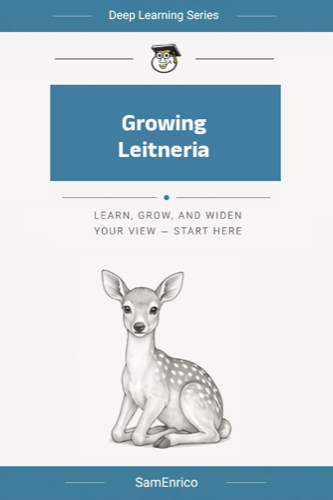
Growing Leitneria eBook
This publication, published by SamEnrico, covers G
This publication, published by SamEnrico, covers Growing Leitneria
Formats
Free sample
Chapter 1: The Ghost of the Swamp...--–- The first time I saw a corkwood tree, I did not believe it was real.I was standing knee-deep in black water somewhere in the Missouri Bootheel, the kind of swamp that smells like prehistoric decay and sounds like a thousand invisible frogs mocking your presence. My GPS had failed twenty minutes ago. My boots were leaking. And I had been walking in circles for what felt like hours, following a hand-drawn map given to me by a retired botanist who swore on his grandmother’s grave that Leitneria floridana still grew here—even though the state database listed it as extirpated, gone, wiped out.Then I saw it.A thicket of gray-green stems rising from the dark water like skeletal fingers. The leaves were unremarkable—oblong, pointed, the kind of foliage you would walk past without a second glance.
But the stems… the stems were wrong. They were too light. A dead branch floating beside me caught my eye. I picked it up. It weighed nothing.
Literally nothing. I tossed it back down, and it refused to sink. It just sat there on the surface, bobbing gently, as if the water were beneath its notice.I had found it. Or rather, it had found me.That moment—wet, cold, lost, and utterly transfixed—was the beginning of everything. It was the moment I realized that America had forgotten one of its strangest, most useful, most forgiving native plants.
And it was the moment I decided to dedicate the next decade of my life to understanding why—and to fixing it.This book is the result of that decade. It is the complete guide to growing Leitneria floridana, known colloquially as corkwood or poor man’s cork. It is a rescue mission disguised as a gardening manual, a love letter to a forgotten swamp tree, and a practical handbook for anyone with a wet, unusable patch of ground that nothing else will grow in.But before we talk about how to grow corkwood, we need to talk about why you have never heard of it.The Botanical Ghost Leitneria floridana is not rare because it is difficult to grow. This is the single most important sentence in this entire book, and I want you to tattoo it on your gardening brain. The plant is not finicky.
It does not require a greenhouse, a laboratory, or a degree in botany. It does not demand perfect soil, constant coddling, or prayers to the gardening gods.It is rare because it has fallen through the cracks of American horticulture.Let me explain. The nursery industry—the system that decides what plants you see at Home Depot, your local garden center, and even most native plant sales—operates on a simple set of rules. A plant must be easy to propagate in large numbers. It must grow quickly in containers.
It must look attractive at the point of sale. It must survive being shipped across the country in a cardboard box. And it must thrive in the average suburban garden, which typically means well-drained soil, full sun to part shade, and reliable summer rainfall.Leitneria breaks almost every one of these rules.It prefers wet feet—swampy, boggy, flood-prone ground that most gardeners curse and try to drain. Its suckering habit means it spreads sideways rather than growing into a neat, predictable specimen. It is dioecious, meaning it has separate male and female plants, so a nursery cannot guarantee that the plant you buy will produce the attractive drupes (berries) that customers want.
And its propagation requires a trick—root pruning at exactly ten inches deep—that most commercial growers have never learned because they have never bothered to try.So the industry ignored it. And because the industry ignored it, gardeners never asked for it. And because gardeners never asked for it, the industry felt justified in ignoring it. A perfect, self-fulfilling cycle of botanical neglect.But here is the twist: the very things that make Leitneria commercially inconvenient make it extraordinarily valuable for the rest of us.The Plant That Does Not Sink Let me give you the scientific hook first, then the human story.Leitneria floridana produces the lightest wood of any tree native to North America east of the Rocky Mountains. Its specific gravity—a measure of wood density compared to water—is approximately 0.25.
That means corkwood is one-quarter as dense as water. It floats like a cork (hence the common name), and it floats better than almost any other wood on the continent. Balsa, the famous lightweight champion, is native to tropical South America. Among our native trees, corkwood wears the crown.But specific gravity numbers do not capture the experience of holding a piece of corkwood. The first time I picked up a dried branch, I actually laughed out loud.
I had expected heft—the satisfying weight of a hardwood like oak or hickory. Instead, my hand jerked upward as if I had been tricked. The branch felt like a prop, like something carved from foam. I turned it over in my hands, convinced it was a fake. It was not.This property—extreme buoyancy—is the reason Native Americans and early European settlers valued corkwood.
They carved it into fishing floats that would not drag down their nets. They made arrow shafts so light that the arrow flew farther and faster than anything else available. They crafted hat blocks, the wooden forms used to shape felt hats, because the lightness meant a milliner could work all day without arm fatigue. In the coastal South, fishermen used corkwood floats for seine nets well into the twentieth century, preferring them to cork imported from Europe because they were cheaper and worked just as well.One old-timer in Louisiana told me a story I have never forgotten. He said his grandfather used a corkwood log as a makeshift buoy marker in a tidal creek.
The log was cut in 1923. He last saw it in 1987, still bobbing in the same bend of the creek, worn smooth by sixty-four years of tides. I cannot verify that story, but I want to believe it. It feels true.The Anatomy of a Forgotten Tree Before we go further, let me give you the basic botanical facts. You will need these as we move into the practical chapters, but I promise to keep them digestible.Leitneria floridana is the sole member of the Leitneriaceae family.
It has no close living relatives. In botanical terms, it is a monotypic genus and a monotypic family—a lone survivor from an evolutionary lineage that has otherwise vanished. The closest relatives, based on recent DNA evidence, appear to be the wax myrtles (Myricaceae) and sweet gale, but the relationship is distant. Think of corkwood as the botanical equivalent of the platypus: a weird, wonderful, one-of-a-kind organism that defies easy categorization.Depending on where it grows, corkwood can be either a shrub or a small tree. In open, sunny wetlands—the edges of marshes, the banks of slow rivers—it typically grows as a thicket-forming shrub, reaching six to twelve feet tall.
It spreads via suckers from its root system, creating dense colonies that can cover fifty feet or more. In shaded…
This is the end of the free sample. Get the eBook to keep going. Buy now
About this book
Details
- Author
- Kopp Alphonso
- Publisher
- SamEnrico
- Language
- English
- Genre
- Non-Fiction, Informative, Educational
- Released
- 2026-05-09
- Pages (approx.)
- 146
- Available as
- eBook, Audiobook

Read better in the ZLOADR app
Your eBooks on your phone or tablet. Sign in with your SamEnrico account and start reading.
More by Kopp Alphonso
 Special Needs Parent RageKopp Alphonso$11.99
 Eisenhower For FreelancersKopp Alphonso$11.99
 Leadership Presence BuildingKopp Alphonso$11.99
 Aging Parent Guilt ReleaseKopp Alphonso$11.99
 Tension Headache and SinusitisKopp Alphonso$11.99
 Overconfidence Bias MitigationKopp Alphonso$11.99
 Dealing with Difficult PeopleKopp Alphonso$11.99
 Creatine Brain Muscle GuideKopp Alphonso$11.99
 Sadness Recognition ToolsKopp Alphonso$11.99
 The Green Revolution: How Frank Lloyd Wright’s Legacy Shaped Sustainable ArchitectureKopp Alphonso$11.99
 The Last Flight of the Phoenix: How a 19th-Century Balloonist Disappeared Over the AtlanticKopp Alphonso$11.99
 Hashtag Revolution: The Viral Rise of the Arab SpringKopp Alphonso$11.99