
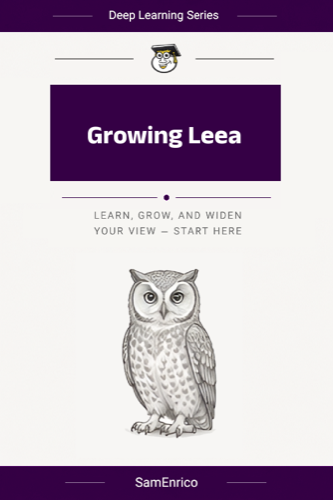
Non-FictionInformativeEducational
Growing Leea eBook
This publication, published by SamEnrico, covers G
This publication, published by SamEnrico, covers Growing Leea
Formats
Free sample
Chapter 1: The Pearl Gland Promise--–- The first time I saw a Leea, I almost walked past it.It was buried in the back corner of a humid, overcrowded nursery in Miami, tucked between a leggy ficus and a rack of discount orchids with spent blooms. The price tag was hand-written on masking tape: "Hawaiian Holly – $12.99." The leaves were a deep, bruised burgundy, almost purple in the shadows, and when the nursery worker misted the rows of plants, something caught my eye. Tiny droplets of liquid – clear as morning dew – sat perched on the leaf stems like a necklace of miniature diamonds. I touched one. It was sticky, almost syrupy.
I asked the worker what it was. She shrugged. "Does that on some of 'em," she said. "Don't know why."That moment of mystery – a plant weeping jewels for no apparent reason – is what started this book. And it is exactly why you are reading these words right now.You have likely come to Leea the same way I did: by accident, by curiosity, or by the simple fact that you saw one and could not look away.
Maybe you bought it because the foliage was unlike anything else in the greenhouse. Maybe a friend gave you a cutting wrapped in a damp paper towel, saying, "Just stick this in dirt and see what happens." Or maybe you are a collector who has heard the whispers – that Leea is the hidden gem of the Vitaceae family, the plant that serious tropical gardeners keep to themselves, like a secret handshake.Whatever brought you here, you have made a choice that most plant owners never will. You have chosen to grow a genus that almost no one has heard of, that most gardening books ignore entirely, and that offers rewards far beyond a splash of green in your living room. This chapter is your orientation. By the time you finish it, you will understand not only what Leea is, but why it deserves a book of its own – and why you, specifically, are the right person to grow it.The Great Impostor: What Leea Is (And Isn't)Let us begin with the first point of confusion, because it trips up nearly everyone.
Leea is not a holly. It is not a coffee plant. It is not a member of the family it most resembles.Despite the common name "Hawaiian Holly" (which appears on more nursery tags than the correct botanical name), Leea has no genetic relationship to true hollies of the genus Ilex. The leaves are superficially similar – broad, often toothed or wavy at the edges, with a certain holly-like attitude – but the resemblance ends there. Hollies are woody, temperate, often dioecious (meaning individual plants are male or female), and they produce bright red berries.
Leea produces clusters of small flowers followed by berries that range from black to purple to red, but the internal anatomy is completely different.The correct family is Vitaceae – the grape family.Yes, the same family that brings us wine grapes, Virginia creeper, and the ornamental vine Parthenocissus. If you look closely at a Leea flower cluster (called a cyme, as you will learn in the glossary), you will see the five-petaled structure typical of the grape family. The stems, when broken, reveal a similar fibrous texture. And the pearl glands? Those appear in other Vitaceae members as well, though never as prominently as in Leea.This misidentification matters for one simple reason: if you treat Leea like a holly – full sun, dry soil, cold tolerance – you will kill it.
If you treat it like a grape vine – aggressive pruning, poor soil, high trellising – you will also kill it. Leea is its own creature, and understanding its true family is the first step toward respecting its specific needs.The Geographic Tapestry: Where Leea Rules the Understory Close your eyes for a moment. Imagine a tropical forest floor at dawn. The canopy above filters sunlight into dappled coins that shift with every breeze. The air is thick and warm, and your bare feet sink into leaf litter that has been decomposing for decades.
Around you, ferns uncurl, moss carpets fallen logs, and somewhere a bird calls in a language you do not understand. Now look down. At your knee level, a shrub pushes upward – not demanding attention, not competing with the towering trees above it, but simply existing in the spaces that light and water allow. That shrub is Leea.Leea is an understory plant by nature and by evolution. It did not develop in open meadows or on windswept hillsides.
It developed in the dappled shadows of the world's most ancient rainforests, from West Africa to the islands of the Pacific. Let me take you on a quick tour.West Africa – Specifically the coastal forests of Ghana, Ivory Coast, and Nigeria – is home to several Leea species, including the widely cultivated Leea guineensis. Here, the plant grows alongside oil palms, mahogany trees, and the vibrant understory flora that makes West African forests some of the most biodiverse on Earth. Local names for Leea vary by language, but the plant is often associated with medicine and ritual. The pearl glands, which we will discuss shortly, are seen as a sign of vitality.Southeast Asia – From Myanmar to Vietnam to the islands of Indonesia – Leea is everywhere once you learn to spot it.
Leea rubra, with its brilliant red flowers, is particularly common in disturbed forest edges and along riverbanks. In Thailand, the plant is used in traditional medicine for fevers and inflammation. In the Philippines, Leea philippinensis grows in the lowland rainforests of Luzon and Mindanao, where humidity rarely drops below 70 percent and temperatures stay between 75 and 85 degrees Fahrenheit year-round.New Guinea and Northern Australia – This is where Leea gets truly interesting. Leea zippeliana, the slender, white-veined species that collectors prize, grows along stream banks and in the filtered light of monsoon forests. The contrast between the dark green leaf and the pale white veins is an adaptation for low-light conditions – the white reflects what little light exists back onto the green tissue, maximizing photosynthesis in the shadows.The Philippines again – Leea philippinensis deserves a second mention because it is the diva of the genus.
It requires high humidity, consistent warmth, and absolutely hates drafts. In its native habitat, it grows in the understory of primary rainforest, where air movement is gentle but constant, and where the canopy never fully closes.Why does geography matter to you, a gardener in Ohio or London or Melbourne? Because when you understand where a plant came from, you understand what it needs. A Leea that evolved under a West African canopy expects filtered light, high humidity, and rich, well-draining soil. Give it those things, and it will thrive.
Give it a dark corner in a dry living room, and it will drop every leaf in protest.The Pearl Gland Phenomenon: A Plant That Weeps Now we arrive at the most fascinating – and most useful – feature of the Leea genus. The pearl glands.These are small, translucent, dome-shaped structures that appear primarily on the stems, petioles (the stalk that attaches a leaf to the stem), and sometimes along the leaf veins. Under…
This is the end of the free sample. Get the eBook to keep going. Buy now
About this book
Details
- Author
- Houghton Roxana
- Publisher
- SamEnrico
- Language
- English
- Genre
- Non-Fiction, Informative, Educational
- Released
- 2026-06-02
- Pages (approx.)
- 156
- Available as
- eBook, Audiobook

Read better in the ZLOADR app
Your eBooks on your phone or tablet. Sign in with your SamEnrico account and start reading.
More by Houghton Roxana
 Gambia Independence 1965Houghton Roxana$11.99
 Fisetin Brain Aging GuideHoughton Roxana$11.99
 Migraine and Pregnancy GuideHoughton Roxana$11.99
 Elderly Parent Financial GuideHoughton Roxana$11.99
 Validation Phrases HandbookHoughton Roxana$11.99
 Feelings Vocabulary BuilderHoughton Roxana$11.99
 Assertiveness for Introverts CourseHoughton Roxana$11.99
 Endowment Effect ExplainedHoughton Roxana$11.99
 First Date Nonverbal GuideHoughton Roxana$11.99
 Whirlwind Prophecy: The Storm That Split a KingdomHoughton Roxana$11.99
 The Silk Road Conspiracy: How a Darknet Kingpin FellHoughton Roxana$11.99
 Bones of the Forgotten: The Hound of PompeiiHoughton Roxana$11.99
You may also like
 Hong Kong Handover 1997Dunn Johnnie$11.99
 Zumba For Postnatal Recovery CourseNeal Christian$11.99
 Zumba for BeginnersLadner Nikia$11.99
 YouTube Comment Mining GuideHumes Pandora$12.99
 Worry Box MeditationCarlin Rudy$11.99
 Workplace Stress MeditationNguyen Lynn$11.99
 Workplace Stress and Sleep RepairHawley Ivory$11.99
 Workplace Perfectionism CureDelaney Jeffry$11.99
 Workplace Injustice Anger GuideWallen Isabelle$11.99
 Work Addiction and Burnout LinkGreenwood Ester$11.99
 Women in Yoga and WellnessBeattie Galina$11.99
 Women in Stand Up ComedyChun Evangeline$11.99