
Non-FictionInformativeEducational
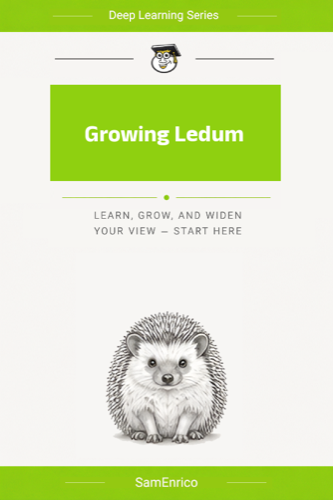
Growing Ledum eBook
This publication, published by SamEnrico, covers G
This publication, published by SamEnrico, covers Growing Ledum
Formats
Free sample
Chapter 1: The Leaf That Refused Extinction--–- On a late June morning in northern Newfoundland, a botanist named Dr. Helena Vance knelt in a peat bog that had not changed in ten thousand years. The air smelled of wet earth and something else—something sweet, spicy, and vaguely medicinal, like rosemary that had been dried over a campfire. She was searching for Ledum groenlandicum, a plant she had studied for two decades, and she found it exactly where it had always been: thriving in the one place almost nothing else wanted to live.Around her, the bog was a graveyard of failed ambitions. A stunted black spruce, no taller than her waist, struggled to survive in soil too acidic for most trees.
Pitcher plants stood like hungry sentinels, their hollow leaves filled with the digested remains of insects. Sphagnum moss carpeted everything in shades of green that ranged from pale lime to deep emerald. And there, rising from the moss on woody stems no thicker than a pencil, was Ledum—its narrow leaves curled at the edges as if recoiling from the world, their undersides coated with a dense mat of rust-colored fuzz that caught the morning light like copper wire.Dr. Vance smiled. She had seen this plant a thousand times, but it never failed to impress her.
"This," she would later write in her field notes, "is a plant that has been declared extinct, reclassified, misunderstood, and nearly forgotten—and yet here it grows, exactly where it has always grown, as if to say: I was here before you, and I will be here after you."The story of Ledum—known to most as Labrador Tea or Wild Rosemary—is not merely a botanical curiosity. It is a story of survival against impossible odds, of chemical warfare waged silently for millennia, of human obsession and occasional tragedy, and of a plant so perfectly adapted to its environment that it has no need to adapt to anything else. To understand Ledum is to understand what it means to thrive in the margins, to find abundance in scarcity, to build a life where life should not exist.This chapter is not a simple identification guide, though it contains that. It is an origin story—the origin of a leaf that refused to die when the ice came, that refused to hybridize into oblivion when taxonomists tried to rename it out of existence, and that refuses, even now, to grow in your backyard unless you understand exactly what it needs. By the end of this chapter, you will know Ledum not as a plant on a page, but as a character in a drama that began two and a half million years ago and continues in your garden today.The Pleistocene Survivor: How Ledum Outran the Ice To understand Ledum, you must first understand the world that made it.
Two and a half million years ago, the Pleistocene epoch began, and with it came a series of ice ages that would sculpt the northern hemisphere into something unrecognizable. Glaciers a mile thick scraped continents clean, pushing entire ecosystems southward or extinguishing them entirely. In North America, the Laurentide Ice Sheet advanced and retreated more than fifty times, each cycle lasting tens of thousands of years.Most plants could not keep up. Species that had flourished in the warm, wet Pliocene found themselves trapped between advancing ice and shrinking habitat. The fossil record tells a story of mass extinction punctuated by occasional, desperate migrations.But Ledum did something different.
Instead of fleeing the ice, Ledum adapted to it.Paleobotanical evidence places Ledum in the Arctic and subarctic regions throughout the Pleistocene. Pollen cores extracted from peat bogs in Greenland, Labrador, and Scandinavia show continuous Ledum presence for at least 1.8 million years. While oaks and maples retreated south, Ledum stayed put, evolving a suite of survival strategies that would make it one of the most cold-hardy flowering plants on Earth.The first strategy was its leaf. The Ledum leaf is a masterpiece of thermal regulation. Its narrow, lanceolate shape minimizes surface area, reducing heat loss in winter and water loss in summer.
The rolled-under margins—technically called revolute margins—create a boundary layer of still air that insulates the leaf's underside. And that rust-colored fuzz, the indumentum, is not decorative. It is a dense mat of trichomes, hair-like structures that trap moisture, reflect excess light, and create a microenvironment that buffers the leaf against temperature swings of fifty degrees or more in a single day.The second strategy was its root system. Ledum does not send down a deep taproot. It cannot—the permafrost beneath most of its native range prevents roots from penetrating more than a few inches.
Instead, Ledum spreads horizontally, sending out shallow roots that weave through the upper layer of sphagnum moss. This root mat is so dense that botanists call it a "root carpet." It allows Ledum to absorb what little nutrition exists in the bog's surface layer while staying above the frozen ground below.The third strategy was chemical. Ledum produces a cocktail of secondary compounds—ledol, palustrol, and a dozen others—that serve multiple functions. Some compounds deter herbivores, making the leaves taste terrible to most mammals. Others inhibit the growth of competing plants, a strategy called allelopathy.
Still others act as natural antifreeze, preventing ice crystals from forming inside the plant's cells during winter thaws and refreezes.These strategies worked so well that when the last ice age ended twelve thousand years ago, Ledum found itself not just surviving but thriving. It had turned the bog—a place of scarcity, acidity, and extreme temperatures—into a fortress that almost nothing else could breach.The Taxonomy Wars: Why Your Plant Has Three Names If you look up Ledum in a botany textbook written before 1990, you will find it classified as its own genus: Ledum, with four or five species depending on which authority you consult. If you look up the same plant in a textbook written after 2010, you will find it absorbed into the genus Rhododendron, with species names like Rhododendron groenlandicum and Rhododendron tomentosum.This is not a minor editorial change. It is the result of a decades-long taxonomic battle that has implications for how we understand plant evolution, how we classify hybrids, and—most practically—how you should care for your plants.The controversy began in the 1970s, when botanists started using DNA analysis to resolve relationships that had long been debated on morphological grounds alone. Traditional taxonomy grouped Ledum and Rhododendron separately because Ledum has small, narrow leaves with revolute margins, while Rhododendron has larger, flatter leaves.
Ledum flowers have five separate petals, while Rhododendron flowers have fused petals forming a bell or trumpet shape.But DNA told a different story. Genetic analysis repeatedly placed Ledum species within the Rhododendron clade—specifically, within a subclade that includes Rhododendron subsection Ledum. In plain English, the genes said: These plants are not separate cousins. They are siblings. Close siblings.The first major reclassification came in 1990, when botanists W.R.
Philipson and M.N. Philipson published a paper arguing that Ledum should be merged into Rhododendron. The reaction was immediate and polarized. Traditionalists accused the molecular biologists…
This is the end of the free sample. Get the eBook to keep going. Buy now
About this book
Details
- Author
- Kozlowski Cleora
- Publisher
- SamEnrico
- Language
- English
- Genre
- Non-Fiction, Informative, Educational
- Released
- 2026-06-02
- Pages (approx.)
- 146
- Available as
- eBook, Audiobook

Read better in the ZLOADR app
Your eBooks on your phone or tablet. Sign in with your SamEnrico account and start reading.
More by Kozlowski Cleora
 ABCDE For Overwhelm RescueKozlowski Cleora$11.99
 Anthocyanins Heart GuideKozlowski Cleora$11.99
 The Broken Record Technique GuideKozlowski Cleora$11.99
 Sibling Caregiver CoordinationKozlowski Cleora$11.99
 Persuasive Software RFP ResponseKozlowski Cleora$11.99
 Empathy for Anger ManagementKozlowski Cleora$11.99
 Emotion Labeling HandbookKozlowski Cleora$11.99
 Body Image After MastectomyKozlowski Cleora$11.99
 Dating App Profile Body CuesKozlowski Cleora$11.99
 The Mariner Who Conquered the Unknown: Magellan’s Unfinished OdysseyKozlowski Cleora$11.99
 Neon Gods of the Silk Road: The Forgotten Cybernetic CaravansKozlowski Cleora$11.99
 The Last Goodbye: The Heartbreaking Final Broadcast of Apollo 13Kozlowski Cleora$11.99
You may also like
 Hong Kong Handover 1997Dunn Johnnie$11.99
 Zumba For Postnatal Recovery CourseNeal Christian$11.99
 Zumba for BeginnersLadner Nikia$11.99
 YouTube Comment Mining GuideHumes Pandora$12.99
 Worry Box MeditationCarlin Rudy$11.99
 Workplace Stress MeditationNguyen Lynn$11.99
 Workplace Stress and Sleep RepairHawley Ivory$11.99
 Workplace Perfectionism CureDelaney Jeffry$11.99
 Workplace Injustice Anger GuideWallen Isabelle$11.99
 Work Addiction and Burnout LinkGreenwood Ester$11.99
 Women in Yoga and WellnessBeattie Galina$11.99
 Women in Stand Up ComedyChun Evangeline$11.99