
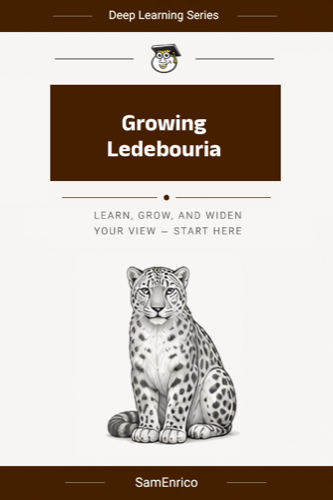
Non-FictionInformativeEducational
Growing Ledebouria eBook
This publication, published by SamEnrico, covers G
by Luke Eugene
This publication, published by SamEnrico, covers Growing Ledebouria
Formats
Free sample
Chapter 1: The Accidental Obsession...–- It began, as many obsessions do, with a plant I killed. Or rather, with a plant I failed to kill—which was, for me at that time, an even more remarkable feat. My name is Sam Enrico, and for the first thirty years of my life, I was a botanical serial killer. Orchids wilted in my care. Succulents turned to mush.
The great irony of my gardening journey is that the plant which finally broke my losing streak wasn’t a rare treasure or a show-stopping specimen. It was a forgotten bulb, shoved in the back of a dark closet, that I discovered six months after I had moved apartments, still in its original plastic nursery pot, bone-dry, forgotten, and very much alive.That bulb was Ledebouria socialis. The Silver Squill. The plant that had no right to survive my neglect—and yet, when I pulled it from the darkness, it had actually thrived. New leaves pushed up through the dust.
The bulb had multiplied. A single forgotten plant had become a colony.That was the moment I realized: I had been trying too hard. Every plant I had killed before was a victim of overwatering, overfeeding, over-potting, over-everything. But Ledebouria didn't want my hovering attention. It wanted me to leave it alone.
It wanted the rhythm of drought and flood that its ancestors evolved for over millions of years in the rocky savannas and cliff faces of South Africa. And in that realization, I discovered not just a plant, but a philosophy.This book is the result of that accidental obsession. Over the past decade, I have grown, propagated, hybridized, and occasionally killed more Ledebouria than I care to count. I have corresponded with botanists in South Africa, traded cuttings with collectors on three continents, and learned the hard way which advice in gardening books is useless (most of it) and which advice actually matters (very little, but that little is critical). This book distills everything I wish I had known when I pulled that forgotten bulb from my closet.But before we dive into soil recipes and lighting schedules, we need to answer a more fundamental question: Why Ledebouria?
Why this genus, among the thousands of plants you could grow? And why now?The Quiet Rise of the Spotted Hyacinth If you browse Instagram or Pinterest for "houseplants," you will see a predictable parade of monsters: Monstera deliciosa with their Swiss-cheese leaves, Fiddle-leaf figs standing sentinel in minimalist living rooms, and the ubiquitous Snake plant in every waiting room and office lobby. Ledebouria has not yet joined that pantheon—and that is precisely its appeal.For the past decade, the houseplant world has been dominated by what I call the "High-Maintenance Heroes": plants that demand specific humidity, precise watering schedules, and constant vigilance. Social media has glorified the plant parent who has mastered the finicky Fiddle-leaf or coaxed a Calathea into showing its purple undersides. But there is a quieter, smarter movement growing alongside this trend: the search for plants that are resilient, architectural, and forgiving.Ledebouria sits at the crossroads of these desires.
It is a bulbous geophyte—a plant that stores water and nutrients underground, allowing it to survive long periods of drought. Its leaves, depending on the species, range from silver-spotted to purple-striped to deep green with leopard-like markings. Its flowers, which emerge on delicate spikes in spring, are wispy, hyacinth-like affairs that range from pale pink to deep purple, often with a subtle, sweet fragrance that intensifies in the evening.But the true genius of Ledebouria is not its beauty—it is its independence. This is a plant that thrives on benign neglect. It wants to be underwatered rather than overwatered.
It prefers bright shade to harsh sun. It actively spreads into colonies, rewarding even the most hands-off grower with the satisfaction of multiplication. In a world where many houseplants are sold as "easy" but quickly reveal their fragility, Ledebouria delivers on its promise.The "Spotted Hyacinth" is having a cultural moment, and the reasons are not hard to find. First, the rise of remote work has made indoor gardening accessible to millions of people who now spend more time at home—but who also face the distraction of work and family, making low-maintenance plants more attractive than ever. Second, the succulent craze of the 2010s trained a generation of gardeners to appreciate plants that store water and tolerate drought; Ledebouria fits perfectly into this aesthetic and care paradigm.
Third, and perhaps most importantly, Ledebouria is deeply photogenic. The spotted, striped, and variegated leaves photograph beautifully, and the plant's compact, sculptural form makes it a favorite among interior designers and plant influencers alike.Yet, despite its growing popularity, Ledebouria remains surprisingly unknown. Walk into a big-box garden center, and you will find a dozen varieties of Sansevieria but rarely a single Ledebouria. Specialty nurseries and bulb societies are the primary sources, which creates an air of exclusivity and discovery for those who seek it out. This book aims to change that—to make Ledebouria accessible to every gardener, from the apartment dweller with a single sunny windowsill to the collector with a greenhouse full of rare bulbs.A Name with a History: From Scilla to Ledebouria One of the first obstacles new growers encounter is the taxonomic confusion surrounding Ledebouria.
If you search online for "Silver Squill," you will find it listed as Scilla violacea, Scilla socialis, Ledebouria socialis, and occasionally under the defunct genus Drimiopsis. This is not mere academic hair-splitting; understanding the plant's classification tells us something important about its relationships and care requirements.The story begins with Carl Peter Thunberg, a Swedish botanist and student of Carl Linnaeus, who first described many South African bulbs in the late 18th century. He placed several spotted-leaf species in the genus Scilla, which was then a catch-all for any bulbous plant with hyacinth-like flowers. For nearly two hundred years, the Silver Squill and its relatives languished in Scilla, a taxonomic dumping ground that obscured their unique characteristics.In 1970, the German botanist Franz Speta took a closer look at these African bulbs and concluded that they differed from true Scilla in several important ways: their bulbs produce a distinctive stringy sap when broken (the "Thread Test," which we will explore in Chapter 3), their leaves often lie flat against the ground rather than standing erect, and their seed morphology is distinct. Speta resurrected the genus Ledebouria, named after the 19th-century Baltic German botanist Carl Friedrich von Ledebour, who had first recognized the group as distinct but had not formally separated it.Even then, the taxonomy remained fluid.
Some species were moved to Drimiopsis (the "Leopard Plants"), others to Resnova. Only in the 2000s, with the advent of molecular phylogenetics (DNA analysis), did a clearer picture emerge. Today, Ledebouria is placed in the subfamily Scilloideae of the Asparagaceae family—making it a distant cousin of asparagus, hyacinth, and bluebells. The genus now includes approximately 60 to 80 species, depending on which taxonomist you ask, with new species still being discovered in the remote mountains and valleys of southern Africa.Why does this matter to a grower? Because knowing a plant's taxonomic relatives tells you…
This is the end of the free sample. Get the eBook to keep going. Buy now
About this book
Details
- Author
- Luke Eugene
- Publisher
- SamEnrico
- Language
- English
- Genre
- Non-Fiction, Informative, Educational
- Released
- 2026-05-09
- Pages (approx.)
- 152
- Available as
- eBook, Audiobook

Read better in the ZLOADR app
Your eBooks on your phone or tablet. Sign in with your SamEnrico account and start reading.
More by Luke Eugene
 The Stress Migraine Trigger GuideLuke Eugene$11.99
 Daily Priority Reset GuideLuke Eugene$11.99
 Construction Safety SignalsLuke Eugene$11.99
 Quercetin Allergy GuideLuke Eugene$11.99
 Persuasive Training ProposalLuke Eugene$11.99
 The Assertiveness Scripting HandbookLuke Eugene$11.99
 Postpartum Body AcceptanceLuke Eugene$11.99
 Feelings Recognition GuideLuke Eugene$11.99
 Hospice Care for ParentsLuke Eugene$11.99
 Whispers of the Forgotten River: The Lost Civilization of the IndusLuke Eugene$11.99
 The Last Waltz: How a King’s Ballroom Danced into OblivionLuke Eugene$11.99
 The Last Oracle of Delphi: Cracking the Code of the Ancient SeerLuke Eugene$11.99
You may also like
 Hong Kong Handover 1997Dunn Johnnie$11.99
 Zumba For Postnatal Recovery CourseNeal Christian$11.99
 Zumba for BeginnersLadner Nikia$11.99
 YouTube Comment Mining GuideHumes Pandora$12.99
 Worry Box MeditationCarlin Rudy$11.99
 Workplace Stress MeditationNguyen Lynn$11.99
 Workplace Stress and Sleep RepairHawley Ivory$11.99
 Workplace Perfectionism CureDelaney Jeffry$11.99
 Workplace Injustice Anger GuideWallen Isabelle$11.99
 Work Addiction and Burnout LinkGreenwood Ester$11.99
 Women in Yoga and WellnessBeattie Galina$11.99
 Women in Stand Up ComedyChun Evangeline$11.99