
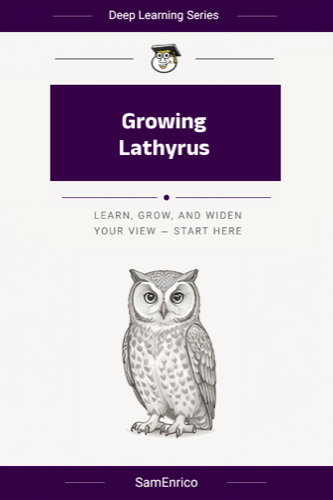
Non-FictionInformativeEducational
Growing Lathyrus eBook
This publication, published by SamEnrico, covers G
This publication, published by SamEnrico, covers Growing Lathyrus
Formats
Free sample
Chapter 1: The Obsession Begins...--Every garden has its divas. Roses demand pruning with surgical precision. Orchids require humidity levels that make your living room feel like a rainforest. Tomatoes throw tantrums at the first sign of blight. But among all the plants that have ever tempted, frustrated, and ultimately rewarded the human hand, few inspire the particular breed of devotion reserved for the sweet pea.There is something about Lathyrus odoratus—and its less fragrant but equally fascinating perennial cousins—that transforms casual gardeners into obsessed enthusiasts.
It is not merely the scent, though that alone would be enough. It is not merely the colors, though they span a spectrum that painters envy. It is not merely the history, though that history includes aristocrats, newspaper magnates, and a flower show that drew thirty-nine thousand entries in a single year. It is the combination of all these things, wrapped around a plant that rewards patience with unparalleled beauty and punishes carelessness with yellow leaves, bud drop, and the dreaded white ghost of powdery mildew.This book exists because Lathyrus deserves a guide as dedicated as the gardeners who grow it. Not a pamphlet.
Not a collection of blog posts. A complete, authoritative, and deeply practical resource that covers everything the top ten books on this subject cover—and then goes further. Whether you are planting your first seed or planning your first cross-pollination, whether you have a balcony with a single pot or an acre of cutting garden, this book will transform how you grow sweet peas, perennial peas, and their beautiful relatives.Before we dig a single trench or chip a single seed coat, we must understand what we are growing and why it matters. This opening chapter establishes the foundations: what Lathyrus is, why it has captivated gardeners for centuries, and how to choose the right plant for your specific garden purpose. By the end, you will understand why the sweet pea is not merely another flower but an obsession worth having.What Is Lathyrus, Anyway?Let us begin with taxonomy, because names matter and confusion is expensive in both time and money.
The genus Lathyrus belongs to the Fabaceae family—the legume family, the same group that includes peas, beans, and lentils. This explains much about how the plant behaves: it fixes its own nitrogen, it produces seed pods that resemble pea pods (because they are, botanically speaking, pea pods), and it climbs using tendrils that evolved in parallel with its edible cousins.For most of gardening history, Lathyrus was divided into two camps: the fragrant annuals everyone called sweet peas (Lathyrus odoratus) and everything else. But modern botanical classification has tightened the family circle. The common garden pea, Pisum sativum, has been reclassified as Lathyrus oleraceus, bringing the entire pea clan under one genus. This means that every pea you have ever grown—snap peas, snow peas, shelling peas—is technically a Lathyrus.
You have been growing this genus all along.But for our purposes, the ornamental species take center stage. The genus contains approximately 160 species, ranging from annuals to perennials, from sprawling ground covers to climbing vines reaching eight feet or more. The flowers share a common architecture—that butterfly-like form of standard, wings, and keel—but vary enormously in size, color, and fragrance. Some are intensely scented. Some have no scent at all.
Some bloom for a single glorious season and die. Others return year after year, indifferent to your attention or neglect.The most important species for gardeners fall into three groups. First, and most famous, is Lathyrus odoratus, the annual sweet pea, grown for its fragrance and cut flowers. Second is Lathyrus latifolius, the perennial everlasting pea, grown for its vigor and reliability on fences and trellises. Third is Lathyrus vernus, the spring vetchling, a compact perennial for shade gardens that blooms early and asks for little.
There are others—Lathyrus japonicus for coastal gardens, Lathyrus sativus for its unusual seed pods, Lathyrus niger for dark flowers—but these three groups form the core of what most gardeners grow.Understanding which species you are growing is not academic pedantry. It determines when you sow (autumn or spring), how you support the plant (netting or cordon), whether you feed heavily or lightly, and what you can reasonably expect in terms of fragrance and bloom time. A gardener who treats a perennial everlasting pea like an annual sweet pea will be disappointed in both fragrance and longevity. A gardener who treats an annual sweet pea like a perennial everlasting pea will wonder why it dies after one season. Know your plant.
The chapters ahead will guide you through each species in detail, but this fundamental distinction—annual versus perennial, fragrant versus scentless—must be clear from the start.The Unique Appeal of the Show Pea Why does Lathyrus inspire such devotion? The answer has four parts: fragrance, color, form, and the peculiar satisfaction of growing a climbing plant that seems to understand exactly what you want it to do.Fragrance is the first hook. The scent of a sweet pea is not a single note but a complex blend of compounds that chemists call lathyrine and gardeners call heaven. It has been described as honey, orange blossom, hyacinth, and fresh peas all at once. Unlike roses, which can smell cloying in excess, or lilies, which can tip into funereal, the sweet pea's scent remains delicate, clean, and unmistakably springlike.
It is the fragrance that makes you stop walking and simply breathe. And it is found almost exclusively in the annual species. If fragrance is your priority, you want Lathyrus odoratus. The perennials, with few exceptions, offer little to nothing in this department.Color is the second obsession. Sweet peas come in nearly every color except true yellow (breeders are still working on that one) and true blue (though some come tantalizingly close).
You can find pure white, cream, pale pink, hot pink, salmon, magenta, scarlet, crimson, maroon, lavender, violet, purple, and shades that hover between blue and purple. There are bicolors, with standards in one shade and wings in another. There are striped varieties, flaked varieties, and picotees with contrasting edges on each petal. The color range is so extensive that dedicated growers often maintain separate beds for different color families, treating their sweet pea patch like an artist's palette.Form is the third element. The sweet pea flower is not a simple bloom but an intricate structure of overlapping petals.
The standard rises like a banner. The wings spread to either side. The keel curves beneath, protecting the reproductive parts. In Spencer types—the exhibition standard—the petals are frilled and waved, like expensive silk that has been carefully ruffled. In Grandifloras, the flowers are smaller but more numerous, creating a cascade of color.
In multifloras, each stem carries half a dozen or more blooms, making them ideal for cutting. The variety of forms means that even within a single species, you can curate an entire garden of distinct looks and textures.The climbing habit is the final piece of the puzzle. Sweet peas want to climb. They send out tendrils that search for support, coil around anything within reach, and pull the plant upward.…
This is the end of the free sample. Get the eBook to keep going. Buy now
About this book
Details
- Author
- Charlton Octavia
- Publisher
- SamEnrico
- Language
- English
- Genre
- Non-Fiction, Informative, Educational
- Released
- 2026-06-02
- Pages (approx.)
- 149
- Available as
- eBook, Audiobook

Read better in the ZLOADR app
Your eBooks on your phone or tablet. Sign in with your SamEnrico account and start reading.
More by Charlton Octavia
 Congo Independence CrisisCharlton Octavia$11.99
 Beta Cryptoxanthin Lung GuideCharlton Octavia$11.99
 From Anger To AssertivenessCharlton Octavia$11.99
 Tension Headache and MeditationCharlton Octavia$11.99
 Focus Habit FormationCharlton Octavia$11.99
 CAR T Cell SurvivorCharlton Octavia$11.99
 Anchoring Effect StrategiesCharlton Octavia$11.99
 Legal Courtroom Body LanguageCharlton Octavia$11.99
 Sandwich Generation Survival GuideCharlton Octavia$11.99
 The Day the Internet Broke: How a Single Bug Shut Down the WorldCharlton Octavia$11.99
 The Last Empress: How One Woman Ruled a Falling EmpireCharlton Octavia$11.99
 Quetzalcoatl’s Celestial Symphony: The Feathered Serpent’s Divine AnthemCharlton Octavia$11.99
You may also like
 Hong Kong Handover 1997Dunn Johnnie$11.99
 Zumba For Postnatal Recovery CourseNeal Christian$11.99
 Zumba for BeginnersLadner Nikia$11.99
 YouTube Comment Mining GuideHumes Pandora$12.99
 Worry Box MeditationCarlin Rudy$11.99
 Workplace Stress MeditationNguyen Lynn$11.99
 Workplace Stress and Sleep RepairHawley Ivory$11.99
 Workplace Perfectionism CureDelaney Jeffry$11.99
 Workplace Injustice Anger GuideWallen Isabelle$11.99
 Work Addiction and Burnout LinkGreenwood Ester$11.99
 Women in Yoga and WellnessBeattie Galina$11.99
 Women in Stand Up ComedyChun Evangeline$11.99