
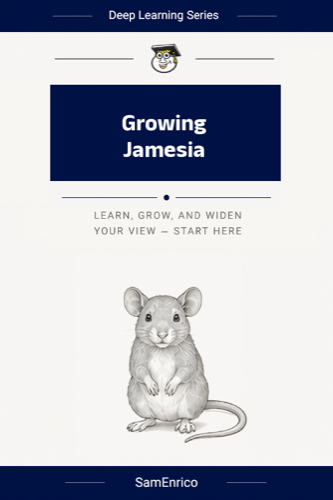
Non-FictionInformativeEducational
Growing Jamesia eBook
This publication, published by SamEnrico, covers G
This publication, published by SamEnrico, covers Growing Jamesia
Formats
Free sample
Chapter 1: The Cliff Not the Lawn...--I have a confession to make. For the first four years of my daughter’s life, I was a lawn parent. I mowed, watered, fertilized, and weeded with the frantic energy of someone trying to win a “Best in Show” ribbon at a county fair that nobody else was attending. I read every sleep-training book, purchased organic wooden toys that cost more than my first car, and scheduled “enrichment activities” with the precision of a military operation. And the result?
By age four, my daughter was anxious, brittle, and unable to play by herself for more than ninety seconds without asking for direction. I had created a perfect, beautiful, high-maintenance lawn. And it was dying.This book is the story of how I stopped being a lawn parent and became a cliff parent. It is the story of a plant called Jamesia americana—the Cliffbush—and what it taught me about raising a resilient human being. But before we get to the plant, we need to talk about the problem.
The problem is not our children. The problem is the cult of the lawn.The Lawn Parent Manifesto (You Might Be One)Let me describe the lawn parent to you. See if any of this sounds familiar.The lawn parent believes that a child is a blank slate, a patch of bare soil waiting to be sculpted into something admired by the neighbors. The lawn parent reads the books, follows the Instagram accounts, and knows the “correct” way to do everything—from pureeing organic sweet potatoes to managing a toddler’s tantrum with “gentle but firm” scripts. The lawn parent fears dandelions.
A dandelion is any deviation from the plan: a bad grade, a weird friendship, a sudden refusal to wear anything but purple, a day of inexplicable crying. The lawn parent’s first instinct is to pull the dandelion—to correct, to intervene, to schedule a conference, to call the pediatrician, to post an anonymous question on a parenting forum at 2:00 AM.The lawn parent waters constantly. Every problem is met with immediate attention. The child is thirsty? Here is a snack, a hug, a solution, a playdate, a tutor, a therapist (and to be clear, therapy can be wonderful—we will talk about the difference between safety and comfort later).
The lawn parent believes that love is measured in the speed and volume of the response. The child falls down. The lawn parent rushes over before the child even decides whether it hurts. The child forgets a jacket. The lawn parent drives it to school.
The child is bored. The lawn parent provides a screen, a craft, an activity, a scheduled playdate. The lawn parent leaves no empty space.And the lawn parent mows. Regularly, obsessively, to a uniform height. The lawn parent wants consistency above all else.
Bedtime must be exact. Vegetables must be eaten in a specific order. Achievements must be celebrated with the same enthusiasm for every child, regardless of temperament. The lawn parent measures growth in inches per week and panics when the neighbor’s lawn (i.e., the influencer’s child, the cousin’s perfect student) looks greener.Here is what the lawn parent does not understand: a lawn is not a natural ecosystem. A lawn is a monoculture.
It requires constant, unsustainable inputs of water, fertilizer, pesticide, and labor. Without these inputs, it dies. And the child who is raised like a lawn grows up dependent on external validation, unable to tolerate discomfort, and terrified of the weeds that inevitably appear in every human life.I know this because I was that lawn parent. I know this because I watched my daughter’s anxiety spike every time I tried to leave the room. I know this because I was exhausted, broke, and secretly resentful of a four-year-old who had never asked for any of this intensity.
And then I discovered the Cliffbush.The Discovery of Jamesia Americana I am not a botanist. I am a parent who, in a moment of desperation, drove to a botanical garden two hours away because I needed to be somewhere that did not have a diaper-changing station. I was wandering through the native plant section—the scraggly, unloved part of the garden where nothing is in bloom and everything looks like it might be dead—when I saw a sign that read:Jamesia americana Cliffbush Native Range: Rocky mountainsides of the Western United States Hardiness Zones: 3-7Conditions: Full sun to partial shade. Well-drained, rocky, alkaline soil. Drought-tolerant once established.Bloom time: 10-20 years after planting.I stopped.
Ten to twenty years after planting? Who waits twenty years for a flower? In the parenting world, we cannot wait twenty minutes. We want the four-month-old to sleep through the night, the two-year-old to share, the six-year-old to read chapter books, the ten-year-old to decide on a career. We have no patience for a plant that takes two decades to show its full glory.I looked at the Cliffbush.
It was not impressive. It was a scraggly, nondescript shrub about three feet tall, growing out of a crack in a artificial rock pile the garden had built to mimic its native habitat. Its leaves were small and slightly wrinkled. Its bark was peeling in weird, cinnamon-colored strips that looked like it was sick. Nothing about it said, “Buy me.
Water me. Love me.” And yet, according to the sign, this unremarkable little shrub would one day produce “fragrant white panicles cascading down the cliff face like mountain snow.” But only if you grew it correctly. And “correctly,” it turned out, meant almost the opposite of everything I had been doing as a parent.The Three Native Habitats (Because Every Child Is a Different Species)Let me clarify something important. I am not saying that every child should be raised like a Cliffbush. That would be the same mistake as the lawn parent—forcing one model onto every unique human being.
The Cliffbush is one native habitat among many. And your job, as the gardener, is to identify which habitat your child was born to occupy.After studying the research on temperament (I recommend the work of Jerome Kagan and Mary Rothbart, though I will spare you the dense academic prose), I have identified three primary native habitats that map onto the vast majority of children. I call them the Cliff, the Meadow, and the Woodland. You will recognize your child in one of these descriptions.The Cliff Jamesia (Hardiness equivalent: Zones 3-4)The Cliff child is independent, cool-tolerant, and internally motivated. From a young age, they prefer to play alone.
They do not need constant praise or reassurance. They are comfortable with boredom, even seek it out. They are often labeled “shy” or “stubborn” by well-meaning relatives, but they are neither—they are simply self-contained. The Cliff child thrives on firm boundaries and natural scarcity. Too much attention, too many choices, too much emotional intensity actually overwhelms them.
They need what the Cliffbush needs: rocky, alkaline soil (clear rules, high expectations, minimal coddling) and infrequent deep watering (intense connection followed by long periods of independence).If you have a Cliff child, your instinct…
This is the end of the free sample. Get the eBook to keep going. Buy now
About this book
Details
- Author
- Jefferson Fredrick
- Publisher
- SamEnrico
- Language
- English
- Genre
- Non-Fiction, Informative, Educational
- Released
- 2026-05-11
- Pages (approx.)
- 128
- Available as
- eBook, Audiobook

Read better in the ZLOADR app
Your eBooks on your phone or tablet. Sign in with your SamEnrico account and start reading.
More by Jefferson Fredrick
 Remote Team Collaboration PlaybookJefferson Fredrick$11.99
 Problem Statement Persuasion CraftJefferson Fredrick$11.99Remote Team Collaboration PlaybookJefferson Fredrick$11.99
 Bipolar Disclosure DecisionJefferson Fredrick$11.99
 Empathy in Conflict GuideJefferson Fredrick$11.99
 Blue Zone Water IntakeJefferson Fredrick$11.99
 Stress Related Muscle Tension GuideJefferson Fredrick$11.99
 Ko fi Creator JourneyJefferson Fredrick$11.99
 Running Low on EverythingJefferson Fredrick$11.99
 Anderson Cooper SilverJefferson Fredrick$11.99
 Debt and Dynasty: The Billion-Dollar Betrayal of the Trump OrganizationJefferson Fredrick$11.99
 The Quantum Leap: Schrödinger, Heisenberg, and the Birth of a New PhysicsJefferson Fredrick$11.99
You may also like
 Hong Kong Handover 1997Dunn Johnnie$11.99
 Zumba For Postnatal Recovery CourseNeal Christian$11.99
 Zumba for BeginnersLadner Nikia$11.99
 YouTube Comment Mining GuideHumes Pandora$12.99
 Worry Box MeditationCarlin Rudy$11.99
 Workplace Stress MeditationNguyen Lynn$11.99
 Workplace Stress and Sleep RepairHawley Ivory$11.99
 Workplace Perfectionism CureDelaney Jeffry$11.99
 Workplace Injustice Anger GuideWallen Isabelle$11.99
 Work Addiction and Burnout LinkGreenwood Ester$11.99
 Women in Yoga and WellnessBeattie Galina$11.99
 Women in Stand Up ComedyChun Evangeline$11.99