
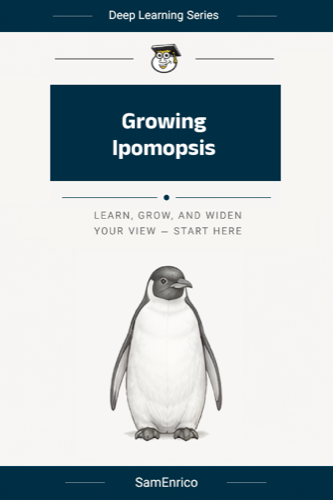
Non-FictionInformativeEducational
Growing Ipomopsis eBook
This publication, published by SamEnrico, covers G
This publication, published by SamEnrico, covers Growing Ipomopsis
Formats
Free sample
Chapter 1: The Rocket in the Dust--–- It began, as most obsessions do, with a single flower. I was walking a dry ridge in the Colorado Front Range, late July, the kind of afternoon when the air shimmers and the only sensible creatures are the lizards flattened against warm rocks. The trail was dust and scree, dotted with the usual suspects: scrub oak, prickly pear, a few tired-looking asters. I was not expecting to be stopped in my tracks. But there it was, rising from a crack in a sandstone slab like something from a botanical fever dream.
A single spire, three feet tall, absolutely loaded with tubular scarlet flowers. Hummingbirds were fighting over it. Not visiting—fighting. A rufous hummingbird the size of my thumb chased off a broad-tailed twice its weight, then returned to hover, its needle bill disappearing into flower after flower. The plant seemed to be on fire.
That was my first Ipomopsis. I did not even know its name yet. I stood there for fifteen minutes, sweating through my shirt, watching the aerial combat. And when I finally knelt to look at the base of this impossible spire, I found a modest cluster of lobed leaves hugging the ground, nothing more. One stem, one season, one performance.
And then, presumably, death. I walked away that day with a photograph and a question: what kind of plant spends an entire year hiding, only to launch a skyrocket of color and then disappear? That question became this book. What follows is everything I have learned about Ipomopsis aggregata—the scarlet gilia, the skyrocket, the hummingbird's favorite fuel station—from a decade of growing, failing, succeeding, and failing again. This chapter is not a growing guide.
Not yet. This is the why. Because before you dig a single hole or stratify a single seed, you need to fall in love. And to fall in love, you need to understand what you are actually looking at.The Plant That Refuses to Be Ignored Let us begin with the obvious: Ipomopsis aggregata is not subtle. In a family of plants known for modesty—many Polemoniaceae species are small, ground-hugging affairs—the skyrocket is the rebellious teenager who shows up to a formal dinner in a sequined red dress.
The flower stalks regularly reach two to three feet, sometimes four in ideal conditions. Each stalk produces dozens, sometimes over a hundred, individual flowers. And those flowers are not just red. They are the specific shade of red that hummingbirds have evolved to see better than any other color in the spectrum. This is not an accident.
This is coevolution written in pigment and feather.The flowers are tubular, typically five-lobed at the tip, flaring open just enough to admit a hummingbird's bill and tongue. The reproductive parts—stamens with their pollen-dusted anthers, and the single branched style leading to the ovary—protrude just beyond the corolla tube, ensuring that any visiting bird gets dusted with pollen from one flower and delivers it to the next. This is pollination by design, precise and efficient. And it works. A single well-visited plant can produce hundreds of seeds, each contained in a small capsule that splits open when dry, scattering the next generation to the wind and the rain.But the flowers are only half the story.
Below that spire, hidden from casual view, is the true engine of the plant: the basal rosette. In its first year, Ipomopsis produces no flower stalk at all. Instead, it pours all its energy into a cluster of leaves that spread flat against the ground, seldom rising more than a few inches. These leaves are lobed or deeply toothed, somewhat fuzzy, and arranged in a spiral that maximizes sunlight capture. Beneath them, a taproot is growing—slowly, steadily, driving down into the soil in search of moisture and stability.
By the end of that first summer, that taproot may be as thick as a finger and just as fleshy, packed with stored carbohydrates that will fuel the following year's explosion.Then comes winter. The rosette may persist, green or bronzed, depending on the cold. It waits. And when spring soil temperatures rise and day length triggers a hormonal cascade that botanists still do not fully understand, that same rosette sends up a single-minded stalk. The transformation is astonishing.
Within weeks, the plant goes from a quiet ground cover to a towering inflorescence, as if someone threw a switch. The flowers open from the bottom of the stalk upward, a progressive unfurling that can last a month or more. And then, having set seed, the parent plant dies. The biennial contract fulfilled. The taproot, exhausted, decays.
The rosette browns. And if the seeds found good ground, a new generation of rosettes will appear the following spring, and the cycle begins again.This is the basic rhythm of Ipomopsis aggregata. But basic rhythms, as any musician knows, contain infinite variation.The Many Faces of a Genus Before we go further, we need to talk about names. Ipomopsis is a genus within the phlox family, Polemoniaceae. The name comes from the Greek ips (worm) and opsis (like), a reference to the twisted, worm-like appearance of the flower stalk in some species.
Aggregata means "crowded" or "clustered," describing the dense arrangement of flowers along the stalk. Together, Ipomopsis aggregata is the plant I just described: the common scarlet gilia, also known as skyrocket, standing cypress (though it is not a cypress), and sometimes simply "red gilia."But the genus is larger than a single species. Gardeners who fall in love with Ipomopsis aggregata often find themselves curious about its relatives. The most notable is Ipomopsis congesta, known as ballhead ipomopsis or simply "congesta." This species could not be more different from its flamboyant cousin. Instead of a towering spike, congesta produces a compact, rounded cluster of flowers—a "ball head"—atop a stem that seldom exceeds a foot.
The flowers are typically white or pale pink, sometimes cream, and they lack the hummingbird-magnet red of aggregata. Congesta is a plant for rock gardens, for alpine troughs, for the collector who appreciates subtlety. It is no less interesting for being quieter.There are others. Ipomopsis tenuituba has longer, narrower flower tubes adapted to long-tongued pollinators like certain moths. Ipomopsis polyantha, the Pagosa skyrocket, is a rare and protected species found only in a small area of Colorado.
And the genus hybridizes readily, producing natural crosses that confuse botanists and delight gardeners. In fact, the evolutionary biology of Ipomopsis has been studied intensively precisely because these hybrids offer a window into how new species form. The plant is a living laboratory.For the home gardener, however, the choice usually comes down to aggregata. It is the showstopper. It is the plant that will make your neighbors ask questions.
And it is the plant that will teach you, whether you want to learn or not, about patience, drainage, and the irreducible fact that some things cannot be rushed.The Ecological Stage: Where Skyrockets Belong To understand how to grow Ipomopsis, you must first understand where it grows wild. And that means leaving the garden behind for a moment and walking, at least in imagination, into…
This is the end of the free sample. Get the eBook to keep going. Buy now
About this book
Details
- Author
- Mcmahon Catarina
- Publisher
- SamEnrico
- Language
- English
- Genre
- Non-Fiction, Informative, Educational
- Released
- 2026-06-02
- Pages (approx.)
- 139
- Available as
- eBook, Audiobook

Read better in the ZLOADR app
Your eBooks on your phone or tablet. Sign in with your SamEnrico account and start reading.
More by Mcmahon Catarina
 CPR Quality FeedbackMcmahon Catarina$11.99
 The Label Letting GoMcmahon Catarina$11.99
 Pranayama Breath FoundationsMcmahon Catarina$11.99
 Case Study Persuasion FrameworkMcmahon Catarina$11.99
 Gratitude for Blended FamiliesMcmahon Catarina$11.99
 The Galapagos StopoverMcmahon Catarina$11.99
 Mastodon Influencer JourneyMcmahon Catarina$11.99
 Senior Napping Health GuideMcmahon Catarina$11.99
 Centenarian Diet PrinciplesMcmahon Catarina$11.99
 The Codebreakers' War: How the Enigma Machine Almost Lost WWIIMcmahon Catarina$11.99
 The Ballad of the Singing Bridge: When a Town Danced with DisasterMcmahon Catarina$11.99
 The Architect of Eternity: Apollodorus and the Grandeur of RomeMcmahon Catarina$11.99
You may also like
 Hong Kong Handover 1997Dunn Johnnie$11.99
 Zumba For Postnatal Recovery CourseNeal Christian$11.99
 Zumba for BeginnersLadner Nikia$11.99
 YouTube Comment Mining GuideHumes Pandora$12.99
 Worry Box MeditationCarlin Rudy$11.99
 Workplace Stress MeditationNguyen Lynn$11.99
 Workplace Stress and Sleep RepairHawley Ivory$11.99
 Workplace Perfectionism CureDelaney Jeffry$11.99
 Workplace Injustice Anger GuideWallen Isabelle$11.99
 Work Addiction and Burnout LinkGreenwood Ester$11.99
 Women in Yoga and WellnessBeattie Galina$11.99
 Women in Stand Up ComedyChun Evangeline$11.99