
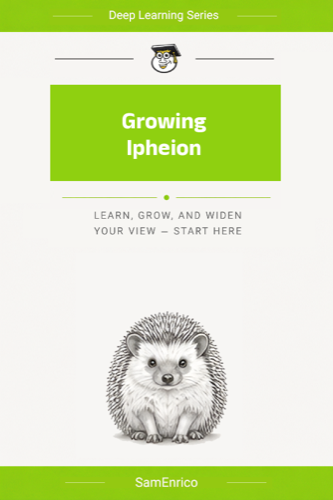
Non-FictionInformativeEducational
Growing Ipheion eBook
This publication, published by SamEnrico, covers G
This publication, published by SamEnrico, covers Growing Ipheion
Formats
Free sample
Chapter 1: The $10,000 Lie...–- Let me tell you about the most expensive plant you will never grow.It is not a rare orchid from the cloud forests of Ecuador. It is not a Japanese maple trained over centuries into a bonsai masterpiece. It is not even something you buy from a catalog. The most expensive plant in America is the one sitting outside your window right now, covering millions of acres of suburban real estate, consuming billions of gallons of water, and requiring hundreds of millions of hours of labor every single year.It is your lawn.And I am about to show you how to replace it with something cheaper, easier, and infinitely more beautiful.The Great American Lawn Lie Let me start with a confession: I used to be a lawn person. Not the kind who measures blade height with a ruler or paints stripes into the grass for aesthetic effect, but the kind who felt a low-grade sense of obligation every Saturday morning from April through October.
The lawn needed mowing. The edges needed trimming. The brown patches needed watering. The weeds needed spraying. The leaves needed raking.
The thatch needed dethatching. The soil needed aerating. The cycle never ended, and neither did the spending.I did not realize how much I was spending until I actually added it up.Gas for the mower: forty dollars a month during the growing season, or about two hundred and forty dollars a year. Fertilizer and weed control: another hundred and fifty dollars annually, even buying the cheap stuff from the big-box store. Water during dry spells: highly variable, but easily two hundred to four hundred dollars in a typical summer.
Replacement grass seed for the patches I killed through overwatering or underwatering or just bad luck: another fifty dollars. The edger, the trimmer, the spreader, the sprayer, the hoses, the nozzles, the sprinklers: amortized across their lifespans, probably another hundred dollars per year.I was spending well over seven hundred dollars annually to maintain a plant that provided no food, no flowers, no habitat, and almost no joy. A plant that I resented every time I looked at it. A plant that existed solely because the neighbors had one and because the previous owner had installed it and because I had never stopped to ask whether any of this made sense.Then I discovered Ipheion, and I stopped mowing that part of my yard forever.The Math That Will Change Your Yard Before you plant a single bulb, let me show you the numbers. These are averages based on data from the United States Environmental Protection Agency, the Lawn Institute, and several university extension services.
Your actual costs may vary, but the ratios will not.The Average American Lawn: Annual Costs Expense Low Estimate High Estimate Typical Mowing (gas, maintenance, depreciation)$120$300$180Fertilizer and soil amendments$50$200$120Weed and pest control (chemicals)$30$150$80Water (based on 1 inch per week in summer)$150$600$300Seed, sod, and repairs$20$100$50Equipment (spreader, sprayer, hoses, etc.)$30$100$60Total Annual Cost$400$1,450$790Now add your time. The average American homeowner spends forty to sixty hours per year on lawn maintenance – mowing, edging, trimming, watering, fertilizing, weeding, and repairing. At minimum wage, that time is worth another five hundred to eight hundred dollars. At your actual hourly rate, it is worth significantly more.Now consider that this entire expense – both the money and the time – goes toward maintaining a monoculture that provides almost no ecological value. Turfgrass is not a meaningful source of food for pollinators.
It does not sequester significant carbon. It does not prevent erosion better than alternatives. It does not provide habitat for birds, butterflies, or beneficial insects. It is, in ecological terms, a green desert.The Ipheion Meadow: One-Time Cost Now let me show you the alternative.Five hundred Ipheion bulbs cost approximately thirty dollars from any reputable mail-order catalog. That is enough to cover five hundred square feet – roughly twenty by twenty-five feet – at standard spacing.
If you want to cover a larger area, buy more bulbs. The cost per square foot is about six cents.That is the entire expense. There is no ongoing cost for water, because Ipheion does not need summer irrigation. There is no ongoing cost for fertilizer, because Ipheion prefers poor soil. There is no ongoing cost for pest control, because Ipheion repels deer and rabbits naturally.
There is no ongoing cost for mowing, because you will stop mowing that area from spring through early summer.The only recurring task is a single mowing in late spring or early summer, after the Ipheion foliage has died back naturally. That is it. Fifteen minutes once per year.Expense Ipheion Meadow Traditional Lawn Savings First year cost$30$790$760Five-year cost$30$3,950$3,920Ten-year cost$30$7,900$7,870Over a decade, replacing a five-hundred-square-foot lawn with Ipheion saves nearly eight thousand dollars. Over a quarter-acre property – the typical American suburban lot – the savings would exceed fifty thousand dollars.Beyond Dollars: The Ecological Argument Money is one thing. But let me make a different argument, one that speaks not to your wallet but to your conscience.The traditional American lawn is an ecological catastrophe.
Not because lawns are inherently evil – a small patch of grass for children to play on is perfectly fine – but because we have covered two percent of the entire land area of the continental United States in turfgrass. That is an area larger than the state of Georgia, all devoted to a single plant species that supports almost no other life.Consider the insects. Native bees, butterflies, moths, and other pollinators have lost an estimated ninety percent of their natural habitat in the last century. Lawns are part of the problem. A lawn offers no nectar, no pollen, no host plants for caterpillars, no shelter for ground-nesting bees.
It is, from an insect's perspective, a barren wasteland.Consider the birds. Most bird species feed their young on insects – not seeds, not berries, but soft-bodied caterpillars and grubs. When you eliminate insects from the landscape, you eliminate the food source for birds. The decline of grassland birds in North America tracks almost perfectly with the expansion of suburban lawns.Consider the water. Lawns consume an estimated nine billion gallons of water per day in the United States – more than the entire domestic water use of New York City, Los Angeles, and Chicago combined.
Much of that water is applied during the hottest part of the day, when evaporation losses are highest. Much of it runs off into storm drains, carrying fertilizers and pesticides into rivers, lakes, and ultimately the ocean.Now consider Ipheion.Ipheion blooms in early spring, when few other plants are flowering. Its star-shaped flowers produce nectar that feeds queen bumblebees emerging from hibernation, early solitary bees searching for nesting sites, and hoverflies looking for protein. A single Ipheion meadow can support hundreds of pollinators per square yard during the critical spring window when other food sources are scarce.Ipheion requires no irrigation during its summer dormancy. Once established, it survives entirely on natural rainfall.
In most of the continental United States, that means no watering at all from June through September. The water savings are immediate and permanent.Ipheion requires no fertilizer. It prefers poor soil and…
This is the end of the free sample. Get the eBook to keep going. Buy now
About this book
Details
- Author
- Cottrell Adan
- Publisher
- SamEnrico
- Language
- English
- Genre
- Non-Fiction, Informative, Educational
- Released
- 2026-06-02
- Pages (approx.)
- 143
- Available as
- eBook, Audiobook

Read better in the ZLOADR app
Your eBooks on your phone or tablet. Sign in with your SamEnrico account and start reading.
More by Cottrell Adan
 Objection Handling Written ResponsesCottrell Adan$11.99
 High Performance Breath TrainingCottrell Adan$11.99
 Early Onset Bipolar GuideCottrell Adan$11.99
 CPR Training App GuideCottrell Adan$11.99
 Gratitude for AnniversariesCottrell Adan$11.99
 The Panama Canal SoloCottrell Adan$11.99
 BeReal Authentic InfluencerCottrell Adan$11.99
 Student Study Break NappingCottrell Adan$11.99
 Mickey Brown Holiday InnCottrell Adan$11.99
 The Last Broadcast: How a 1938 Radio Play Sparked a Nationwide PanicCottrell Adan$11.99
 The Sweethearts of Pasteur: Love and the Birth of Modern MedicineCottrell Adan$11.99
 Quantum Alchemists: The Secret Code of the I ChingCottrell Adan$11.99
You may also like
 Hong Kong Handover 1997Dunn Johnnie$11.99
 Zumba For Postnatal Recovery CourseNeal Christian$11.99
 Zumba for BeginnersLadner Nikia$11.99
 YouTube Comment Mining GuideHumes Pandora$12.99
 Worry Box MeditationCarlin Rudy$11.99
 Workplace Stress MeditationNguyen Lynn$11.99
 Workplace Stress and Sleep RepairHawley Ivory$11.99
 Workplace Perfectionism CureDelaney Jeffry$11.99
 Workplace Injustice Anger GuideWallen Isabelle$11.99
 Work Addiction and Burnout LinkGreenwood Ester$11.99
 Women in Yoga and WellnessBeattie Galina$11.99
 Women in Stand Up ComedyChun Evangeline$11.99