
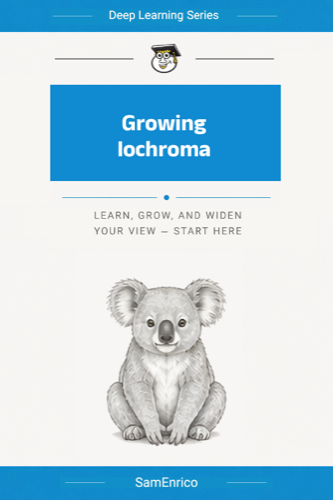
Non-FictionInformativeEducational
Growing Iochroma eBook
This publication, published by SamEnrico, covers G
This publication, published by SamEnrico, covers Growing Iochroma
Formats
Free sample
Chapter 1: The Blue Obsession--It begins, as most obsessions do, with a single image. For me, that image was a photograph buried on an obscure gardening forum in 2015: a plant covered in pendulous, electric-blue bells that seemed to glow against the dark green foliage. The caption read simply, "Iochroma cyaneum – my pride and joy." I had never heard of Iochroma. I had certainly never seen a flower that shade of true, unapologetic cobalt blue. I spent the next six hours reading every post, every comment, every grainy photo I could find.
By midnight, I had ordered three plants from a specialty nursery I had never used before. Eleven days later, a cardboard box arrived at my door containing three sticks with a few shriveled leaves and a note that said, "Plant immediately. They're tougher than they look." I was skeptical. I was also, as it turns out, completely unprepared for what happened next.That was nine years and thirty-seven Iochromas ago. I have killed more of these plants than I care to admit—drowned them in kindness, roasted them in summer sun, frozen them by trusting a late-spring forecast, and once, memorably, pruned a four-year-old specimen down to a nub in July because I confused it with my Brugmansia.
That plant survived, by the way. Iochromas are resilient in ways that surprise you and fragile in ways that humble you. But when you get it right—when the conditions align, when the watering rhythm clicks, when you see that first flush of a hundred blooms all opening at once—you understand why collectors chase these plants across continents and why a single cutting can spark a friendship between strangers on opposite sides of the world.This chapter is not a botanical treatise or a dry list of facts. It is an invitation to understand what Iochroma is, why it matters, and how to avoid the mistakes I made so you can fast-forward to the part where your neighbors ask, "What is that incredible blue thing in your yard?" We will cover the essential distinctions between Iochroma and its confusing cousins (Brugmansia, Datura, and Cestrum), the four main species you are likely to encounter, the hidden truth about flower color and what it tells you about the plant's needs, and the single most important decision you will make as an Iochroma grower: which variety to choose based on your climate, space, and ambitions. By the end of this chapter, you will have a clear roadmap for selecting your first plant with confidence—and you will understand why so many gardeners who start with one Iochroma end up with a dozen.The Great Solanaceae Confusion: What Iochroma Is (And Isn't)Let us begin with the elephant in the room.
Iochroma belongs to the Solanaceae family, the nightshades, which includes tomatoes, potatoes, eggplants, peppers, petunias, tobacco, and—most relevant to our confusion—Brugmansia (angels' trumpets), Datura (devil's trumpets), and Cestrum (jessamine). The family resemblance is real: all produce trumpet-shaped flowers, all contain potent alkaloids (more on toxicity in Chapter 12), and all have a certain audacious quality that attracts plant collectors. But mistaking Iochroma for Brugmansia is like mistaking a house cat for a mountain lion. They are related, yes. They share some features.
But the differences matter tremendously for how you grow them.Iochroma vs. Brugmansia: Brugmansia flowers are enormous—six to ten inches long, sometimes longer—and they hang straight down like trumpets pointing at the earth. They are famously fragrant, especially at night, when their scent can fill an entire garden. Iochroma flowers are smaller, usually two to three inches long, and they hang in clusters rather than singly. They have little to no fragrance.
Brugmansia grows into a small tree, often ten to fifteen feet tall, with a woody trunk that persists for years. Iochroma is more of a woody shrub, typically four to six feet in containers (larger in the ground), and it has a looser, more open habit. Brugmansia requires significant space and is difficult to overwinter in small homes. Iochroma is more manageable for container gardeners. The most practical difference for the home grower is this: Brugmansia blooms on new growth, so you can prune it hard and still get flowers the same season.
Iochroma also blooms on new growth, but it is more sensitive to pruning timing (Chapter 6 covers this in detail). If you have grown Brugmansia successfully, you will find Iochroma familiar but distinct—thirstier, slightly less cold-hardy (with the notable exception of I. australe), and much more likely to reward you with a continuous bloom cycle if you treat it right.Iochroma vs. Datura: Datura is the weedier, more aggressive cousin. Datura flowers face upward, not downward, and they open in the evening, closing by mid-morning.
The seed pods are spiky and memorable—they look like medieval weapons. Datura is an annual or short-lived perennial in most climates, and it self-seeds with enthusiasm. Iochroma does not self-seed aggressively in cultivation, and its flowers face downward or hang at an angle. Datura is generally hardier in cold climates (some species survive zone 5 as reseeding annuals), while Iochroma requires winter protection anywhere north of zone 8b (with I. australe being the sole exception).
If you see a plant with upright white or purple flowers and spiky green balls forming afterward, you are looking at Datura, not Iochroma.Iochroma vs. Cestrum: This is a more subtle distinction. Cestrum (jessamine) produces tubular flowers in clusters similar to Iochroma, and some Cestrum species have showy red or orange blooms. The key difference is the flower shape: Cestrum flowers are more narrowly tubular, often with a flared face that is distinctly different from Iochroma's broader trumpet. Cestrum also tends to have a stronger, sweeter fragrance, especially at night, while Iochroma is essentially unscented.
From a cultivation standpoint, Cestrum is generally hardier and more forgiving of poor soil, but its flowers are less dramatic. Most gardeners who grow Iochroma do so for the visual impact—the clusters of pendulous bells that seem to defy the color palette of the natural world.Why the confusion persists: Nurseries sometimes mislabel plants. Online sellers use the wrong names. Gardeners inherit cuttings with no identification. I have personally received a "blue Iochroma" cutting that turned out to be a purple Cestrum, and a "white Brugmansia" that was clearly an I.
australe. The only reliable way to know what you have is to buy from reputable sources or to propagate from a known parent plant (Chapter 2). When in doubt, wait for flowers. The differences become obvious once the plant blooms.The Hidden Language of Flower Color Here is something most guides do not tell you: the color of an Iochroma flower is not just an aesthetic choice. It is a signal about the plant's genetics, its growing requirements, and even its behavior in your garden.
Understanding this hidden language will help you choose the right plant for your space and avoid frustrating mismatches.Blue flowers (I. cyaneum and hybrids): True blue is rare in the plant kingdom. Most "blue" flowers are actually purple or lavender, but Iochroma cyaneum produces a genuine cobalt blue that is unmistakable. Blue-flowered Iochromas tend to be the most vigorous growers, often reaching five…
This is the end of the free sample. Get the eBook to keep going. Buy now
About this book
Details
- Author
- Bellamy Alane
- Publisher
- SamEnrico
- Language
- English
- Genre
- Non-Fiction, Informative, Educational
- Released
- 2026-06-02
- Pages (approx.)
- 146
- Available as
- eBook, Audiobook

Read better in the ZLOADR app
Your eBooks on your phone or tablet. Sign in with your SamEnrico account and start reading.
More by Bellamy Alane
 Home AED Buying GuideBellamy Alane$11.99
 Diving Breath PreparationBellamy Alane$11.99
 The Timeline RushBellamy Alane$11.99
 Persuasive Sales Deck StructureBellamy Alane$11.99
 WhatsApp Status InfluencerBellamy Alane$11.99
 Joyful New Year Resolution GuideBellamy Alane$11.99
 Rounding Cape Horn AloneBellamy Alane$11.99
 Dick Cavett InterviewsBellamy Alane$11.99
 Blue Zone Walking HabitsBellamy Alane$11.99
 The Last Voyage of the SS Ourang Medan: A Cursed CargoBellamy Alane$11.99
 The Condottieri's Gambit: Blood and Betrayal in the Italian WarsBellamy Alane$11.99
 The Architect of the Marid: A Djinn’s Tower of BabelBellamy Alane$11.99
You may also like
 Hong Kong Handover 1997Dunn Johnnie$11.99
 Zumba For Postnatal Recovery CourseNeal Christian$11.99
 Zumba for BeginnersLadner Nikia$11.99
 YouTube Comment Mining GuideHumes Pandora$12.99
 Worry Box MeditationCarlin Rudy$11.99
 Workplace Stress MeditationNguyen Lynn$11.99
 Workplace Stress and Sleep RepairHawley Ivory$11.99
 Workplace Perfectionism CureDelaney Jeffry$11.99
 Workplace Injustice Anger GuideWallen Isabelle$11.99
 Work Addiction and Burnout LinkGreenwood Ester$11.99
 Women in Yoga and WellnessBeattie Galina$11.99
 Women in Stand Up ComedyChun Evangeline$11.99