
Non-FictionInformativeEducational
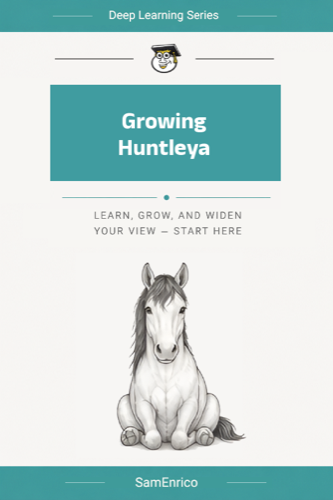
Growing Huntleya eBook
This publication, published by SamEnrico, covers G
This publication, published by SamEnrico, covers Growing Huntleya
Formats
Free sample
Chapter 1: Ghosts of the Cloud Forest...--The first time I watched a Huntleya flower open, I nearly killed the plant.It was three in the morning, and I had convinced myself that the bud—swollen for seventeen days, teasing me with incremental movements—would finally unfurl under the cover of darkness. I had dragged my sleeping bag into the greenhouse, a mug of cold coffee in one hand and a headlamp strapped across my forehead like a coal miner approaching a vein of diamonds. The plant sat on a wooden bench surrounded by thirty-seven other orchids, most of them common Phalaenopsis and Cattleyas that I had bought from grocery stores and learned to keep alive through sheer stubbornness. But this one was different. This Huntleya meleagris had cost me more than I wanted to admit, shipped from a specialist vendor in Ecuador with a phyto-sanitary certificate and a handwritten note that said simply: “Be patient.
She is worth it.”I was not patient. At 3:17 AM, I saw it happen: the sepals parted with a sound I can only describe as a whisper, and then the petals unfolded like origami designed by a god. The flower was thick and waxy, almost artificial in its perfection, painted in maroon and cream with spots that reminded me of guinea fowl eggs. And the smell—clove and vanilla and something else, something green and wet, like the air after a thunderstorm in a forest I had never visited. I sat there breathing it in until dawn, and by the time the sun rose, I had forgotten to open the greenhouse vents.
The humidity spiked to 95%, the temperature climbed to 32°C, and within forty-eight hours, the leaves had developed soft, water-soaked spots that told me I had made a classic beginner’s mistake. I had fallen in love with the flower and forgotten the plant.That Huntleya survived, barely. It took two years to bloom again. But in those two years, I learned something that no orchid book had ever taught me: Huntleya are not just difficult plants. They are ghosts of a world that is disappearing, and growing them requires more than good horticulture.
It requires understanding where they come from, why they grow the way they do, and how to recreate a climate that most of us have never experienced. This chapter is about that origin story. Before we talk about pots and watering schedules and fertilizer ratios—and believe me, we will spend entire chapters on those things—we have to understand the cloud forest.The Cloud Forest: A World That Should Not Exist Close your eyes for a moment. Imagine a mountain range rising from the lowland jungle, its slopes so steep that the soil barely clings to the rock. Now imagine the trade winds blowing in from the ocean, carrying moisture that rises, cools, and condenses into a fog so thick that you cannot see ten meters in front of you.
This fog does not burn off at noon. It persists, day and night, year after year, draping the forest in a perpetual mist that drips from every leaf and branch. The temperature stays cool—not cold, never freezing, but cool enough that you reach for a jacket even at midday. The trees are short and twisted, covered in mosses and ferns and orchids that have never known the dry season because there is no dry season here. This is the cloud forest, and it is one of the rarest ecosystems on Earth.Huntleya species grow exclusively in these cloud forests, from Costa Rica and Panama down through Colombia and Ecuador into northern Brazil and across to Trinidad.
They are found at elevations between 600 and 1,200 meters—roughly 2,000 to 4,000 feet. At these altitudes, the average daytime temperature hovers around 22°C (72°F), and nighttime temperatures drop to 15°C (59°F). That diurnal swing of 7°C is not incidental; it is the drumbeat that drives their entire life cycle. The relative humidity rarely falls below 70% and often climbs to 90% or higher. Rainfall is abundant but not constant; the real moisture comes from the fog, which deposits water directly onto every surface, including the leaves and roots of epiphytic orchids.What makes the cloud forest unique is not just the moisture but the light.
Above the canopy, the sun would be intense, but the cloud layer diffuses it into a soft, dappled glow. The light levels that reach the orchids range from 1,000 to 1,500 foot-candles—about the same as a bright windowsill with a sheer curtain. There is no direct sunburning the leaves, no harsh midday glare. Just a steady, filtered brightness that persists through the short days of the wet season and the slightly longer days of the dry season, though even the dry season brings morning fogs and afternoon mists.For the orchids that live here, this is not a harsh environment. It is stable, predictable, forgiving.
The problem is that most of us do not live in cloud forests. We live in houses with dry air and drafty windows, in apartments with radiators that turn the humidity to dust, in climates that swing from frozen winters to broiling summers. When we try to grow Huntleya, we are not just growing a plant. We are trying to smuggle a piece of the cloud forest into our living rooms, and the cloud forest does not travel well.The Anatomy of a Ghost: Why Huntleya Looks the Way It Does If you have never seen a Huntleya in person, you might mistake it for a small Phalaenopsis or a compact Cattleya. The leaves grow in a fan shape, two ranks emerging from a central growing point, overlapping like the pages of a book that has been fanned open.
The leaves are soft, pliable, and bright green when healthy—not the hard, leathery texture of a Cattleya, not the thick succulent leaves of a Phalaenopsis. They feel almost like the leaves of a tender houseplant, which is exactly what they are.Here is the single most important anatomical fact about Huntleya, and if you forget everything else in this chapter, remember this: they have no pseudobulbs.In the orchid world, pseudobulbs are survival insurance. They are swollen stem structures that store water and nutrients, allowing orchids to survive periods of drought, low humidity, or neglect. A Cattleya can go weeks without water, drawing on the reserves in its pseudobulbs. A Dendrobium can survive a missed watering or two.
Even a Phalaenopsis, which has no pseudobulbs, stores water in its thick, fleshy leaves. But Huntleya have none of these adaptations. Their leaves are thin, their roots are aerial and exposed, and they have no internal reservoir to fall back on. Every drop of water they need must come from the environment, right now, today, this hour.This is why cloud forests are their natural home. In a cloud forest, the air is so saturated with moisture that the plants never need to store water.
They absorb it directly from the fog through their leaves and roots, constantly, passively, without effort. The lack of pseudobulbs is not a weakness in that environment; it is an efficiency. Why waste energy building water storage when the air gives you everything you…
This is the end of the free sample. Get the eBook to keep going. Buy now
About this book
Details
- Author
- Lake Charmaine
- Publisher
- SamEnrico
- Language
- English
- Genre
- Non-Fiction, Informative, Educational
- Released
- 2026-05-09
- Pages (approx.)
- 128
- Available as
- eBook, Audiobook

Read better in the ZLOADR app
Your eBooks on your phone or tablet. Sign in with your SamEnrico account and start reading.
More by Lake Charmaine
 The Glass EyeLake Charmaine$11.99
 Listening In Quality AssuranceLake Charmaine$11.99
 The Door to Door Sales TrapLake Charmaine$11.99
 Stress and In Laws BoundariesLake Charmaine$11.99
 Evening Wind Down BreathLake Charmaine$11.99
 Music Therapy Low CostLake Charmaine$11.99
 Joyful Eating Gratitude PracticeLake Charmaine$11.99
 Habit Stacking StudyLake Charmaine$11.99
 Nadia Comaneci PerfectLake Charmaine$11.99
 Sarajevo 1914: The Spark That Ignited the WorldLake Charmaine$11.99
 The Vanishing Hitchhiker: A Highway EnigmaLake Charmaine$11.99
 Silk Road Shadows: The Opium Wars and the Birth of Global TradeLake Charmaine$11.99
You may also like
 Hong Kong Handover 1997Dunn Johnnie$11.99
 Zumba For Postnatal Recovery CourseNeal Christian$11.99
 Zumba for BeginnersLadner Nikia$11.99
 YouTube Comment Mining GuideHumes Pandora$12.99
 Worry Box MeditationCarlin Rudy$11.99
 Workplace Stress MeditationNguyen Lynn$11.99
 Workplace Stress and Sleep RepairHawley Ivory$11.99
 Workplace Perfectionism CureDelaney Jeffry$11.99
 Workplace Injustice Anger GuideWallen Isabelle$11.99
 Work Addiction and Burnout LinkGreenwood Ester$11.99
 Women in Yoga and WellnessBeattie Galina$11.99
 Women in Stand Up ComedyChun Evangeline$11.99