
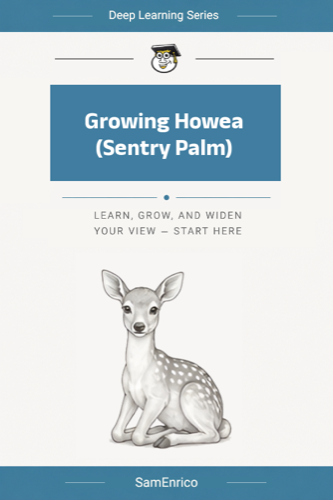
Non-FictionInformativeEducational
Growing Howea (Sentry Palm) eBook
This publication, published by SamEnrico, covers G
This publication, published by SamEnrico, covers Growing Howea (Sentry Palm)
Formats
Free sample
Chapter 1: The Island Garden...--The South Pacific, some 600 kilometers east of mainland Australia, exists a sliver of land so isolated that it developed its own rules of life. Lord Howe Island does not look like the birthplace of one of the world's most beloved houseplants. There are no factory greenhouses, no automated irrigation lines, no shipping containers labeled "Kentia Palm – Handle With Care." Instead, there is a crescent of volcanic rock, draped in subtropical rainforest, surrounded by the world's southernmost coral reef, and inhabited by just 350 permanent residents who share their home with more than 1,500 species of native flora and fauna found nowhere else on Earth. This is where the Sentry Palm began its story, and unless you understand this place, you will never truly understand the plant sitting in your living room.Most houseplant guides skip this part. They jump straight to watering schedules and fertilizer ratios, treating the Howea as if it were manufactured in a plastic pot rather than carved by millions of years of evolutionary pressure.
This is a mistake. The secrets of keeping a Sentry Palm healthy indoors are written in the volcanic soils, the coral sands, the trade winds, and the peculiar absence of large mammals on this tiny island. If you want to know why your palm is turning yellow, why it refuses to grow, or why it suddenly collapsed despite your best intentions, the answers lie not in a troubleshooting chart but in the ecology of a place you have likely never heard of.So close your eyes for a moment and imagine an island where palm trees outnumber people a thousand to one. Where the only native land mammal is a bat. Where seeds fall to the forest floor and germinate in deep shade, protected from predators that exist elsewhere.
This is the world that shaped the Howea, and once you see it, you will never look at your potted palm the same way again.A Lost World in the Tasman Sea Lord Howe Island was discovered accidentally in 1788 by Lieutenant Henry Lidgbird Ball, commander of HMS Supply, who was transporting convicts from Botany Bay to Norfolk Island. A storm pushed his ship off course, and through the rain, he saw a mountainous island rising from the sea. He named it after Richard Howe, First Earl of Howe, then Treasurer of the British Royal Navy. For the next several decades, the island served as an occasional stopping point for whalers and supply ships, but no permanent settlement took root until 1834. Even today, the island feels like a secret—a place that time forgot and development never reached.Geologically, the island is young and violent.
It emerged from the ocean approximately 6.5 million years ago, the product of volcanic eruptions along a nascent underwater ridge. Two massive shield volcanoes built the island's backbone: Mount Gower and Mount Lidgbird, which rise nearly 900 meters straight from the sea. Their dark basalt cliffs are so steep that they catch clouds, wringing moisture from the prevailing trade winds. The island receives between 1,600 and 1,800 millimeters of rain annually, spread relatively evenly throughout the year, with a slight winter peak. Temperatures rarely drop below 55°F (13°C) or exceed 80°F (27°C)—a remarkably stable climate by global standards.But the most unusual feature of Lord Howe Island is not its geology or climate.
It is the complete absence of several categories of ecological pressure that dominate continental ecosystems. There are no native grazing animals—no kangaroos, no wallabies, no deer, no cattle. There are no native ground-dwelling predators. The only native mammal is the Lord Howe Island flying fox (Pteropus howensis), a fruit bat that feeds on nectar and fruit high in the canopy, rarely touching the forest floor. This means that for millions of years, the seeds of the Howea palm fell to the ground and remained undisturbed.
No rodents dug them up. No pigs rooted through the leaf litter. No insects had evolved the specific digestive enzymes required to penetrate the tough, fibrous outer husk of a Howea seed.This is the single most important fact you will learn about the Sentry Palm, and it explains almost everything about its behavior in your home. The Howea evolved in an environment where its seeds were never under significant predation pressure. As a result, it never developed aggressive chemical defenses (thorns, toxins, unpalatable resins) that characterize many other palms.
It is, in the most literal sense, a gentle plant—unarmed, chemically mild, and evolutionarily naive to the pests and diseases that would later attack it when humans began moving it around the world.The Two Sentinels Before you can successfully grow a Sentry Palm, you must know which species you actually own. This is not merely botanical pedantry. The two species of Howea behave differently, respond differently to soil conditions, and come from different parts of Lord Howe Island. Confusing them has killed more palms than any disease.The genus Howea contains exactly two species. That's it.
There are no subspecies, no varieties, no hybrids recognized in botanical literature. Two species, endemic to one island, nowhere else.Howea forsteriana—known commonly as the Kentia Palm, Sentry Palm, or Paradise Palm—is the one you almost certainly own. It accounts for approximately 95% of the global houseplant trade. This species grows primarily on the lowland calcareous soils of Lord Howe Island, which are derived from decomposed coral and shell deposits. These soils are alkaline, rich in calcium and magnesium, and extremely well-draining.
The lowland forests where H. forsteriana dominates are relatively open, allowing dappled sunlight to reach the forest floor. Consequently, H. forsteriana is more tolerant of bright light than its cousin, though it still prefers indirect exposure.Visually, H. forsteriana produces a straight, unbuttressed trunk that can reach 15 meters in the wild, though indoor specimens rarely exceed 3 meters.
The fronds are long and gracefully arching, with leaflets that droop downward in a relaxed, weeping habit. The overall silhouette is feathery and elegant—what most people imagine when they hear "palm tree." Leaflets are dark green on top, slightly paler beneath, and grow to about 10-15 inches in length. The trunk is covered in persistent leaf bases that create a distinctive woven or "hessian" texture, which many growers mistakenly try to peel off (do not do this; those old leaf bases protect the trunk).Howea belmoreana—the Belmore Sentry Palm or Curly Palm—is the rarer species, seldom seen outside botanical gardens and serious collector greenhouses. It grows on the volcanic soils of the island's upper slopes, specifically on the weathered basalt of Mount Gower and Mount Lidgbird. These soils are acidic, iron-rich, and significantly less fertile than the lowland calcareous sands.
H. belmoreana therefore has lower nutrient requirements and is more sensitive to alkaline conditions. If you plant it in calcareous soil or water it with hard tap water containing high calcium, it will develop chlorosis (yellowing between leaf veins) and slowly decline.Visually, H. belmoreana is distinct. The trunk is slightly curved rather than perfectly straight, and the fronds have a distinctive upright, "curly" appearance because the leaflets are arranged in a more vertical plane.
The fronds do not droop as dramatically as those of H. forsteriana. Instead, they arch upward before cascading, creating a…
This is the end of the free sample. Get the eBook to keep going. Buy now
About this book
Details
- Author
- Parkinson Mathilde
- Publisher
- SamEnrico
- Language
- English
- Genre
- Non-Fiction, Informative, Educational
- Released
- 2026-05-06
- Pages (approx.)
- 148
- Available as
- eBook, Audiobook

Read better in the ZLOADR app
Your eBooks on your phone or tablet. Sign in with your SamEnrico account and start reading.
More by Parkinson Mathilde
 Stress Management Blended FamiliesParkinson Mathilde$11.99
 The Request RejectionParkinson Mathilde$11.99
 Forgiveness Breath MeditationParkinson Mathilde$11.99
 Listening In Project ManagementParkinson Mathilde$11.99
 Dream Character JournalParkinson Mathilde$11.99
 Savoring Technique Mastery GuideParkinson Mathilde$11.99
 CBT in Low Resource SettingsParkinson Mathilde$11.99
 The Quilt of NamesParkinson Mathilde$11.99
 Babe Ruth CalledParkinson Mathilde$11.99
 The Pharaoh's Shadow: How a Forgotten Heist Rocked EgyptologyParkinson Mathilde$11.99
 The Admiral Who Defied the Tides: Togo Heihachiro and the Battle of TsushimaParkinson Mathilde$11.99
 Iron Veins: The Unseen Foundations of Manhattan’s SkylineParkinson Mathilde$11.99
You may also like
 Hong Kong Handover 1997Dunn Johnnie$11.99
 Zumba For Postnatal Recovery CourseNeal Christian$11.99
 Zumba for BeginnersLadner Nikia$11.99
 YouTube Comment Mining GuideHumes Pandora$12.99
 Worry Box MeditationCarlin Rudy$11.99
 Workplace Stress MeditationNguyen Lynn$11.99
 Workplace Stress and Sleep RepairHawley Ivory$11.99
 Workplace Perfectionism CureDelaney Jeffry$11.99
 Workplace Injustice Anger GuideWallen Isabelle$11.99
 Work Addiction and Burnout LinkGreenwood Ester$11.99
 Women in Yoga and WellnessBeattie Galina$11.99
 Women in Stand Up ComedyChun Evangeline$11.99