
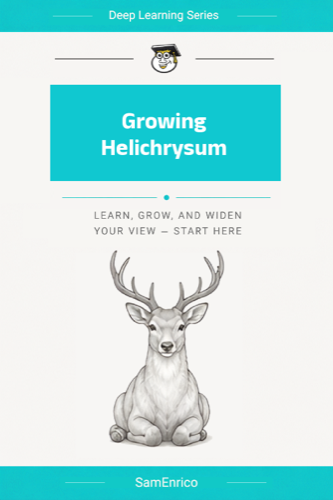
Non-FictionInformativeEducational
Growing Helichrysum eBook
This publication, published by SamEnrico, covers G
by Lively Cammy
This publication, published by SamEnrico, covers Growing Helichrysum
Formats
Free sample
Chapter 1: The Immortal Plant...--–- Imagine a flower that laughs at time. Cut it at its peak, hang it in a dark closet, and forget about it for three years. When you finally remember, the flower still holds its color—maybe a shade paler, but unmistakably vibrant. The papery petals crackle when touched, but they do not crumble. The stem bends but does not break.
Place it in a vase, and your guests will ask if you grew it that morning. This is not fantasy. This is Helichrysum, the genus of “everlasting” flowers that have been cultivated for millennia because they refuse to behave like normal plants.Why would any gardener dedicate space, water, and time to a flower that most people have never heard of? The answer lies in three extraordinary gifts that Helichrysum offers, gifts that no other single genus provides with such generosity.First, Helichrysum produces flowers that can be dried and displayed for years without losing their essential beauty. The commercial cut flower industry operates on a clock measured in days.
A rose lasts a week. A hydrangea might hold for two. A strawflower—one member of the Helichrysum genus—can hang on a wreath for five years and still draw compliments. For home gardeners who love fresh flowers but hate watching them wilt, this is revolutionary. For crafters and small business owners, it is even more: dried Helichrysum flowers are inventory that does not expire.Second, Helichrysum italicum produces an essential oil that ranks among the most valuable in the world.
A single ounce of high-quality immortelle oil—the perfumer’s name for H. italicum—often sells for fifty to one hundred dollars. That is more than jasmine absolute, more than rose otto, more than almost any oil a home grower can produce. The oil contains rare compounds like nerolidol and curcumenone, which have demonstrated remarkable anti-inflammatory and skin-regenerating properties. Burn yourself in the kitchen?
A drop of Helichrysum oil on the site can reduce blistering and speed healing. Have a scar that refuses to fade? Regular application of diluted immortelle oil can soften and lighten it over time. These are not fanciful claims from internet forums. They are documented in peer-reviewed research and centuries of folk tradition.Third, Helichrysum thrives on neglect.
In an era of climate change, water restrictions, and busy schedules, this is no small thing. These plants evolved in some of the harshest environments on Earth—the rocky limestone slopes of the Mediterranean, the dry coastal dunes of Australia, the sandy fynbos of South Africa. They do not want your rich compost, your daily watering, or your fussing. They want full sun, sharp drainage, and to be left alone. Give them that, and they will produce more flowers and oil than you can use.
Pamper them, and they will reward you with floppy stems, fungal diseases, and disappointing harvests.This book exists because no single resource has ever brought together everything a modern grower needs to know about Helichrysum. The best-selling books on herb gardening cover it in a paragraph, if at all. Cut flower farming guides mention strawflowers in passing. Aromatherapy texts praise immortelle oil but never explain how to produce it from seed to bottle. Sam Enrico published this guide to fill that gap, drawing on the top ten books in each related field and synthesizing their core wisdom into a single, practical, actionable volume.By the time you finish this chapter, you will understand the botanical basics of Helichrysum, the key species you can grow, and the hardiness realities that will determine which plants can survive in your garden.
More importantly, you will see why this genus deserves a spot in your garden—whether you have a quarter-acre market farm, a suburban backyard, or a dozen pots on an apartment balcony.The Sun-Gold Flower: What Helichrysum Means The name Helichrysum comes from the ancient Greek words helios, meaning sun, and chrysos, meaning gold. Walk through a Mediterranean hillside in July, and you will understand why the plant earned this name. The button-like flower heads of Helichrysum italicum catch the midday light like scattered coins, glowing against dusty silver foliage. But the name also carries a deeper meaning. Gold does not tarnish.
Gold does not corrode. Gold endures. The same is true of Helichrysum flowers, which hold their form and color long after other blooms have turned to brown mush.Botanically, Helichrysum belongs to the Asteraceae family, the largest family of flowering plants on Earth, with over 32,000 species. This is the family of sunflowers, daisies, asters, and echinacea. What sets Helichrysum apart is the structure of its flower heads.
What we call a “flower” is actually a cluster of tiny individual flowers called disc florets, surrounded by petal-like structures called bracts. In most Asteraceae, these bracts are green and leaf-like. In Helichrysum, the bracts are brightly colored, stiff, and papery. More importantly, they are designed to dry in place. When the plant is cut and hung upside down, the bracts lose moisture but not structure.
They lock into place, preserving the flower’s appearance for years.The genus Helichrysum includes over 500 recognized species, distributed across Africa, Madagascar, Australia, and Eurasia. But for the home gardener, small farmer, or herbalist, only three species truly matter. Each serves a distinct purpose, and each has different requirements. Choosing the wrong one for your goal is like buying a chainsaw to slice bread—you might eventually get the job done, but the process will be frustrating and the results disappointing.The Three Essential Species Let me introduce you to the three Helichrysum species that you will actually grow. I will give you their botanical names, their common names, their native homes, and—most importantly—what they are good for.Helichrysum italicum: The Curry Plant and Medicinal Gold If you brush against Helichrysum italicum on a warm afternoon, your fingers will come away smelling of curry.
Not the sharp, powdered curry of a spice jar, but a softer, herbaceous version—curry leaves simmering in olive oil, with undertones of honey and pine. This scent comes from a complex essential oil stored in tiny glandular hairs covering the leaves and flower bracts. When you crush the plant, those hairs release their contents into the air. That is your first clue that H. italicum is different from its cousins.
It is not grown primarily for its visual display, though the clusters of small yellow button flowers are charming in their own modest way. It is grown for what lives inside those glandular hairs.This species is a perennial subshrub in its native habitat, meaning it develops woody stems at the base and soft, herbaceous growth at the tips. It grows wild across the Mediterranean basin—Spain, France, Italy, Croatia, Greece, Turkey, and North Africa. In the wild, it scrambles over limestone rocks and through low scrub, never reaching more than twenty-four inches in height. The leaves are narrow, silver-gray, and covered in fine hairs that reflect sunlight and reduce water loss.
The flowers appear in early summer as small yellow clusters, each individual bloom no larger than a pea, but together forming dense corymbs that bees adore.Why does this species command such attention from herbalists…
This is the end of the free sample. Get the eBook to keep going. Buy now
About this book
Details
- Author
- Lively Cammy
- Publisher
- SamEnrico
- Language
- English
- Genre
- Non-Fiction, Informative, Educational
- Released
- 2026-05-06
- Pages (approx.)
- 152
- Available as
- eBook, Audiobook

Read better in the ZLOADR app
Your eBooks on your phone or tablet. Sign in with your SamEnrico account and start reading.
More by Lively Cammy
 Pomodoro Distraction Control CourseLively Cammy$11.99
 Zumba International StylesLively Cammy$11.99
 The Cleaning Crew SurvivorLively Cammy$11.99
 Conversation Starters for Multiracial FamiliesLively Cammy$11.99
 Graduate Exam PrepLively Cammy$11.99
 Child Death And SexualityLively Cammy$11.99
 Garmin Smartwatch RemindersLively Cammy$11.99
 Bipolar Personality IntegrationLively Cammy$11.99
 Workplace EQ Assessment GuideLively Cammy$11.99
 The Medici Dynasty: Banking, Art, and the Birth of the RenaissanceLively Cammy$11.99
 The Last Broadcast: The Mysterious Vanishing of Flight MH370Lively Cammy$11.99
 Shadows of the Reconquista: The Last Moorish Stand at GranadaLively Cammy$11.99
You may also like
 Hong Kong Handover 1997Dunn Johnnie$11.99
 Zumba For Postnatal Recovery CourseNeal Christian$11.99
 Zumba for BeginnersLadner Nikia$11.99
 YouTube Comment Mining GuideHumes Pandora$12.99
 Worry Box MeditationCarlin Rudy$11.99
 Workplace Stress MeditationNguyen Lynn$11.99
 Workplace Stress and Sleep RepairHawley Ivory$11.99
 Workplace Perfectionism CureDelaney Jeffry$11.99
 Workplace Injustice Anger GuideWallen Isabelle$11.99
 Work Addiction and Burnout LinkGreenwood Ester$11.99
 Women in Yoga and WellnessBeattie Galina$11.99
 Women in Stand Up ComedyChun Evangeline$11.99