
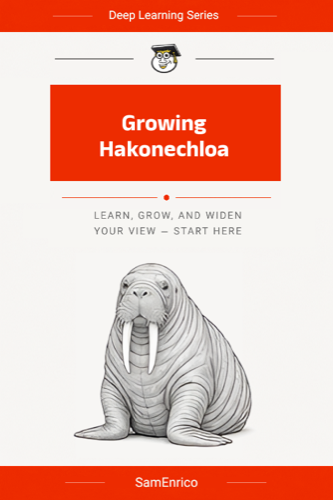
Growing Hakonechloa
This publication, published by SamEnrico, covers G
by Dobbs Eldon
This publication, published by SamEnrico, covers Growing Hakonechloa
Formats
About this book
Free sample
Chapter 1: The Dancing Grass--What if the most beautiful plant for your garden is the one you have been walking past in the nursery, dismissed as “just another ornamental grass”? That was my own mistake for nearly a decade. Every spring, I would push my cart past the rack of Hakonechloa, glance at its modest, fountain-like clumps, and think the same thing: “I don’t have room for another grass. And besides, grasses are for sunny borders, right?” I was wrong on both counts, and it took a chance purchase from a retiring master gardener to prove it. That first 'Aureola' – planted as an afterthought in a dark, forgotten corner beneath a maple tree – did something I had never seen a plant do.
On a still, humid July afternoon when every other leaf in my garden hung limp and lifeless, that grass began to move. Not because the wind had suddenly picked up, but because its leaves are attached to the stems at precisely the angle that catches the slightest breath of air. It rippled. It shimmered. It danced.
And in that moment, I understood why Hakonechloa is not just another grass. It is the grass for the places other plants fear to go, and it transforms those dark, forgotten spaces into theaters of movement and light.Why This Grass Breaks Every Rule Before we dig into planting depths or fertilizer schedules, you need to understand what makes Hakonechloa fundamentally different from every other ornamental grass in your garden. Most grasses – from the towering Miscanthus to the spiky Festuca – are sun worshippers. They demand eight or more hours of direct light to maintain their form, color, and structural integrity. Plant them in shade, and they flop, fade, and eventually disappear.
Hakonechloa does the opposite. It evolved on the forest floor of Mount Hakone, a volcanic mountain south of Tokyo, where the canopy of Japanese beech, maple, and hemlock blocks all but the gentlest morning light. This single species – Hakonechloa macra – adapted not by fighting for the sun, but by learning to thrive without it.That evolutionary history explains every quirk…
This is the end of the free sample. Get the eBook to keep going. Buy now
Contents
- Chapter 1
- Chapter 2
- Chapter 3
- Chapter 4
- Chapter 5
- Chapter 6
- Chapter 7
- Chapter 8
- Chapter 9
- Chapter 10
- Chapter 11
- Chapter 12
Details
- Author
- Dobbs Eldon
- Publisher
- SamEnrico
- Language
- English
- Genre
- Non-Fiction, Informative, Educational
- Released
- 2026-06-02
- Pages (approx.)
- 157
- Available as
- eBook, Audiobook

Read better in the ZLOADR app
Your eBooks on your phone or tablet. Sign in with your SamEnrico account and start reading.
More by Dobbs Eldon
 Napping for Chronic MigraineDobbs Eldon$11.99
 Small Talk for College Dorm LifeDobbs Eldon$11.99
 Boundary Setting For ImmigrantsDobbs Eldon$11.99
 iPhone Reminders GuideDobbs Eldon$11.99
 Bipolar Light Therapy GuideDobbs Eldon$11.99
 Zumba Party in PracticeDobbs Eldon$11.99
 Antidepressant Risks GuideDobbs Eldon$11.99
 Test Anxiety Memory FixDobbs Eldon$11.99
 Death Of Only ChildDobbs Eldon$11.99
 The Visionary Streets of L'Enfant: Designing a Capital for a NationDobbs Eldon$11.99
 The Last Broadcast: Y2K's Forgotten Radio WarDobbs Eldon$11.99
 The Last Stand of the Whale Wars: When Science Met JusticeDobbs Eldon$11.99