

Non-FictionInformativeEducational
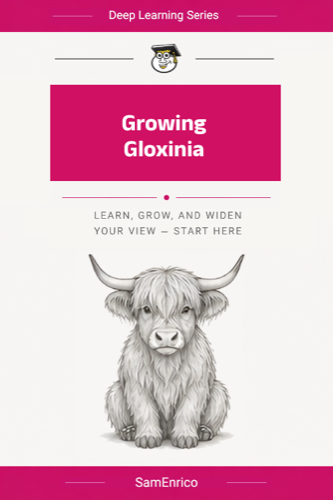
Growing Gloxinia eBook
This publication, published by SamEnrico, covers G
Be the first to reviewThis publication, published by SamEnrico, covers Growing Gloxinia
Formats
Free sample
Chapter 1: The Flower That Fooled You--I killed my first seven Gloxinias.There. I said it. The confession that would get me expelled from any respectable gardening society, whispered over coffee at plant swaps, the shameful secret buried beneath bags of expired potting soil. Seven beautiful, promising, velvety-leaved Gloxinias, each one purchased with hope and dispatched with remarkable efficiency. I watered them when they looked sad.
I put them in "bright light" (whatever that meant). I watched their leaves droop, then yellow, then crisp into brown-edged tragedies. And then—here is the real sin—I threw them away.Because they looked dead. Of course they looked dead. Any reasonable person would have pronounced them dead, performed last rites, and moved on to a nice, forgiving pothos.
But here is what no one told me, what no tag on a plastic pot from the garden center ever explains, what I had to learn through those seven corpses and one accidental resurrection:They weren't dead. They were resting.And that misunderstanding—that single, catastrophic confusion between death and dormancy—is responsible for more discarded Gloxinias than all the pests, diseases, and bad advice combined.This book exists because of that seventh Gloxinia. The one I forgot to throw away. The one I shoved to the back corner of a dark basement shelf, intending to deal with it "someday," and then discovered three months later looking like a shriveled, ugly potato in a pot of dust. I almost tossed it into the compost bin.
But something made me stop—guilt, maybe, or the stubborn hope that I hadn't wasted fifteen dollars for the seventh time. I gave it a splash of water. I put it under a grow light. And six weeks later, that ugly potato sprouted leaves like green fists punching toward the sun.Within four months, it produced thirty-two blooms. Thirty-two.
From a plant I had left for dead in a dark basement.I have been chasing that feeling ever since.This book is the result of that chase. It is not a dry botanical encyclopedia written by academics for academics. It is not a collection of pretty photographs with vague captions like "enjoys bright, indirect light." It is a practical, opinionated, experience-hardened guide to growing Gloxinia—Sinningia speciosa, if you want to get technical about it—written by someone who has killed every possible way and finally figured out what works.Here is what this chapter will teach you: the single biggest lie the plant industry tells you about Gloxinia, the three things you must unlearn from other houseplants, and a simple test to determine whether your Gloxinia is thriving, struggling, or just taking a nap. By the end of this chapter, you will understand why your past failures were not your fault—and why your next Gloxinia will be different.The Identity Crisis at the Heart of Everything Let us start with a confession that will annoy botanists and confuse everyone else.The plant you call Gloxinia is not actually a Gloxinia.I know. I am sorry.
But this matters, I promise, and understanding it will save you hours of confused internet searching and contradictory advice.The plant sold in every grocery store, big-box garden center, and nursery under the name "Gloxinia" is scientifically known as Sinningia speciosa. It was named Gloxinia by Victorian plant collectors who noticed a passing resemblance to a different genus, Gloxinia perennis, and decided that was close enough. The mistake stuck. For nearly two hundred years, the wrong name has been stamped on nursery tags, written into gardening books, and shouted across plant forums.True Gloxinia—Gloxinia perennis—is a completely different plant. It does not form a tuber.
It spreads by stolons like a strawberry. It requires consistently wet soil and never goes dormant. You have almost certainly never seen one unless you have visited a botanical garden or a specialty gesneriad collector's greenhouse. They are rare, fussy, and utterly unlike the plant on your windowsill.So why does this matter? Two reasons.First, because when you search for "Gloxinia care" online, you are wading through two centuries of mislabeled information.
Some advice applies to Sinningia speciosa. Some applies to Gloxinia perennis. Some is generic houseplant advice copied from one website to another without anyone actually growing the plant. By knowing the correct scientific name—Sinningia speciosa—you can find the specific, accurate information that applies to your plant.Second, because the name confusion hides the plant's true nature. Sinningia speciosa is a gesneriad, a family that includes African violets, Streptocarpus, and Episcia.
These plants share specific needs: high humidity, consistent moisture without sogginess, and a sensitivity to cold water on their leaves. If you have grown African violets successfully, you already know ninety percent of what you need to grow Gloxinia. If you have killed African violets, do not worry—I will teach you why, and it is probably the same reason you killed your Gloxinias.Throughout this book, I will use the name "Gloxinia" because that is what you search for, what you buy, and what you call it. But I will treat it like Sinningia speciosa, because that is what it actually is. Think of it as a polite fiction—a name we use for convenience while secretly knowing the truth.The Brazilian Cliff Dweller Understanding where your Gloxinia came from explains almost everything about why it behaves the way it does.Sinningia speciosa was discovered growing on rocky cliffs and outcroppings in southeastern Brazil, primarily in the states of Rio de Janeiro and Espírito Santo.
These are not lush, tropical rainforests with constant warmth and moisture. They are seasonal environments with a distinct wet season and dry season, dramatic temperature swings between day and night, and soil that is thin, rocky, and fast-draining.Picture a moss-covered boulder on a Brazilian mountainside. During the wet season, torrential rains soak the rock, water trickles through cracks and crevices, and Sinningia speciosa sprouts from its tuber, grows leaves, and produces spectacular blooms. During the dry season, the rain stops. The leaves yellow and die.
The plant retreats entirely into its tuber, waiting underground—sometimes for months—for the next wet season to begin.This is the single most important fact about Gloxinia. It is not a "tropical houseplant" in the way Monstera or Philodendron are. It is a geophyte—a plant that survives adverse conditions through an underground storage organ. Its natural cycle is not constant growth. It is growth, bloom, dormancy, regrowth.
Year after year, season after season, completely indifferent to whether you want it to look pretty for your dinner party.When you buy a Gloxinia in full bloom from a grocery store, that plant has been forced out of its natural cycle by commercial growers. They have manipulated temperature, light, and fertilizer to produce flowers on demand, regardless of the season. The plant is essentially jet-lagged, confused, and running on artificial life support. No wonder it collapses two weeks after you bring it home.The secret—the entire point of this book—is learning to work with the plant's natural cycle instead of fighting it. You cannot force a Gloxinia to bloom year-round without eventually exhausting and killing it.
But you can learn to ride its rhythm: growth in spring, blooms in summer, rest in fall, dormancy in winter.…
This is the end of the free sample. Get the eBook to keep going. Buy now
About this book
Details
- Author
- Croteau Leatha
- Publisher
- SamEnrico
- Language
- English
- Genre
- Non-Fiction, Informative, Educational
- Released
- 2026-05-11
- Pages (approx.)
- 149
- Available as
- eBook, Audiobook
Reader reviews
No reviews yet — be the first to share what you thought.
Write a review
Reviews are from readers with a SamEnrico account. Please keep them about the book.
Sign in to write a review
Read better in the ZLOADR app
Your eBooks on your phone or tablet. Sign in with your SamEnrico account and start reading.
More by Croteau Leatha
 Post Crisis Opportunity GuideCroteau Leatha$11.99
 Parent Estrangement Grief GuideCroteau Leatha$11.99
 Rapid Cycling Management GuideCroteau Leatha$11.99
 The Bipolar Spectrum GuideCroteau Leatha$11.99
 The Nap Tracker WorkbookCroteau Leatha$11.99
 Global Team MeasurementCroteau Leatha$11.99
 Breath Awareness PainCroteau Leatha$11.99
 Physical Boundary SettingCroteau Leatha$11.99
 The Siege of Yarkot: The Han Dynasty's Desert Gambit (101 BC)Croteau Leatha$11.99
 The Gladiators' Roar: How Ancient Fans Turned Bloodsport into a Cultural PhenomenonCroteau Leatha$11.99
 The Comeback Kid: How a Teen Hacker Took Down a DictatorCroteau Leatha$11.99
 Sustainable Business PracticesCroteau Leatha$11.99
You may also like
 Hong Kong Handover 1997Dunn Johnnie$11.99
 Zumba For Postnatal Recovery CourseNeal Christian$11.99
 Zumba for BeginnersLadner Nikia$11.99
 YouTube Comment Mining GuideHumes Pandora$12.99
 Worry Box MeditationCarlin Rudy$11.99
 Workplace Stress MeditationNguyen Lynn$11.99
 Workplace Stress and Sleep RepairHawley Ivory$11.99
 Workplace Perfectionism CureDelaney Jeffry$11.99
 Workplace Injustice Anger GuideWallen Isabelle$11.99
 Work Addiction and Burnout LinkGreenwood Ester$11.99
 Women in Yoga and WellnessBeattie Galina$11.99
 Women in Stand Up ComedyChun Evangeline$11.99