
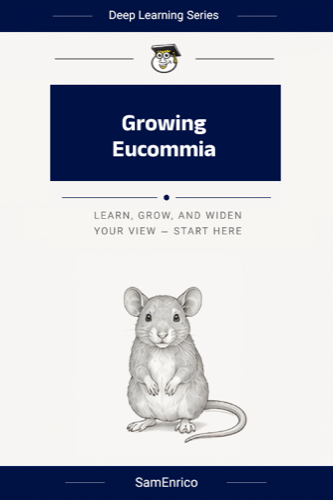
Non-FictionInformativeEducational
Growing Eucommia eBook
This publication, published by SamEnrico, covers G
This publication, published by SamEnrico, covers Growing Eucommia
Formats
Free sample
Chapter 1: The Frozen Tear...-- In the winter of 2013, I stood shivering in an abandoned corner of the Holden Arboretum in Kirtland, Ohio, staring at a tree that should have been dead. The temperature had dropped to minus seventeen degrees Celsius overnight. Every maple, oak, and birch in sight had surrendered to the cold, their branches bare and brittle. But this tree—unremarkable in summer, easy to overlook among showier specimens—held a secret that would alter the trajectory of my life. Someone had carved a small V-shaped wound into its bark months earlier, perhaps as a demonstration for a botany class.
And there, frozen solid yet perfectly intact, was a tear of rubber. It was rigid to the touch. I expected it to shatter like glass when I pressed my fingernail into it. It didn't. It bent.
In minus seventeen degrees Celsius, that tiny bead of latex flexed like warm taffy.That moment changed everything I thought I knew about plants, about resilience, and about the future of rubber. I had spent the previous decade as a hobbyist gardener, growing the usual suspects: tomatoes that blighted, apples that coddled moths, and peppers that demanded more heat than my Ohio summers could provide. I was good at killing plants, not growing them. But this tree was different. This tree had survived the ice age that wiped out its North American relatives.
This tree had been cultivated for two thousand years in the mountains of central China. This tree produced a kind of rubber that did not melt, did not freeze brittle, and did not require a tropical rainforest to thrive. And yet, almost no one in the Western world knew it existed.The tree was Eucommia ulmoides. The rubber was gutta-percha. And the question that consumed me for the next decade was simple: why is this not growing in every temperate backyard, homestead, and food forest from Vermont to Vancouver?This chapter answers that question by introducing you to the living fossil that you are about to grow.
We will explore what Eucommia is and—equally important—what it is not. We will distinguish its unique rubber from the Amazonian latex that dominates global markets. We will uncover its status as the sole surviving species of an ancient lineage. And we will grapple with the horticultural reality of its dioecious nature: the fact that sex matters when you are growing for seed or medicine, and that you cannot reliably tell male from female until years after planting. By the end of this chapter, you will understand why Eucommia is not just another ornamental tree but a strategic resource hiding in plain sight.
You will also understand why patience—more than passion—will be your most important tool.The Rubber That Does Not Melt To understand Eucommia, you must first unlearn almost everything you know about rubber. When most people hear the word "rubber," they picture the elastic, stretchy material of car tires, rubber bands, and shoe soles. That material is natural rubber from the Amazonian tree Hevea brasiliensis, vulcanized with sulfur to make it elastic and durable. Vulcanized rubber stretches, snaps back, and withstands abrasion. It is a remarkable material, but it has critical weaknesses.
It melts under high heat. It freezes stiff in extreme cold. And it absolutely requires a tropical climate to produce.Eucommia produces something entirely different: a thermoplastic rubber called gutta-percha. The name comes from the Malay words getah (latex) and percha (the tree species that first supplied it to European markets in the nineteenth century, Palaquium gutta, a different plant entirely). Chemically, gutta-percha is a trans-1,4-polyisoprene, while Hevea rubber is a cis-1,4-polyisoprene.
That single letter difference—trans versus cis—changes everything about how the molecules arrange themselves. Cis polymers coil and kink, creating the elasticity we associate with rubber bands. Trans polymers line up in straight, crystalline chains, creating a material that is rigid at room temperature but softens when heated.This is not a minor academic distinction. It is the functional difference that made gutta-percha the wonder material of the Victorian era. In 1847, the gutta-percha telegraph cable laid across the English Channel revolutionized communication.
Unlike rubber, which degraded in saltwater and lost insulation properties when wet, gutta-percha was impervious to seawater, resistant to marine borers, and remained stable for decades underwater. By the 1860s, gutta-percha insulated the first transatlantic telegraph cable, allowing messages to pass between continents in minutes rather than weeks. The material also found its way into golf ball covers (it gave the original gutta-percha ball its distinctive dimpled flight), dental fillings (it is still used today in root canal procedures), tool handles, furniture inlays, and even jewelry.But the industrial revolution eventually moved on. Synthetic polymers—plastics—replaced gutta-percha for most applications. Hevea rubber, grown on vast plantations in Southeast Asia, became cheaper and more versatile for tires and mechanical goods.
Gutta-percha production from Palaquium trees declined, and Eucommia, which had never been more than a regional source of gutta-percha in China, faded into obscurity outside of Traditional Chinese Medicine.Now, in the twenty-first century, gutta-percha is poised for a comeback—and Eucommia is the vehicle. Why? Because Hevea rubber is in trouble. Leaf blight disease (Microcyclus ulei, also known as South American leaf blight) has destroyed plantations in its native Amazon and threatens Southeast Asian production. Climate change is pushing optimal Hevea growing zones poleward, but rubber plantations are trapped in place, losing productivity as temperatures rise and rainfall patterns shift.
And perhaps most relevant for the home grower: Hevea requires a tropical climate with no frost, high humidity, and consistent rainfall. You cannot grow Hevea in Ohio. You cannot grow it in Ontario, France, Germany, or northern Japan. But you can grow Eucommia.Eucommia rubber—gutta-percha—has unique properties that modern materials science is rediscovering. It is a thermoplastic, meaning it can be melted and reshaped multiple times without losing integrity.
It has shape memory: if you heat a piece of gutta-percha, mold it, and cool it, it will return to that shape every time you reheat it. It is an electrical insulator, a moisture barrier, and a dielectric material. Dental surgeons still use gutta-percha for root canal fillings because it is biocompatible, non-toxic, and expands slightly to seal the tooth canal. Golf club manufacturers are experimenting with gutta-percha for vibration-damping inserts. And for the home grower, the appeal is simpler: you can tap your own tree for a hundred grams of latex per year, enough to waterproof a jacket, mold a custom tool handle, or experiment with small-scale rubber casting.But let me be honest with you from the start: Eucommia will never replace Hevea for commodity rubber production.
The yields are too low, the growth rate too moderate, and the processing requirements too specialized. If you are dreaming of a backyard rubber plantation that will make you wealthy, adjust your expectations. What Eucommia offers is not riches but resilience: the ability to produce your own latex, your own medicine, and your own timber from a single species that asks for almost nothing in return. And as we established in the Introduction, this tree grows at a moderate rate of thirty to sixty centimeters per year—not…
This is the end of the free sample. Get the eBook to keep going. Buy now
About this book
Details
- Author
- Meredith Shirly
- Publisher
- SamEnrico
- Language
- English
- Genre
- Non-Fiction, Informative, Educational
- Released
- 2026-05-07
- Pages (approx.)
- 142
- Available as
- eBook, Audiobook

Read better in the ZLOADR app
Your eBooks on your phone or tablet. Sign in with your SamEnrico account and start reading.
More by Meredith Shirly
 Passive Aggressive Stress ResponseMeredith Shirly$11.99
 Tumblr Aesthetic Comparison GuideMeredith Shirly$11.99
 Sleep Apnea in Men HandbookMeredith Shirly$11.99
 Jet Lag Reset Meditation GuideMeredith Shirly$11.99
 Financial Stress InsomniaMeredith Shirly$11.99
 TM for Irritable Bowel SyndromeMeredith Shirly$11.99
 Vietnam Remote Tax GuideMeredith Shirly$11.99
 Pomodoro Timer AppsMeredith Shirly$11.99
 Memory Loci for SeniorsMeredith Shirly$11.99
 The Medici Bank: Financing the RenaissanceMeredith Shirly$11.99
 The Puzzle of the Missing Million: The Great Pi Digit HeistMeredith Shirly$11.99
 The Blackout: When the Lights Went Out in New YorkMeredith Shirly$11.99
You may also like
 Hong Kong Handover 1997Dunn Johnnie$11.99
 Zumba For Postnatal Recovery CourseNeal Christian$11.99
 Zumba for BeginnersLadner Nikia$11.99
 YouTube Comment Mining GuideHumes Pandora$12.99
 Worry Box MeditationCarlin Rudy$11.99
 Workplace Stress MeditationNguyen Lynn$11.99
 Workplace Stress and Sleep RepairHawley Ivory$11.99
 Workplace Perfectionism CureDelaney Jeffry$11.99
 Workplace Injustice Anger GuideWallen Isabelle$11.99
 Work Addiction and Burnout LinkGreenwood Ester$11.99
 Women in Yoga and WellnessBeattie Galina$11.99
 Women in Stand Up ComedyChun Evangeline$11.99