
Non-FictionInformativeEducational
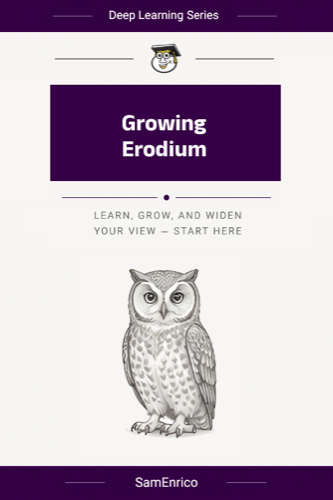
Growing Erodium eBook
This publication, published by SamEnrico, covers G
by Dahl Hans
This publication, published by SamEnrico, covers Growing Erodium
Formats
Free sample
Chapter 1: Beyond Crane's Bill--–- In the world of hardy geraniums, there exists a quiet imposter. For decades, gardeners have admired the mounded foliage and delicate flowers of plants they believed to be cranesbills, only to discover that their toughest, most drought-resistant specimens belonged to an entirely different genus. This is the secret that rock garden enthusiasts have guarded for generations: the plant that thrives where geraniums wither, that blooms for months where pelargoniums sulk, and that sows itself with mechanical precision—this plant is not a geranium at all. It is an erodium.The confusion is understandable. Walk through any alpine garden or scan the catalog of a specialty nursery, and you will find Erodium listed alongside Geranium, their common names overlapping like tangled stems.
Both are members of the Geraniaceae family. Both produce five-petaled flowers in shades of pink, magenta, and white. Both have lobed or dissected leaves that form attractive mounds or mats. But beneath this superficial resemblance lies a world of difference—differences that determine not only how these plants are classified but how they must be grown, watered, and propagated.This chapter serves as your botanical passport to the genus Erodium. It will equip you with the knowledge to distinguish stork’s bill from crane’s bill at a glance, to understand the evolutionary genius behind the spiral awn, and to appreciate the geographic breadth of a genus that spans from the Mediterranean maquis to the Patagonian steppe.
By the time you finish these pages, you will never confuse an Erodium with a Geranium again. More importantly, you will understand why the distinctions matter—not as academic trivia, but as practical tools for growing these remarkable plants successfully.The Geraniaceae Family Tree: Three Branches, One Root The Geraniaceae family is a modest-sized clan of flowering plants, comprising approximately 800 species distributed across five to eight genera, depending on which botanist you consult. For the gardener, only three genera matter: Geranium, Pelargonium, and Erodium. Each occupies a distinct ecological niche and requires different cultivation strategies.Geranium (the true crane’s bill) is the largest genus in the family, with roughly 430 species distributed across the temperate zones of every continent except Antarctica. From the woodlands of eastern North America to the meadows of the European Alps, Geraniums are familiar sights.
Their flowers are actinomorphic—radially symmetrical, like a perfect star. You can draw a line through the center of a Geranium flower in any direction, and the two halves will mirror each other. Each flower produces ten fertile stamens, and the fruit—the “crane’s bill”—is relatively short and thick. Geraniums are, with few exceptions, hardy perennials that prefer consistent moisture, rich soil, and partial shade. They are the shade gardeners’ workhorses, not the sun-baked warriors of the rock garden.Pelargonium is the second-largest genus, with approximately 280 species, almost all native to southern Africa.
The flowers of Pelargonium are zygomorphic—bilaterally symmetrical, like a human face. There is only one line of symmetry, running down the middle of the flower, dividing it into a mirror-image left and right. The upper petals are typically different in size and shape from the lower petals, giving the flower a distinctive “face.” Pelargoniums have seven fertile stamens (or fewer in some species) and produce fruit that lacks the elongated beak of its relatives. Most Pelargoniums are tender perennials that cannot tolerate frost. They demand rich, well-drained soil and consistent moisture, and they reward gardeners with spectacular blooms from spring through autumn.
The common “geraniums” of garden centers—the zonal, ivy-leaved, and regal pelargoniums—all belong here.Erodium, the focus of this book, occupies an intermediate position in both form and function. Like Pelargonium, Erodium flowers are zygomorphic, with bilateral symmetry and distinct upper and lower petals. But unlike Pelargonium, Erodium has exactly five fertile stamens, complemented by five staminodes—sterile stamens that often function as nectar guides or pollinator attractants. This five-plus-five arrangement is a reliable diagnostic feature. The fruit of Erodium is the longest and most slender in the family, giving rise to the common names “stork’s bill” (for larger species) and “heron’s bill” (for smaller species).
And while Erodium includes both hardy and tender species, the genus as a whole is defined by its preference for sharp drainage, full sun, and the dry summers of its Mediterranean and alpine homelands.Why does this taxonomy matter? Because the distinctions predict behavior. A Geranium planted in a sunny, dry rock garden will languish. An Erodium planted in a shady, moist woodland border will rot. A Pelargonium left outdoors through a hard freeze will die.
But an Erodium planted in a crevice between sun-baked stones, with water draining away instantly, will thrive and bloom for months. Taxonomy is not an end in itself; it is a tool for successful cultivation.Field Identification: Telling Them Apart at a Glance In the garden, you will not have a botanical key or a hand lens at every moment. Fortunately, telling Erodium from its relatives is straightforward once you know what to look for.First, examine the flower symmetry. Stand above the flower and look down. If the flower looks like a perfect star, with all petals the same size and shape radiating from the center, you are looking at a Geranium.
If the flower has a distinct “upper lip” of two petals and a “lower lip” of three petals, with the upper petals often larger or differently colored, you are looking at either a Pelargonium or an Erodium. This bilateral symmetry is the first clue that you are not dealing with a true crane’s bill.Second, look at the stamens—if you can. This requires a hand lens or a macro lens on a camera. Pelargoniums typically have seven fertile stamens arranged in a ring around the ovary. Erodiums have exactly five fertile stamens, and they are usually alternating with five staminodes—sterile structures that look like small, flattened petals or tongue-like appendages.
If you see five stamens and five staminodes, you have an Erodium. If you see seven stamens and no obvious staminodes, you have a Pelargonium.Third, examine the fruit. After the flowers fade, the developing fruit provides the most reliable field mark. Geraniums produce a short, thick fruit (1–2 centimeters) that resembles a crane’s beak—hence the common name. Pelargoniums, especially the common garden hybrids, are often sterile and produce no fruit at all; when fruit is present, it lacks the elongated beak.
Erodiums produce a long, slender fruit (2–10 centimeters, depending on species) that tapers to a fine point. As the fruit matures, the five seeds inside become visible as bulges near the base, while the upper portion—the awn—remains slender and spiraled. When the seeds are ripe, the awns separate from the central column and curl dramatically, forming the tight spirals that are the genus’s signature.Fourth, assess the growth habit and growing conditions. Geraniums are generally upright or mounding plants with soft, green leaves that prefer rich soil and partial shade. Pelargoniums are often succulent-stemmed, with fragrant or velvety leaves, and they demand frost protection.
Erodiums are usually low-growing, mat-forming, or cushion-forming plants with tough, often gray or hairy leaves. They prefer full sun and…
This is the end of the free sample. Get the eBook to keep going. Buy now
About this book
Details
- Author
- Dahl Hans
- Publisher
- SamEnrico
- Language
- English
- Genre
- Non-Fiction, Informative, Educational
- Released
- 2026-06-02
- Pages (approx.)
- 140
- Available as
- eBook, Audiobook

Read better in the ZLOADR app
Your eBooks on your phone or tablet. Sign in with your SamEnrico account and start reading.
More by Dahl Hans
 Mindfulness Meditation for Test AnxietyDahl Hans$11.99
 Bipolar Online Community GuideDahl Hans$11.99
 Pinterest Perfection SyndromeDahl Hans$11.99
 Neuropathic Pain Cheat SheetDahl Hans$11.99
 Forgiveness Meditation for SleepDahl Hans$11.99
 High Achiever InsomniaDahl Hans$11.99
 Medical Drug Interactions LociDahl Hans$11.99
 Transcendental Meditation and the BrainDahl Hans$11.99
 Greece Remote Tax GuideDahl Hans$11.99
 The Golden Spike: How One Hammer Changed the WorldDahl Hans$11.99
 The Last Waltz: How a Forgotten Ballroom Saved a GenerationDahl Hans$11.99
 The Dream Team's Secret Weapon: How a Soviet Coach Shaped Olympic BasketballDahl Hans$11.99
You may also like
 Hong Kong Handover 1997Dunn Johnnie$11.99
 Zumba For Postnatal Recovery CourseNeal Christian$11.99
 Zumba for BeginnersLadner Nikia$11.99
 YouTube Comment Mining GuideHumes Pandora$12.99
 Worry Box MeditationCarlin Rudy$11.99
 Workplace Stress MeditationNguyen Lynn$11.99
 Workplace Stress and Sleep RepairHawley Ivory$11.99
 Workplace Perfectionism CureDelaney Jeffry$11.99
 Workplace Injustice Anger GuideWallen Isabelle$11.99
 Work Addiction and Burnout LinkGreenwood Ester$11.99
 Women in Yoga and WellnessBeattie Galina$11.99
 Women in Stand Up ComedyChun Evangeline$11.99