
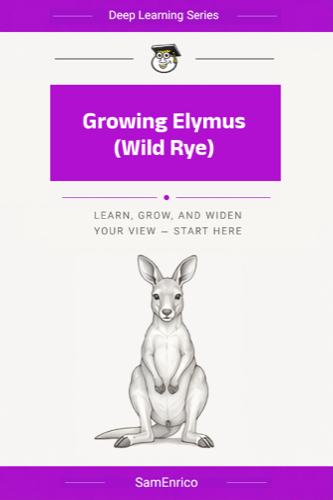
Non-FictionInformativeEducational
Growing Elymus (Wild Rye) eBook
This publication, published by SamEnrico, covers G
by Hawley Ara
This publication, published by SamEnrico, covers Growing Elymus (Wild Rye)
Formats
Free sample
Chapter 1: The Lawn Is a Lie--The summer my lawn died, I finally paid attention to the grass I had been ignoring for a decade.It was late July in the third year of a drought that had turned our suburban neighborhood into a patchwork of brown, crackling rectangles. My neighbors were running sprinklers at dawn and dusk, fighting a losing battle against water restrictions that grew stricter by the week. Their lawns looked like dying carpets—yellowing, thinning, pathetic. My own front yard, which I had dutifully watered, fertilized, and mowed every seven days like some sort of penitent monk, had given up entirely. The fescue had gone crispy.
The Kentucky bluegrass had retreated to scattered clumps of green surrounded by dust. Even the clover, which I had always considered unkillable, had thrown in the towel.But behind the garage, on a narrow strip of land between the fence and the compost bins, something else was happening. That strip was where I threw things I didn't want to deal with—old pots, broken bags of mulch, the lawn mower during winter. I had never planted anything there. I had never watered it.
I had certainly never fertilized it. And yet, standing tall and defiantly green in that forgotten wasteland, was a grass I didn't recognize.It was beautiful, in an unruly sort of way. It grew in elegant clumps, each one a fountain of blue-green blades that arched outward and then dropped gracefully at the tips. Rising from those clumps were seed heads unlike anything on my lawn: tall, nodding spikes that looked like wheat but wilder, each one adorned with long, bristly awns that caught the afternoon light and shimmered like whiskers. When the wind blew, the whole patch swayed together, a chorus line of dancers moving as one organism.I had no idea what it was.
I had certainly never planted it. And yet, there it was—thriving, seeding, spreading—while the grass I had poured hundreds of dollars and hours into was dead.That was the moment everything changed.The Expensive Lie We’ve Been Sold Let me tell you something that took me another five years to fully understand: the American lawn is a lie. It is one of the most successful marketing campaigns in human history, and we have all been paying for it—with our time, our money, our water, and our planet.Here is the truth that the lawn care industry does not want you to know. The grasses that make up nearly every suburban lawn in North America—tall fescue, Kentucky bluegrass, perennial ryegrass, fine fescue—are not native to this continent. They evolved in Europe.
In England. In the cool, moist meadows of the British Isles and the forests of Central Europe. They were brought here by colonists who wanted their new homes to feel like the old country, who wanted to recreate the manicured estates of the English gentry on a continent that had never asked for them.And for more than two centuries, we have been fighting a war against ecology to keep these foreign grasses alive in a landscape they were never designed for.Consider the numbers, because they are staggering. American homeowners spend an estimated $40 billion annually on lawn care. That is more than the GDP of nearly two dozen countries.
We consume 200 million gallons of gasoline each year just mowing—the equivalent of a small oil spill every single day. We pour 9 billion gallons of water onto our lawns every day, enough to cover the entire state of Rhode Island ankle-deep in a year. And we apply 70 million pounds of pesticides to those same lawns annually, chemicals that kill insects, birds, and soil life indiscriminately.For what? For grass that has to be reseeded every year? For grass that goes dormant the moment temperatures rise above 85 degrees?
For grass that provides zero habitat for wildlife, zero food for pollinators, zero carbon sequestration, zero erosion control? For grass that is, in ecological terms, a green desert?I am not saying this to make anyone feel guilty. I had the same lawn. I bought the same products. I believed the same lies because everyone around me believed them too.
The lie that a lawn is supposed to be a monoculture. The lie that dandelions and clover are "weeds" to be eradicated. The lie that a "good" lawn is short, uniform, and chemically maintained.But here is the liberating truth that I discovered behind my garage: there is another way. There is a grass that is native to this continent. A grass that evolved here, adapted here, and belongs here.
A grass that asks for almost nothing and gives almost everything. A grass that can hold soil, feed wildlife, produce grain, and look beautiful doing it.That grass is Elymus. Wild rye.What Is Elymus, Really?Let me introduce you properly to the plant that saved my sanity and changed my relationship with the land beneath my feet.Elymus is a genus of cool-season perennial grasses native to North America. It belongs to the grass family (Poaceae) and is closely related to wheat, barley, and rye—which is why its seed heads look familiar, like something you might see in a commercial grain field. But unlike those annual crops that have to be planted every year, wild rye is a perennial.
It comes back. Year after year. Without you doing anything.The genus includes somewhere between 50 and 150 species, depending on which botanist you ask. The taxonomy is messy because Elymus hybridizes freely with related genera, creating a web of genetic relationships that keeps plant taxonomists up at night. But for our purposes—for the purpose of growing it, using it, and loving it—we only need to focus on a handful of species that are widely available, well-studied, and adaptable to a range of conditions.Before I go further, let me address the name.
"Wild rye" is the common name for most Elymus species, and it is fitting because these grasses really do resemble cultivated rye (Secale cereale). But do not let the "rye" part confuse you. Wild rye is not the same as the annual ryegrass (Lolium multiflorum) that lawn care companies sell as a quick cover crop. That grass is European, short-lived, and often invasive. Wild rye is native, long-lived, and ecologically valuable.
The difference between them is the difference between a temporary visitor and a permanent resident.The other thing you need to know about Elymus is its photosynthetic strategy. Plants use one of two pathways to convert sunlight into energy: C3 or C4. Warm-season grasses like bermudagrass and crabgrass use C4, which is more efficient in hot conditions but shuts down in cool weather. Cool-season grasses like wild rye use C3, which is less efficient in extreme heat but allows them to grow vigorously in spring and fall, when C4 grasses are dormant.This is not just botanical trivia. This is the secret to wild rye's superpower.
While your lawn goes brown in July, wild rye is going to seed. While your warm-season prairie grasses are still waking up in April, wild rye is already knee-high and photosynthesizing. It fills the shoulder seasons, the gaps…
This is the end of the free sample. Get the eBook to keep going. Buy now
About this book
Details
- Author
- Hawley Ara
- Publisher
- SamEnrico
- Language
- English
- Genre
- Non-Fiction, Informative, Educational
- Released
- 2026-06-03
- Pages (approx.)
- 148
- Available as
- eBook, Audiobook

Read better in the ZLOADR app
Your eBooks on your phone or tablet. Sign in with your SamEnrico account and start reading.
More by Hawley Ara
 Mindfulness Meditation for Athletes GuideHawley Ara$11.99
 EQ For Police And First RespondersHawley Ara$11.99
 The Homesick Student GuideHawley Ara$11.99
 Drug Dependency FAQHawley Ara$11.99
 The Compact Loci MethodHawley Ara$11.99
 Child Nightmare Processing GuideHawley Ara$11.99
 Self Worth And Suicidal ThoughtsHawley Ara$11.99
 Palace for Names FacesHawley Ara$11.99
 Loving Kindness For FailureHawley Ara$11.99
 The Velvet Rebellion: How a Secret Society of Designers Toppled the Fashion EliteHawley Ara$11.99
 The Twitter Files: Secrets, Power, and the Battle for TruthHawley Ara$11.99
 The Art of the Steal: How a Billion-Dollar Heist Exposed the Dark Side of Fine ArtHawley Ara$11.99
You may also like
 Hong Kong Handover 1997Dunn Johnnie$11.99
 Zumba For Postnatal Recovery CourseNeal Christian$11.99
 Zumba for BeginnersLadner Nikia$11.99
 YouTube Comment Mining GuideHumes Pandora$12.99
 Worry Box MeditationCarlin Rudy$11.99
 Workplace Stress MeditationNguyen Lynn$11.99
 Workplace Stress and Sleep RepairHawley Ivory$11.99
 Workplace Perfectionism CureDelaney Jeffry$11.99
 Workplace Injustice Anger GuideWallen Isabelle$11.99
 Work Addiction and Burnout LinkGreenwood Ester$11.99
 Women in Yoga and WellnessBeattie Galina$11.99
 Women in Stand Up ComedyChun Evangeline$11.99