
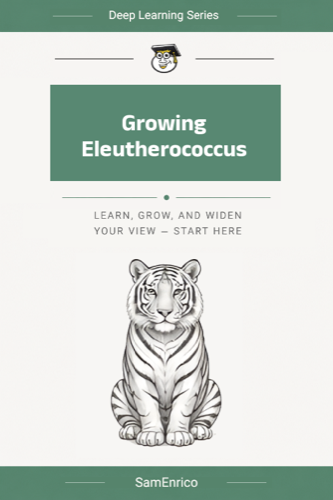
Non-FictionInformativeEducational
Growing Eleutherococcus eBook
This publication, published by SamEnrico, covers G
by Seward Daren
This publication, published by SamEnrico, covers Growing Eleutherococcus
Formats
Free sample
Chapter 1: The Undemanding Ally--–- On a chilly autumn morning in the Russian Far East, a botanist named I.I. Brekhman did something that would quietly change the way we think about stress, resilience, and the plants that grow at the edges of forests. He brewed a cup of tea from the roots of a thorny, unremarkable-looking shrub and drank it himself before giving any to the Soviet Olympic athletes under his care. That shrub was Eleutherococcus senticosus, and the tea he made was not a stimulant, not a sedative, not a drug in any conventional sense. It was something entirely different: an adaptogen.
Brekhman was not searching for a high or a cure for a specific disease. He was searching for something far more subtle and far more powerful: a plant that could help the human body adapt to stress without pushing it in any one direction.–- This book is about that plant. But before we dive into stratification protocols, soil p H, and harvest timing, we need to understand what Eleutherococcus actually is—and perhaps more importantly, what it is not. Walk into any herbal shop or browse any online supplement retailer, and you will find bottles labeled "Siberian Ginseng." The name is marketing genius. It is also botanically incorrect and potentially misleading.
Eleutherococcus is not a ginseng at all. True ginsengs belong to the genus Panax, a name derived from the Greek word for "all-healing." Panax species contain ginsenosides, a completely different class of compounds than the eleutherosides found in our subject. The confusion arose in the mid-twentieth century when Russian researchers, looking for affordable domestic alternatives to expensive imported Panax ginseng, discovered that this spiny shrub from the Araliaceae family—the same family that includes true ginseng, ivy, and devil's club—shared some remarkable properties. The name "Siberian Ginseng" stuck in the Western marketplace, but it has caused nothing but confusion ever since.–- So let us set the record straight from the very first page. Eleutherococcus senticosus is not a ginseng substitute.
It is not a poor man's Panax. It is not a knockoff or a second-tier herb. It is a distinct medicinal and ornamental plant with its own history, its own chemistry, and its own unique value. And unlike the slow-growing, shade-demanding, disease-prone Panax species that can take seven to ten years to reach harvestable size, Eleutherococcus asks almost nothing of the gardener who grows it. It tolerates poor soil, shrugs off drought, resists deer and most insects, survives winter temperatures as low as minus forty degrees Fahrenheit, and begins yielding useful material in just a few years.
This is the plant for people who want to grow their own adaptogenic medicine without devoting their lives to coddling fragile perennials.The Quiet History of a Remarkable Shrub–- To truly appreciate Eleutherococcus, we must travel back in time long before Brekhman and his Soviet athletes. The plant has been used in Traditional Chinese Medicine for millennia under the name Ci Wu Jia. The Chinese characters are instructive: Ci means thorn or spine, Wu means five, and Jia means ginseng or superior. So "spiny five-leaf ginseng"—a perfect botanical description that acknowledges both the plant's appearance and its value without confusing it with Panax. In the classical Chinese medical texts, Ci Wu Jia was prescribed for what traditional practitioners called "wind-damp" pain, a pattern associated with chronic joint discomfort that worsens in cold, wet weather.
It was also used to treat fatigue, weakness, and what we might today call burnout—a state of depleted vitality where the body simply cannot mount an adequate response to ordinary challenges.–- Korean herbalism knows the plant as Gaesip, and it appears in similar contexts: as a tonic for the elderly, a support for recovery from prolonged illness, and a general strengthener of what Korean medicine calls gi—the vital energy that animates the body. In Russia, long before the Soviet scientific establishment took notice, folk healers in Siberia and the Far East used the root to treat everything from colds to tuberculosis. They called it chertovy kusty (devil's bush) for its formidable thorns, but they valued it precisely because of its toughness. A plant that could survive the brutal Siberian winter, they reasoned, must have something to teach the human body about endurance.–- The modern era of Eleutherococcus research began in the 1950s, when the Soviet government funded a massive search for natural substances that could enhance the performance of workers, soldiers, and athletes. The Cold War was in full swing, and both superpowers were looking for an edge—chemical, technological, or biological.
The Soviets took a different approach from the Americans. Instead of developing synthetic stimulants (many of which would later be banned or found to have dangerous side effects), they turned to the vast pharmacopoeia of traditional herbal medicine. Brekhman, working at the Far Eastern Branch of the Soviet Academy of Sciences in Vladivostok, systematically screened hundreds of plants from the Siberian and Far Eastern flora. He was not looking for a quick energy boost. He was looking for something far more sophisticated: a substance that could increase the body's "non-specific resistance" to a wide range of stressors—heat, cold, fatigue, infection, radiation, and psychological pressure.–- This concept of non-specific resistance was Brekhman's great insight.
Most drugs and herbs have specific, directional effects. A stimulant pushes the nervous system toward arousal. A sedative pushes it toward calm. An antibiotic kills bacteria. These are useful tools, but they all share a limitation: they work only in one direction, against a specific problem.
Brekhman wanted something different. He wanted a substance that would push a stressed, depleted body toward normal function—and also push an under-stressed, sluggish body toward normal function. In other words, he wanted a normalizer, not a stimulant or a depressant. When he found that Eleutherococcus extracts could help exhausted athletes recover faster and help healthy workers maintain focus and help laboratory animals resist infections and help stressed rats maintain normal organ weights, he knew he had found something special. He coined the term "adaptogen" to describe this unique category of substances, and Eleutherococcus became the gold standard against which all other adaptogens would be measured.Defining the Genus: What Eleutherococcus Actually Is–- Before we go any further, let us get clear on the taxonomy.
The genus Eleutherococcus belongs to the family Araliaceae, which also includes Panax (true ginseng), Aralia (spikenard), and Oplopanax (devil's club). There are approximately forty species in the genus, distributed across East Asia from the Russian Far East through China, Korea, and Japan. The name itself is derived from Greek: eleutheros meaning "free" and kokkos meaning "berry" or "seed," referring to the fact that the fruits are not fully enclosed by the calyx. This is a botanical detail you will likely never need to remember, but it is included here for completeness.–- The species you are most likely to encounter, and the one this book focuses on primarily, is Eleutherococcus senticosus. The epithet senticosus means "thorny" or "full of brambles," and it is an accurate description.
The stems of young plants are armed with numerous slender, brittle spines that point downward. These spines are not as…
This is the end of the free sample. Get the eBook to keep going. Buy now
About this book
Details
- Author
- Seward Daren
- Publisher
- SamEnrico
- Language
- English
- Genre
- Non-Fiction, Informative, Educational
- Released
- 2026-06-02
- Pages (approx.)
- 137
- Available as
- eBook, Audiobook

Read better in the ZLOADR app
Your eBooks on your phone or tablet. Sign in with your SamEnrico account and start reading.
More by Seward Daren
 Peg System for Foreign ScriptsSeward Daren$11.99
 Sales EQ Influence HandbookSeward Daren$11.99
 The Military Student TransitionSeward Daren$11.99
 Palace for Grocery ListsSeward Daren$11.99
 Mindfulness Meditation for Depression WorkbookSeward Daren$11.99
 Drug Dependency HandbookSeward Daren$11.99
 Art Therapy for NightmaresSeward Daren$11.99
 Self Worth And HoardingSeward Daren$11.99
 Metta For ResistanceSeward Daren$11.99
 The Last Don: The Untold Fall of John Gotti's EmpireSeward Daren$11.99
 Napoleon's Gold: How Money Won the Peninsular WarSeward Daren$11.99
 Striking Back: The 2023 Hollywood Writers' StrikeSeward Daren$11.99
You may also like
 Hong Kong Handover 1997Dunn Johnnie$11.99
 Zumba For Postnatal Recovery CourseNeal Christian$11.99
 Zumba for BeginnersLadner Nikia$11.99
 YouTube Comment Mining GuideHumes Pandora$12.99
 Worry Box MeditationCarlin Rudy$11.99
 Workplace Stress MeditationNguyen Lynn$11.99
 Workplace Stress and Sleep RepairHawley Ivory$11.99
 Workplace Perfectionism CureDelaney Jeffry$11.99
 Workplace Injustice Anger GuideWallen Isabelle$11.99
 Work Addiction and Burnout LinkGreenwood Ester$11.99
 Women in Yoga and WellnessBeattie Galina$11.99
 Women in Stand Up ComedyChun Evangeline$11.99