
Non-FictionInformativeEducational
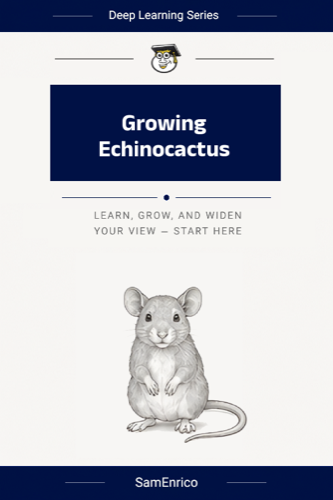
Growing Echinocactus eBook
This publication, published by SamEnrico, covers G
This publication, published by SamEnrico, covers Growing Echinocactus
Formats
Free sample
Chapter 1: The Golden Obsession--Before a single seed is sown or a single pot is filled, before you ever mix your first batch of gritty soil or position your first cactus on a south-facing windowsill, you must understand one fundamental truth: the Echinocactus you are about to grow is not a houseplant. It is not a low-maintenance desk accessory for someone who forgets to water. It is a living fossil, a botanical time capsule that has spent millions of years perfecting the art of survival in places where almost nothing else can live. The moment you recognize this distinction—the moment you stop thinking of your Golden Barrel as a plant and start thinking of it as a survivor—is the moment you stop killing cacti and start growing them.I learned this lesson the hard way, as most cactus enthusiasts do. My first Echinocactus was a beautiful four-inch Golden Barrel, purchased on a whim from a big box store.
It sat on my desk in a decorative pot with no drainage hole. I watered it a little every week, because that seemed like the right thing to do. It died in three months, turning into a soft, brown, foul-smelling mess that I was too embarrassed to show anyone. My second attempt fared better but still failed—I had learned about drainage by then, but I put the cactus in a dark corner of my living room because I thought it looked nice there. It stretched into a pale, skinny, monstrous shape that cactus collectors call etiolated and normal people call "that sad thing in the corner." My third attempt, however, survived.
Then it thrived. Then it flowered—fourteen years after I planted it from seed, on a freezing Michigan winter day, a ring of bright yellow blooms opened at its crown like a tiny desert sunrise. I cried. I am not embarrassed to admit that.That third cactus is still alive today, still sitting on the same south-facing windowsill, now a massive specimen nearly a foot in diameter with over two dozen ribs and spines so golden they seem to glow in the afternoon sun. It has outlived three apartments, two cities, one marriage, and more houseplants than I care to count.
It will likely outlive me. And that, right there, is the promise of Echinocactus: you are not buying a decoration. You are adopting a legacy.Welcome to Chapter One. Before we get into soil ratios and watering schedules and the precise angle of winter sunlight, we need to talk about what you are actually growing. We need to talk about the genus Echinocactus—where it comes from, why it looks the way it does, and why understanding its origins is the single most important factor in your success as a grower.The Desert Classroom Imagine a place where rain falls only a few times a year.
Where summer temperatures routinely exceed 100 degrees Fahrenheit during the day and drop below 50 degrees at night. Where the soil is so thin and rocky that most plants cannot anchor their roots. Where the sun beats down with an intensity that would kill an ordinary plant within hours. This is not a punishment from nature. This is home.The Echinocactus genus is native to the deserts of Mexico and the southwestern United States, with its greatest diversity found in the Chihuahuan Desert and the central highlands of Mexico.
These are not gentle places. The Chihuahuan Desert, which spans parts of Mexico, Texas, New Mexico, and Arizona, is the largest desert in North America. It receives an average of only eight to twelve inches of rainfall per year, much of which comes in sudden, violent thunderstorms that dump weeks' worth of water in a single afternoon. Between these storms, there may be months of absolute drought.The plants that live here have only two options: adapt or die. Most plants chose death.
Echinocactus chose adaptation.The name Echinocactus comes from the Greek words "echinos," meaning hedgehog or sea urchin, and "kaktos," a word that originally referred to a spiny plant. It is a fitting name. Mature Echinocactus specimens are round, heavily spined, and entirely unapproachable to anything that might consider taking a bite. But the spines are not just for defense. They also create shade, trapping a thin layer of cool air against the plant's skin.
They reduce airflow, which minimizes water loss through evaporation. They collect dew and funnel it down toward the roots. Every spine is a multi-tool of survival, engineered by millions of years of evolution to do a dozen different jobs.The body of the plant, hidden beneath those spines, is even more remarkable. An Echinocactus is essentially a living water tank. Its stem is made of specialized succulent tissue that can expand like an accordion to store water during the rare rains and then contract slowly during drought, drawing on those reserves to survive months without a single drop.
The ribs that run vertically along the plant's body are not decorative—they allow this expansion and contraction without tearing the skin. A well-hydrated Echinocactus has plump, rounded ribs with deep furrows between them. A thirsty one has ribs that appear flattened or even sunken. Learning to read these signals is your first step toward becoming an expert grower.And then there are the roots. This is where many beginners go wrong, because they assume a desert plant must have a deep taproot that reaches down to underground water.
Some desert plants do that. Echinocactus does not. Young Echinocactus plants—those under three to five years old—do develop a thick, fleshy taproot that serves as an additional water reservoir. But as the plant matures, that taproot becomes less dominant. The plant shifts its energy to producing a network of shallow, spreading fibrous roots that sit just below the soil surface, ready to absorb every drop of moisture from light rains and morning dew before it evaporates.
This is why you cannot grow Echinocactus in a deep, narrow pot. This is why you must use a wide, shallow container that allows those roots to spread horizontally. And this is why overwatering is so deadly—those shallow roots are adapted to occasional, dramatic soaking rains followed by long periods of bone-dry soil. They cannot handle constant moisture.Understanding this single fact about root structure will save you more heartache than any other piece of advice in this book. Echinocactus is not a houseplant that happens to be spiky.
It is a wild thing, a creature of extremes, and it expects you to treat it that way.The Species You Will Actually Grow Within the genus Echinocactus, there are several species that you might encounter in nurseries, online shops, or plant swaps. Some are common, some are rare, and a few are almost impossible to find outside of specialty collections. Knowing the difference will help you choose the right plant for your skill level and your goals.Let us start with the superstar, the plant that ninety percent of readers will end up growing: Echinocactus grusonii, commonly known as the Golden Barrel Cactus. If you have seen a picture of a round, heavily spined cactus with brilliant golden-yellow spines arranged in neat rows along…
This is the end of the free sample. Get the eBook to keep going. Buy now
About this book
Details
- Author
- Bishop Raymond
- Publisher
- SamEnrico
- Language
- English
- Genre
- Non-Fiction, Informative, Educational
- Released
- 2026-06-03
- Pages (approx.)
- 152
- Available as
- eBook, Audiobook

Read better in the ZLOADR app
Your eBooks on your phone or tablet. Sign in with your SamEnrico account and start reading.
More by Bishop Raymond
 Meditation for Meeting AnxietyBishop Raymond$11.99
 Loving Kindness For Future SelfBishop Raymond$11.99
 The Online Learning BurnoutBishop Raymond$11.99
 Financial Boundary WorkbookBishop Raymond$11.99
 Emotional Regulation for PartnersBishop Raymond$11.99
 Drug Dependency JournalBishop Raymond$11.99
 Virgin Islands Coral ReefBishop Raymond$11.99
 Salt Lake City TalentBishop Raymond$11.99
 Palace for HistoryBishop Raymond$11.99
 The Stone Poets: How Gothic Cathedrals Defined Heaven on EarthBishop Raymond$11.99
 Love Letters to the Moon: The Timeless Romance of Neil Armstrong and Janet ShearonBishop Raymond$11.99
 The Architects of the Sky: The Visionaries of Nubia's PyramidsBishop Raymond$11.99
You may also like
 Hong Kong Handover 1997Dunn Johnnie$11.99
 Zumba For Postnatal Recovery CourseNeal Christian$11.99
 Zumba for BeginnersLadner Nikia$11.99
 YouTube Comment Mining GuideHumes Pandora$12.99
 Worry Box MeditationCarlin Rudy$11.99
 Workplace Stress MeditationNguyen Lynn$11.99
 Workplace Stress and Sleep RepairHawley Ivory$11.99
 Workplace Perfectionism CureDelaney Jeffry$11.99
 Workplace Injustice Anger GuideWallen Isabelle$11.99
 Work Addiction and Burnout LinkGreenwood Ester$11.99
 Women in Yoga and WellnessBeattie Galina$11.99
 Women in Stand Up ComedyChun Evangeline$11.99