
Non-FictionInformativeEducational
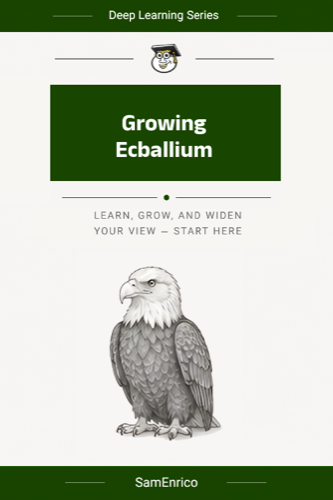
Growing Ecballium eBook
This publication, published by SamEnrico, covers G
by Hart Chelsea
This publication, published by SamEnrico, covers Growing Ecballium
Formats
Free sample
Chapter 1: The Botanical Grenade--–- The first thing you need to understand about Ecballium elaterium is that it has no interest in your approval. This is not a plant that begs for water with drooping leaves, nor does it reward attentive care with fragrant blossoms. It is, by every measure, a survivor of the harshest corners of the Mediterranean—a plant that evolved not to please gardeners but to outlast goats, droughts, and the rocky, collapsing soils of coastal cliffs. And somewhere along that evolutionary path, it developed a party trick that has fascinated, frightened, and occasionally injured humans for over two thousand years: it explodes.Not metaphorically. Not in the way a poet might describe a burst of color.
Literally. Physically. With measurable force, audible pop, and a spray of mucilaginous liquid that can travel ten meters—roughly thirty feet—in a fraction of a second. If you have never witnessed a ripe squirting cucumber detonate, imagine a small, spiny, cucumber-shaped object achieving the velocity of a paintball pellet without any mechanical assistance. The fruit detaches cleanly from its stem, and in that same instant, the internal pressure that has been building for weeks releases through the opening, ejecting seeds and juice in a violent, messy, and astonishingly effective dispersal strategy.This chapter is the foundation upon which the rest of this book is built.
It will introduce you to the taxonomy, anatomy, natural history, and—most importantly—the explosive mechanism of Ecballium elaterium. By the end, you will understand not just what this plant looks like, but why it looks that way, where it comes from, and how its infamous explosion actually works. You will also learn something that many online sources get wrong: the explosion is not a defense mechanism, it is a seed dispersal strategy. The plant is not trying to hurt you; it is trying to reproduce. That you might get hit in the face is an unfortunate side effect, not the point.The Name and Its Meaning Every scientific name tells a story, and Ecballium elaterium is no exception.
The genus name Ecballium comes from the Greek ekballein, meaning "to throw out" or "to eject." This is a direct reference to the explosive fruit. The species epithet elaterium derives from the Greek elaterion, meaning "that which drives out" or "a purgative," referring to the plant's violent medicinal use as a hydragogue cathartic—a drug that forcefully evacuates the bowels. Together, the name literally translates to "the ejecting thing that drives out," which is perhaps the most honest botanical name ever assigned.The plant has no close relatives within its genus; it is the sole species in its genus, making it a monotypic genus. This alone makes Ecballium unusual. Most plant genera contain multiple species, but Ecballium stands alone, a botanical oddity that has no living relatives sharing its exact evolutionary path.
Its closest cousins are in the genera Bryonia (bryony) and Cucumis (cucumbers and melons), but these are distant relatives at best. In everyday language, it is most commonly called the squirting cucumber, though "exploding cucumber" and "wild cucumber" also appear in older texts. In Spain, it is pepino del diablo (devil's cucumber); in France, concombre d'âne (donkey's cucumber); in Italy, cocomero asinino (donkey's watermelon). The consistent donkey references may derive from the plant's coarse, bristly texture being compared to a donkey's hide, or from the historical practice of feeding the foliage to donkeys, who apparently tolerate the bitterness better than other livestock.Taxonomic Classification For readers who appreciate systematic organization, here is the complete taxonomic hierarchy of Ecballium elaterium:Kingdom: Plantae (plants)Clade: Tracheophytes (vascular plants)Clade: Angiosperms (flowering plants)Clade: Eudicots (true dicots)Clade: Rosids (a large group including roses, legumes, and cucurbits)Order: Cucurbitales (the gourd order)Family: Cucurbitaceae (the gourd family, including cucumbers, melons, pumpkins, and squash)Genus: Ecballium (monotypic, meaning only one species)Species: Ecballium elaterium (L.) A.Rich.The "(L.) A.Rich." after the scientific name indicates that Carl Linnaeus originally described the species, and later Achille Richard reclassified it into its own genus. This kind of taxonomic shuffling is common when a plant is unusual enough that botanists disagree about where it belongs.
For a time, Ecballium was placed in the genus Momordica (the balsam pears), but its distinct fruit structure and explosive mechanism eventually earned it a genus of its own.Overall Plant Architecture Before diving into individual structures, it is worth understanding the plant as a whole. Ecballium elaterium is a herbaceous perennial, meaning it dies back to the ground in winter and regrows from its root system each spring. It is not a shrub, not a tree, and not a true vine in the climbing sense, though its sprawling stems can reach 60 to 100 centimeters (two to three feet) in length. The plant has a mounding or sprawling habit: it does not climb unless tied to a support, and it does not stand upright on its own. Instead, it spreads across the ground, forming loose mats that can cover a square meter or more over several growing seasons.The root system is dominated by a thick, fleshy taproot that can extend 30 to 50 centimeters (12 to 20 inches) straight down into the soil.
This taproot is the plant's survival organ: it stores water and carbohydrates during the dry Mediterranean summer and allows the plant to regrow after winter frosts kill the above-ground foliage. Lateral roots branch off from the taproot, but they are relatively sparse; this is not a fibrous, densely branching root system. The deep taproot is also the reason container cultivation requires tall pots (as discussed in Chapter 6).Above ground, the stems are prostrate or ascending—meaning they either lie flat on the ground or curve upward slightly near the tips. They are rough to the touch, covered in short, stiff hairs that make them feel like fine sandpaper. These hairs are technically called trichomes, and they serve multiple functions: they reduce water loss by creating a boundary layer of still air against the stem surface; they deter small herbivores like caterpillars and aphids; and they may help reflect excess sunlight, reducing leaf temperature.Leaves: Coarse, Bristly, and Distinctive The leaves of Ecballium elaterium are immediately recognizable once you know what to look for, but they can be mistaken for those of other cucurbits by the untrained eye.
Each leaf is arranged alternately along the stem (not opposite each other). The leaf shape is broadly ovate to triangular, meaning it is roughly egg-shaped or triangular with the widest part near the base. The leaf margin is coarsely toothed or shallowly lobed, with five to seven angular lobes that give the leaf a somewhat star-shaped outline.The leaf surface is perhaps its most distinctive feature: it is scabrous, a botanical term meaning rough to the touch due to short, stiff hairs. If you run your finger across an Ecballium leaf, it feels like fine sandpaper or the tongue of a cat. Under magnification, these hairs are seen to be multicellular structures with sharp tips.
They are not stinging hairs (like those of nettles), but they are irritating enough that handling the foliage without gloves can cause minor mechanical irritation.Leaf color is a dull, grayish-green rather than…
This is the end of the free sample. Get the eBook to keep going. Buy now
About this book
Details
- Author
- Hart Chelsea
- Publisher
- SamEnrico
- Language
- English
- Genre
- Non-Fiction, Informative, Educational
- Released
- 2026-06-02
- Pages (approx.)
- 157
- Available as
- eBook, Audiobook

Read better in the ZLOADR app
Your eBooks on your phone or tablet. Sign in with your SamEnrico account and start reading.
More by Hart Chelsea
 Trauma Stress Relationship GuideHart Chelsea$11.99
 Self Worth After Chronic IllnessHart Chelsea$11.99
 Meditation for News Induced AnxietyHart Chelsea$11.99
 Letting Go of the DayHart Chelsea$11.99
 First Loci Building CourseHart Chelsea$11.99
 The Sleep Deprived StudentHart Chelsea$11.99
 Palace for VocabularyHart Chelsea$11.99
 Metta For EnemiesHart Chelsea$11.99
 California Talent ExodusHart Chelsea$11.99
 The Ball and the Gods: The Ancient Roots of Latin American FootballHart Chelsea$11.99
 The Van Meegeren Deception: The Greatest Art Hoax of the 20th CenturyHart Chelsea$11.99
 The Ink & the Iron: How the Printing Press Forged a Literary EmpireHart Chelsea$11.99
You may also like
 Hong Kong Handover 1997Dunn Johnnie$11.99
 Zumba For Postnatal Recovery CourseNeal Christian$11.99
 Zumba for BeginnersLadner Nikia$11.99
 YouTube Comment Mining GuideHumes Pandora$12.99
 Worry Box MeditationCarlin Rudy$11.99
 Workplace Stress MeditationNguyen Lynn$11.99
 Workplace Stress and Sleep RepairHawley Ivory$11.99
 Workplace Perfectionism CureDelaney Jeffry$11.99
 Workplace Injustice Anger GuideWallen Isabelle$11.99
 Work Addiction and Burnout LinkGreenwood Ester$11.99
 Women in Yoga and WellnessBeattie Galina$11.99
 Women in Stand Up ComedyChun Evangeline$11.99