
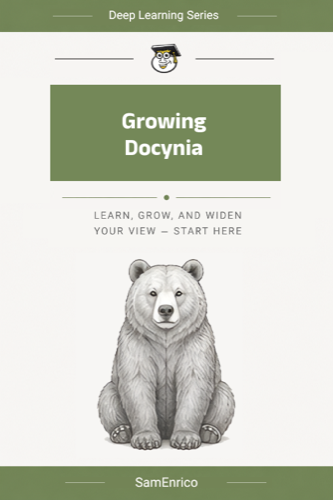
Growing Docynia eBook
This publication, published by SamEnrico, covers G
This publication, published by SamEnrico, covers Growing Docynia
Formats
Free sample
Chapter 1: The Hidden Harvest--–- In the mist-shrouded mountains of northwest Vietnam, where terraced rice paddies cascade down hillsides and the air smells of wet earth and ripening fruit, there stands a tree that most Westerners have never seen, let alone heard of. It is not particularly tall by forest standards — perhaps eight meters, its gnarled branches spreading wide like outstretched arms. Its bark is rough and gray, cracked into deep furrows that tell of decades, maybe centuries, of monsoon rains and dry seasons. In April, it explodes into clouds of white blossoms so dense that from a distance the tree appears to be wearing a fresh coat of snow. By October, those blossoms have transformed into thousands of apple-sized fruits, greenish-yellow with a faint red blush, hanging heavy on the boughs like ornaments on a Christmas tree.But here is what makes this tree extraordinary: it has not been watered, fertilized, pruned, or sprayed in living memory.
The elderly farmer who owns it — a woman named Lan, who remembers when the French still ruled this land — cannot recall anyone ever tending to it. Her grandmother planted it, or perhaps her great-grandmother; the story has grown hazy over the generations. What Lan knows for certain is that every year, without fail, the tree produces more fruit than her entire family can eat, dry, ferment into wine, or sell at the local market. The fruit is sour, astringent, and utterly unlike any apple or pear she has tasted in her seventy-eight years. And yet, she values it above all the other fruit trees on her small holding.The tree is Docynia indica.
And its story is about to change everything you think you know about growing fruit.This book is not about apples. It is not about pears, plums, peaches, or any of the familiar orchard staples that fill supermarket bins from Seattle to Savannah. This book is about a fruit that has been hiding in plain sight for millennia, cultivated by mountain peoples across the Himalayas and Southeast Asia, studied by a handful of botanists, and all but ignored by the commercial fruit industry. That is beginning to change. In Vietnam, government programs have planted over five thousand hectares of Docynia in the past decade, replacing failing plum orchards that were drenched in pesticides and still dying from disease.
In the highlands of northern India, tribal communities have relied on Docynia for generations as a source of medicine, vinegar, and winter sustenance. In China, botanical gardens maintain living collections of both Docynia indica and its lesser-known relative Docynia delavayi, preserving genetic material that may hold the key to drought-tolerant, disease-resistant fruit production for a warming world.And yet, ask any fruit grower in North America or Europe about Docynia, and you will likely receive a blank stare. The few who have heard of it might recall a brief mention in an obscure botanical text or a passing reference in a permaculture forum. There are no commercial orchards in the United States, no nurseries selling grafted trees, no farmers' markets offering baskets of Himalayan pears alongside the Honeycrisps and Boscs. There is, in other words, a vast gap between what this fruit can do and what the world knows about it.This book aims to close that gap.What Docynia Is — And What It Is Not Before we go any further, let us establish the botanical facts.
Docynia belongs to the Rosaceae family — the same family that gives us apples, pears, quinces, roses, and hundreds of other flowering plants. More specifically, it sits within the subfamily Amygdaloideae, tribe Maleae, alongside apples (Malus), pears (Pyrus), and quinces (Cydonia). Taxonomists place it in its own genus, Docynia, which contains two primary species of horticultural significance: Docynia indica (often called the Himalayan pear or simply "docynia") and Docynia delavayi (a higher-altitude relative with smaller fruits and a fully deciduous habit).Here is where most beginners get confused, so pay close attention. Despite its common name — Himalayan pear — Docynia is not a true pear. It is more closely related to quinces, and its fruit resembles a cross between a quince and a small apple.
When you bite into a ripe Docynia, you will notice three things immediately: first, the flesh is crisp and dense, like an apple that has been refrigerated; second, it is intensely sour, with a sharpness that makes your jaw tighten; and third, there is a drying sensation on your tongue and the roof of your mouth — a puckering quality that wine drinkers recognize as astringency. That astringency comes from tannins, the same compounds that give red wine, unripe persimmons, and strong tea their mouth-drying effects.This combination of sourness and astringency is the single greatest obstacle to Docynia's acceptance in Western markets. It is also, paradoxically, the fruit's greatest asset. The same tannins that make fresh Docynia challenging to eat out of hand also make it extraordinarily resistant to pests and diseases. Apple orchards require regular spraying to control codling moth, apple scab, and fire blight.
Docynia orchards, by contrast, can be grown organically with minimal intervention. The fruit's high acid content and tannin profile also make it an exceptional candidate for processing — juices, wines, chutneys, dried slices, and fermented products that transform the astringent fresh fruit into something complex, nuanced, and deeply satisfying.Let us consider the two species in more detail.Docynia indica is the more widely cultivated of the two. It grows naturally at elevations between 1,000 and 2,500 meters (3,300 to 8,200 feet) across a broad range that includes northern India, Nepal, Bhutan, Myanmar, China's Yunnan province, and northern Vietnam. In its native habitat, it can reach heights of twelve meters (forty feet) or more, with a spread nearly as wide. The leaves are lanceolate — shaped like a spearhead — with finely serrated margins and a woolly (tomentose) underside that gives them a silvery appearance when viewed from below.
The trees are evergreen in mild climates, meaning they retain their leaves through winter. But that characterization comes with an important qualification that most reference books omit: Docynia indica only stays evergreen when temperatures remain above approximately -5°C (23°F). When the mercury drops below that threshold, the tree responds by dropping its leaves, effectively becoming deciduous until spring. In USDA hardiness zone 8 (average annual minimum temperature -12°C to -7°C, or 10°F to 20°F), D. indica will keep its leaves through most winters, shedding them only during the coldest snaps.
In zone 7a (-17°C to -15°C, or 0°F to 5°F), it behaves as a fully deciduous tree, leafing out again when temperatures rise in spring.This flexibility is remarkable. Few fruit trees can adapt their growth habit so fluidly in response to temperature. It speaks to the species' resilience and its ability to survive in climates that would kill an apple or pear outright.Docynia delavayi is the cold specialist of the pair. Named for the French missionary and botanist Père Jean Marie Delavay, who collected plants in China in the late nineteenth century, this species is smaller in all respects — smaller leaves, smaller fruits (typically 2-4 centimeters, or 0.8-1.6 inches, in diameter), and smaller overall stature, rarely exceeding six meters (twenty feet). It is also fully deciduous, losing its leaves every…
This is the end of the free sample. Get the eBook to keep going. Buy now
About this book
Details
- Author
- Raines Tyisha
- Publisher
- SamEnrico
- Language
- English
- Genre
- Non-Fiction, Informative, Educational
- Released
- 2026-06-02
- Pages (approx.)
- 141
- Available as
- eBook, Audiobook

Read better in the ZLOADR app
Your eBooks on your phone or tablet. Sign in with your SamEnrico account and start reading.
More by Raines Tyisha
 Research Proposal Appendix CompilationRaines Tyisha$11.99
 College Student PhobiaRaines Tyisha$11.99
 Parent Adult Day Care GuideRaines Tyisha$11.99
 Autistic Student Academic GuideRaines Tyisha$11.99
 Loving Kindness For AnxietyRaines Tyisha$11.99
 Commodity Market DynamicsRaines Tyisha$11.99
 Aging and Exercise Self EsteemRaines Tyisha$11.99
 R&D Talent MigrationRaines Tyisha$11.99
 Bryce Canyon Hoodoo MysteriesRaines Tyisha$11.99
 Whispers in the Wind: The Star-Crossed Lovers of the Great PlainsRaines Tyisha$11.99
 The Bamboo Curtain: The Untold Story of the 1975 Mayaguez IncidentRaines Tyisha$11.99
 The Mineral Guide to CerussiteRaines Tyisha$11.99