
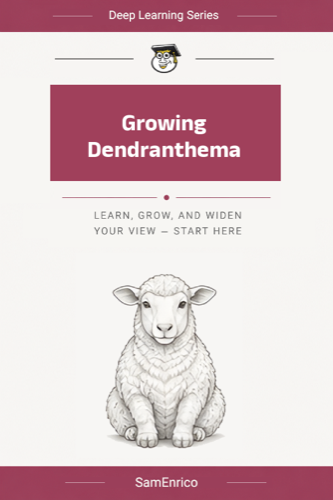
Non-FictionInformativeEducational
Growing Dendranthema eBook
This publication, published by SamEnrico, covers G
by Mccune Irwin
This publication, published by SamEnrico, covers Growing Dendranthema
Formats
Free sample
Chapter 1: The Flower That Fooled Everyone--–- On a cool autumn morning in a Beijing market, a grandmother fills her ceramic teapot with dried golden blossoms that she grew on a hillside terrace. Ten thousand miles away, a florist in Ohio arranges massive, dinner-plate-sized blooms for a Thanksgiving centerpiece. Neither person realizes they are handling the same plant. Even the botanists who named it couldn't agree on what to call it. This is the peculiar story of Dendranthema—the flower that has been misidentified, reclassified, and underestimated for more than two centuries.If you have ever planted a "hardy mum" in your garden, only to watch it die over winter despite your best efforts, you have experienced the confusion firsthand.
You bought a plant labeled Chrysanthemum, but what you actually received was likely a Dendranthema. The difference is not merely academic. It affects how the plant grows, when it blooms, whether it survives your winter, and even whether you can safely brew it into tea. This chapter untangles the taxonomic knot that has frustrated growers for decades, introduces the surprising dual identity of this genus, and gives you the foundational knowledge you need to succeed with Dendranthema whether you are growing for cut flowers, landscape color, or medicinal harvest.The Great Reclassification of 1999For most of horticultural history, the plants we call garden mums, florist mums, and edible chrysanthemums all lived under the genus name Chrysanthemum. That name, derived from Greek chrysos (gold) and anthemon (flower), made perfect sense for the golden-flowered species first described in Asia.
But as botanists began examining these plants more closely—counting chromosomes, studying floral structures, and analyzing DNA—they discovered something unexpected. The group we had been calling Chrysanthemum actually contained two distinct evolutionary lineages.In 1999, the International Code of Botanical Nomenclature ratified a sweeping reclassification. The familiar annual corn marigold kept the name Chrysanthemum segetum (now often called Glebionis segetum), while the perennial "garden mums" were moved to a new genus: Dendranthema. The name combines Greek dendron (tree) and anthemon (flower), referring to the somewhat woody stems that persist longer than those of true Chrysanthemums.Why does this matter to you as a grower? Three practical reasons.
First, seed catalogs and plant patents still suffer from legacy naming. You may order "Chrysanthemum seeds" and receive true annuals that behave completely differently from the perennials you expected. Second, import and export regulations reference the correct botanical name. If you are a commercial grower shipping cuttings across state lines or international borders, using the wrong name on paperwork can delay or destroy your shipment. Third, breeding and variety selection depends on accurate taxonomy.
The plants that survived reclassification into Dendranthema share certain photoperiod responses, root structures, and disease susceptibilities that their annual cousins do not.The Dual Identity You Never Knew Existed Here is where the story becomes genuinely interesting. The genus Dendranthema is not one plant but two very different personalities hiding under similar foliage. On one hand, you have Dendranthema morifolium—the workhorse. This is the plant that produces the massive, showy blooms sold in florist shops, the dense cushion mums in garden centers each September, and the small-flowered tea varieties cherished in Traditional Chinese Medicine. On the other hand, you have Dendranthema weyrichii—the quiet groundcover that most gardeners have never heard of, yet it may be the most reliable plant in the genus.Let us examine the split.
Dendranthema morifolium is a complex hybrid, probably originating from crosses between D. indicum and D. zawadskii over centuries of cultivation in East Asia. It has been bred for large flowers, specific colors, and uniform growth habits. It is also demanding: it needs staking, regular pinching, protection from wind, and careful winter mulching in Zones 5 and colder.
It rewards this attention with spectacular blooms that can reach eight inches across.Dendranthema weyrichii, by contrast, is a low, spreading plant that rarely exceeds twelve inches in height. Its flowers are modest—one to two inches across, typically white or pale pink—but it blooms reliably in October, spreads to three feet wide, and requires absolutely no staking. It suppresses weeds through dense foliage, tolerates poor soil, and survives winter in Zone 4 without special protection. For the landscape gardener tired of coddling fussy mums, D. weyrichii is a revelation.Throughout this book, we will return to these two poles of the Dendranthema universe.
The ornamental grower seeking exhibition blooms will focus on D. morifolium and its cultivars. The landscape designer seeking low-maintenance fall color will turn to D. weyrichii. And the tea producer will work almost exclusively with D.
morifolium selections bred specifically for flavor and medicinal compounds.Why Grow Dendranthema? Ten Compelling Reasons Before we dive deeper into botany, let us answer the most practical question: why should you dedicate garden space, greenhouse benches, or field rows to this genus? Here are ten reasons, ranging from the purely aesthetic to the surprisingly lucrative.1. Unmatched Autumn Color. When most perennials have finished blooming and annuals have been killed by frost, Dendranthema hits its peak.
The genus flowers naturally from late September through November in the Northern Hemisphere, filling the autumn garden with yellows, oranges, bronzes, pinks, purples, and whites when little else is blooming.2. Exceptional Vase Life. Cut Dendranthema stems last ten to fourteen days in a vase at room temperature, and up to three weeks under proper refrigeration. This is double or triple the vase life of many popular cut flowers, making them a favorite of florists and farmers' market sellers.3. Deer Resistance.
While no plant is truly deer-proof, Dendranthema foliage contains bitter compounds (sesquiterpene lactones) that most browsing animals find unpalatable. In areas with heavy deer pressure, mums often survive while hostas and daylilies are stripped to the ground.4. Drought Tolerance Once Established. After the first growing season, Dendranthema develops a fibrous root system that extends six to eight inches deep, allowing it to access soil moisture that surface-level roots cannot reach. Mature plants need supplemental water only during extended dry spells.5.
Medicinal Properties. Species within Dendranthema, particularly D. morifolium and D. indicum, contain flavonoids including luteolin and apigenin, which have demonstrated anti-inflammatory, antioxidant, and neuroprotective effects in clinical studies. (For the full discussion of medicinal chemistry, see Chapter 2.)6.
Tea Market Value. Fresh Dendranthema flowers sell for one to two dollars per pound. Dried, tea-grade flowers sell for thirty to sixty dollars per pound, and premium organic Jinsihuangju (Golden Silk) can reach one hundred dollars per pound. For the small-scale grower, this represents one of the highest value-added opportunities in specialty horticulture.7. Photoperiod Controllability.
Because Dendranthema flowers in response to night length rather than temperature or age, growers can manipulate bloom time precisely. With black cloth or supplemental lighting, you can schedule flowers for any date from Mother's Day to Thanksgiving.8. Container Adaptability. Most Dendranthema cultivars thrive in containers, making them ideal for patios, balconies, and greenhouse production. With appropriate potting mix and fertilization, a single plant can produce dozens of blooms in a twelve-inch pot.9.
Genetic Diversity. The genus includes everything from six-foot-tall cut-flower types to two-inch-tall alpine species. This diversity means there is a Dendranthema for almost any garden situation, provided you select the right cultivar.10. Propagation Ease. Unlike many perennials that…
This is the end of the free sample. Get the eBook to keep going. Buy now
About this book
Details
- Author
- Mccune Irwin
- Publisher
- SamEnrico
- Language
- English
- Genre
- Non-Fiction, Informative, Educational
- Released
- 2026-06-02
- Pages (approx.)
- 160
- Available as
- eBook, Audiobook

Read better in the ZLOADR app
Your eBooks on your phone or tablet. Sign in with your SamEnrico account and start reading.
More by Mccune Irwin
 The Body Dysmorphia CalmMccune Irwin$11.99
 Lawyer Litigation Stress GuideMccune Irwin$11.99
 Bridge Phobia CrossingMccune Irwin$11.99
 Government Job Stability GuideMccune Irwin$11.99
 Exercise Replacement TherapyMccune Irwin$11.99
 The Ambulance HijackingMccune Irwin$11.99
 Muhammad Yunus BankMccune Irwin$11.99
 Mental Health Days from SchoolMccune Irwin$11.99
 Wings Over Vienna: The Commonwealth's Last Stand (1683)Mccune Irwin$11.99
 Three Arrows Capital: Leverage Until It SnappedMccune Irwin$11.99
 Bragi's Golden Lyre: The God Who Spoke in SongMccune Irwin$11.99
 Community-Led Governance ModelsMccune Irwin$11.99
You may also like
 Hong Kong Handover 1997Dunn Johnnie$11.99
 Zumba For Postnatal Recovery CourseNeal Christian$11.99
 Zumba for BeginnersLadner Nikia$11.99
 YouTube Comment Mining GuideHumes Pandora$12.99
 Worry Box MeditationCarlin Rudy$11.99
 Workplace Stress MeditationNguyen Lynn$11.99
 Workplace Stress and Sleep RepairHawley Ivory$11.99
 Workplace Perfectionism CureDelaney Jeffry$11.99
 Workplace Injustice Anger GuideWallen Isabelle$11.99
 Work Addiction and Burnout LinkGreenwood Ester$11.99
 Women in Yoga and WellnessBeattie Galina$11.99
 Women in Stand Up ComedyChun Evangeline$11.99