

Non-FictionInformativeEducational
Growing Davidia eBook
This publication, published by SamEnrico, covers G
by Bostic Val
This publication, published by SamEnrico, covers Growing Davidia
Formats
Free sample
Chapter 1: Understanding the Ghost...–- The first time I saw a mature Davidia in full bloom, I nearly walked past it. That is the honest truth, and it is the most important truth about this tree. Unlike a magnolia, which assaults you with fragrance from fifty meters, or a cherry, which explodes in pink fireworks visible from the highway, Davidia does not demand attention. It invites it. Subtly.
Quietly. Almost reluctantly. I was at the Royal Botanic Gardens at Kew, on a damp April morning that had sent most visitors indoors. The path curved through a collection of rare Chinese trees, and there, half-hidden behind a larger beech, stood a specimen perhaps twelve meters tall. At first glance, it looked ordinary—just another deciduous tree with heart-shaped leaves emerging bronze-green.
But then a breeze moved through the canopy, and the tree seemed to shimmer. White shapes turned and twisted among the branches, catching the weak sunlight like scraps of silk. I stopped. I stared. For a full minute, I could not make sense of what I was seeing.
The tree appeared to be covered in hovering doves, or perhaps handkerchieps hung out to dry, or something else entirely that my brain had no category for. That moment of confusion—of not knowing what I was looking at—is the gift that Davidia offers to every gardener patient enough to grow it.This chapter is not about how to plant, prune, or propagate Davidia. Those subjects deserve—and will receive—their own detailed treatments later in this book. Instead, this chapter is about understanding what Davidia is, where it came from, and why it behaves the way it does. Without this foundation, the practical advice that follows will feel arbitrary.
With it, every decision you make as a grower will be grounded in the biology and evolutionary history of one of the world's most remarkable trees.The Discovery That Changed Botany Father Armand David was not looking for a legendary tree when he set out into the mountains of western China in 1869. A French Lazarist missionary and trained naturalist, David had been sent by the Muséum national d'histoire naturelle in Paris to collect specimens from one of the least-explored regions on Earth. China's interior was largely unknown to Western science at the time—a botanical dark continent that had already yielded rhododendrons, primulas, and lilies that would transform European gardens. David's instructions were simple: collect everything.For two years, he traveled through Sichuan and Hubei provinces, often on foot, accompanied by a small team of local assistants. He sent back thousands of plant specimens, dozens of bird skins, and the first giant panda skin ever seen in Europe.
But on a steep hillside near the border of the two provinces, at an elevation of roughly 2,000 meters, he encountered a tree that stopped him cold. He described it in his field notes as "un arbre remarquable"—a remarkable tree—with no further elaboration. Perhaps he was saving his observations for a formal publication. Perhaps he lacked the words. Even today, looking at the pressed specimen he prepared, now preserved in the herbarium of the Muséum national d'histoire naturelle, one senses his hesitation.
The bracts—those ghostly white structures that define the tree—do not preserve well. They turn brown and brittle, losing all the ethereal quality that makes the living tree so unforgettable.David sent seeds and dried specimens back to Paris, where the botanist Adrien Franchet formally described the genus in 1871. He named it Davidia in honor of its discoverer. The specific epithet involucrata refers to the involucre—the whorl of bracts surrounding the flowers. Neither David nor Franchet could have predicted how long it would take for the tree to reach Western gardens.
The seeds David collected either failed to germinate or produced weak seedlings that did not survive. It would take another thirty years and a more determined plant hunter to bring Davidia to the West.That hunter was Ernest Henry Wilson, a young Englishman sent by the nursery firm Veitch & Sons to collect plants in China. Wilson arrived in 1900, during the Boxer Rebellion, and spent the next several years navigating bandits, disease, and treacherous mountain passes. He collected Davidia seeds twice. The first batch, sent back in 1901, germinated successfully in England, and by 1904, the first Western-grown Davidia trees had flowered.
Wilson later wrote that Davidia was "the most interesting and beautiful of all the trees I have introduced from the Far East." Coming from a man who introduced over a thousand species, this is no small praise.The Genus: One Tree, Two Faces Here is something that surprises many gardeners: there are not one but two distinct forms of Davidia in cultivation. The first, Davidia involucrata var. involucrata, is the species form—the tree that Father David originally discovered. Its leaves are hairy on the underside, a trait that helps reduce water loss in the exposed mountain forests where it grows. The second, Davidia involucrata var.
vilmoriniana, is smoother-leaved (the botanical term is glabrous), with less hair on the leaf undersides and a slightly faster growth rate in cultivation.Which one should you grow? The answer depends on your climate. Vilmoriniana is slightly less cold-hardy than the species form—reliably surviving only to USDA zone 6 rather than zone 5—but it flowers one to three years earlier and produces bracts that are often larger and more consistently white. For most gardeners in temperate zones (USDA zones 6 through 8), vilmoriniana is the better choice. For those in colder regions (zone 5, and occasionally zone 4 with protection), the species form is safer.The Cultivars That Stand Out Beyond the two botanical varieties, a handful of selected cultivars deserve special attention:Davidia involucrata 'Crimson Spring' – This selection, relatively new to the nursery trade, produces new growth of a deep burgundy-red in early spring, before the bracts emerge.
The contrast between the red foliage and the white bracts is striking—a two-tone effect that no other flowering tree can match. 'Crimson Spring' also has excellent disease resistance and a more compact habit, reaching only eight to ten meters at maturity.Davidia involucrata 'Sonoma' – Bred at the Sonoma Horticultural Nursery in California, this cultivar is known for its reliability and early flowering. Trees often bloom in their sixth or seventh year from graft—significantly faster than the species. 'Sonoma' also tolerates warmer climates (zone 9 with afternoon shade) better than other forms, making it the best choice for gardeners in the southern United States and similar climates.Davidia involucrata 'Lady Sunshine' – A variegated form rarely seen outside specialist collections. Its leaves are edged in creamy white, and the bracts emerge pale pink before fading to white.
'Lady Sunshine' is slow-growing and requires more shade than green-leaved forms, as the variegated tissue burns easily in direct sun. Not for beginners, but a treasure for collectors.There are other cultivars—'Pink Lady', 'White Dove', 'Morning Mist'—but many are simply marketing names for seed-grown trees of variable quality. Stick with the named selections above unless you know your nursery well.The Anatomy of a Ghost To understand Davidia, you must understand its flowers. Or rather, you must understand that what most people call flowers are not flowers at all.Like all flowering…
This is the end of the free sample. Get the eBook to keep going. Buy now
About this book
Details
- Author
- Bostic Val
- Publisher
- SamEnrico
- Language
- English
- Genre
- Non-Fiction, Informative, Educational
- Released
- 2026-05-11
- Pages (approx.)
- 146
- Available as
- eBook, Audiobook

Read better in the ZLOADR app
Your eBooks on your phone or tablet. Sign in with your SamEnrico account and start reading.
More by Bostic Val
 The Wisdom Self Esteem WorkbookBostic Val$11.99
 Antidepressant Sexual Side EffectsBostic Val$11.99
 Family Reunification Visa Wait StoryBostic Val$11.99
 Office Hour Confidence GuideBostic Val$11.99
 Gaming and Life Skills DeficitBostic Val$11.99
 The Anxiety Walk MeditationBostic Val$11.99
 Bankruptcy And Pending LitigationBostic Val$11.99
 The Funeral HostageBostic Val$11.99
 The Iron Discipline: Prussia’s Forge of Order and PowerBostic Val$11.99
 The Last Ride of the Knights of the Turf: The Renaissance of Dangerous SportsBostic Val$11.99
 How to Become a Broadcast CheckerBostic Val$11.99
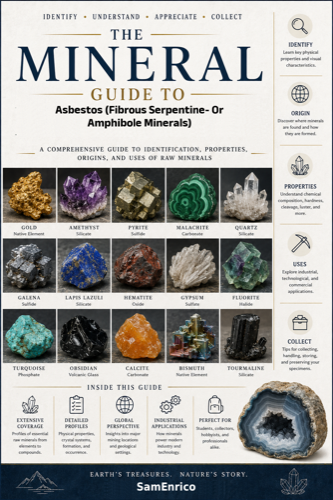 The Mineral Guide to Asbestos (Fibrous Serpentine- Or Amphibole Minerals)Bostic Val$11.99
You may also like
 Hong Kong Handover 1997Dunn Johnnie$11.99
 Zumba For Postnatal Recovery CourseNeal Christian$11.99
 Zumba for BeginnersLadner Nikia$11.99
 YouTube Comment Mining GuideHumes Pandora$12.99
 Worry Box MeditationCarlin Rudy$11.99
 Workplace Stress MeditationNguyen Lynn$11.99
 Workplace Stress and Sleep RepairHawley Ivory$11.99
 Workplace Perfectionism CureDelaney Jeffry$11.99
 Workplace Injustice Anger GuideWallen Isabelle$11.99
 Work Addiction and Burnout LinkGreenwood Ester$11.99
 Women in Yoga and WellnessBeattie Galina$11.99
 Women in Stand Up ComedyChun Evangeline$11.99