
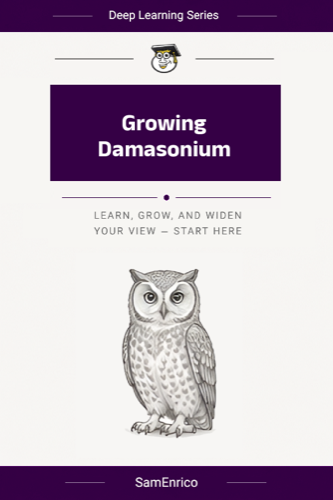
Non-FictionInformativeEducational
Growing Damasonium eBook
This publication, published by SamEnrico, covers G
by Higdon Val
This publication, published by SamEnrico, covers Growing Damasonium
Formats
Free sample
Chapter 1: The Starfruit Key--– You are holding a guide to one of the most misunderstood aquatic plants on Earth. Before you dig your hands into mud or fill a single tray with water, you need to answer a deceptively simple question: What exactly is Damasonium? The answer, as you will soon discover, is not as straightforward as it seems. Most people who try to grow this plant fail not because they lack skill or dedication, but because they never correctly identified what they were growing in the first place. They bought seeds labeled “water starfruit” or traded cuttings with a fellow enthusiast who swore they had Damasonium, only to watch their plants behave in ways no field guide predicted.
Months later, they discovered the truth: they had been growing Alisma, or Sagittaria, or some other impostor that looked close enough but never quite matched the star-shaped fruit that gives this genus its name.This chapter is your key. It will transform you from someone who guesses at identification into someone who knows—with certainty, with confidence, and with the precision of a botanist—exactly which plant you are cultivating. Taxonomy is not dry, academic hair-splitting. It is the difference between success and failure. Different species of Damasonium have different tolerances for submersion, different temperature requirements, and different dormancy needs.
Treat a Mediterranean species like a northern European one, and you will kill it while believing you followed every instruction perfectly. So let us begin at the beginning: with the family tree, the six living species, and the single most important identification feature you will ever learn.The Water-Plantain Family: Alismataceae Explained Damasonium belongs to the Alismataceae, a family of flowering aquatic plants commonly known as water-plantains. This family includes familiar genera such as Alisma (the true water-plantains), Sagittaria (arrowheads, valued for their edible tubers), Echinodorus (Amazon sword plants, beloved by aquarium keepers), and the lesser-known Baldellia, Caldesia, and Luronium. Together, these plants occupy freshwater habitats across every continent except Antarctica. They share several common features: all are monocots, all produce milky sap when cut, all have fibrous root systems rather than taproots, and all bear their flowers in whorls or panicles above the water surface.The Alismataceae family is ancient.
Fossil evidence places its origins in the late Cretaceous period, over 70 million years ago, meaning that water-plantains evolved alongside the last dinosaurs. Their basic body plan—submerged or floating leaves, emergent flowering stalks, and fruit adapted for water dispersal—has proven remarkably successful across deep time. Within this family, Damasonium occupies a distinctive branch. It is most closely related to Alisma and Baldellia, sharing with them the production of achenes (small, dry, one-seeded fruits) that are arranged in rings or clusters. However, Damasonium is the only genus in the family that produces follicles—fruits that split open along one seam to release their seeds, rather than remaining closed like the nutlets of Alisma.Understanding this family context matters because it explains why Damasonium looks so different at different times.
Like its relatives, it is adapted to seasonal wetlands. Unlike many of them, it has retained the ancient trait of heterophylly (different leaf shapes in different conditions), which you will explore in depth in Chapter 3. For now, remember this: if you cannot place a plant in its family, you cannot predict its needs. The Alismataceae are opportunists of temporary water. They do not behave like water lilies or lotuses.
They do not want permanent submersion. Knowing this from the start will save you years of frustration.The Six Species: A Global Tour Let us now meet the six recognized species of Damasonium. Each has its own geographic range, ecological preferences, and cultivation quirks. Some are widely available in the horticultural trade (though often mislabeled). Others are so rare that only a handful of conservation collections exist.
As a grower, you will most likely encounter the first three species on this list.1. Damasonium alisma Miller (European Starfruit)The type species of the genus, D. alisma, ranges across western and central Europe, from the British Isles and France eastward to Germany, Poland, and the Balkan Peninsula, with isolated populations reaching into western Russia and the Caucasus. It is the species most often referenced in conservation literature because it has suffered dramatic declines. Once common in seasonal ponds, cattle troughs, and wet meadows, D.
alisma has disappeared from over 80 percent of its historical sites in the United Kingdom alone. As of 2024, fewer than 50 viable populations remain in England, concentrated in the New Forest, the Lizard Peninsula, and a handful of nature reserves in East Anglia.D. alisma is a mid-sized species, typically reaching 20 to 40 centimeters in height when emergent. Its submerged leaves are narrow and ribbon-like, 5 to 15 centimeters long and only 2 to 5 millimeters wide. Its floating leaves are ovate to elliptical, 2 to 6 centimeters long, with a distinct heart-shaped base.
Its aerial leaves are triangular, thick, and waxy, borne on erect petioles. The flowers are white to pale pink, 8 to 15 millimeters across, arranged in whorls of three to six along a branched scape. The fruit is the star: 6 to 10 follicles arranged in a flat, radiating whorl, each follicle 3 to 5 millimeters long, beaked at the tip, and containing a single seed. This is the species whose seeds can remain viable in sediment for over half a century, waiting for the right combination of drying and flooding to germinate.For the temperate pond gardener, D. alisma is the best choice.
It is cold-hardy to at least Zone 6, tolerates winter freezing as long as it is not frozen solid in a shallow container, and responds well to the drawdown zone cultivation method described in Chapter 6. It is also the species most protected by law (see Chapter 11). Never collect it from the wild. Only purchase seeds or divisions from reputable conservation-minded nurseries.2. Damasonium minus Hooker (Australian Starfruit)As the name suggests, D.
minus is smaller than its European cousin. It grows in southeastern Australia, from Queensland through New South Wales, Victoria, and into South Australia, as well as in Tasmania. Its range overlaps substantially with Australia’s rice-growing regions, which is why it has become a major agricultural weed. Unlike the endangered D. alisma, D.
minus is common, even abundant, in human-disturbed wetlands.D. minus reaches only 10 to 25 centimeters in height. Its submerged leaves are thread-like, barely 1 millimeter wide. Its floating and aerial leaves are smaller than those of D. alisma, rarely exceeding 3 centimeters in length.
The flowers are white, 5 to 10 millimeters across, and the fruit consists of 5 to 8 follicles. The most distinctive feature is the fruit’s shape: the follicles are more sharply pointed and spread more widely than in D. alisma, giving the star a spikier appearance.For the grower, D. minus offers advantages and challenges. It is easier to propagate from seed because it does not require as prolonged a cold stratification period (see Chapter 8).
It also tolerates warmer water than D. alisma, surviving up to 26°C for short periods. However, it is less cold-hardy, and in temperate climates outside Australia, it may behave as an annual rather than a perennial. Many aquarium growers prefer D. minus for submerged cultivation because its narrow leaves are more elegant in the tank.
Just be warned: if you let it seed into a pond in a warm climate, you may find it difficult…
This is the end of the free sample. Get the eBook to keep going. Buy now
About this book
Details
- Author
- Higdon Val
- Publisher
- SamEnrico
- Language
- English
- Genre
- Non-Fiction, Informative, Educational
- Released
- 2026-05-06
- Pages (approx.)
- 140
- Available as
- eBook, Audiobook

Read better in the ZLOADR app
Your eBooks on your phone or tablet. Sign in with your SamEnrico account and start reading.
More by Higdon Val
 Self Esteem Restoration GuideHigdon Val$11.99
 Gaming Peer Support GroupsHigdon Val$11.99
 Test Taking Nausea SolutionsHigdon Val$11.99
 Morning Anxiety SurrenderHigdon Val$11.99
 Asylum Family Reunification JourneyHigdon Val$11.99
 Corporate Lawyer Stress ReductionHigdon Val$11.99
 The Prison Visit Gone WrongHigdon Val$11.99
 Bankruptcy And Your BondHigdon Val$11.99
 Sir Alexander Mackenzie: The Pathfinder of the NorthwestHigdon Val$11.99
 The Twitter Bitcoin ScamHigdon Val$11.99
 The Pedal Pioneers: How Victorian Cyclists Conquered the Tour de France's Forgotten BeginningsHigdon Val$11.99
 The Mineral Guide to Allingite (Synonym of Amber)Higdon Val$11.99
You may also like
 Hong Kong Handover 1997Dunn Johnnie$11.99
 Zumba For Postnatal Recovery CourseNeal Christian$11.99
 Zumba for BeginnersLadner Nikia$11.99
 YouTube Comment Mining GuideHumes Pandora$12.99
 Worry Box MeditationCarlin Rudy$11.99
 Workplace Stress MeditationNguyen Lynn$11.99
 Workplace Stress and Sleep RepairHawley Ivory$11.99
 Workplace Perfectionism CureDelaney Jeffry$11.99
 Workplace Injustice Anger GuideWallen Isabelle$11.99
 Work Addiction and Burnout LinkGreenwood Ester$11.99
 Women in Yoga and WellnessBeattie Galina$11.99
 Women in Stand Up ComedyChun Evangeline$11.99