
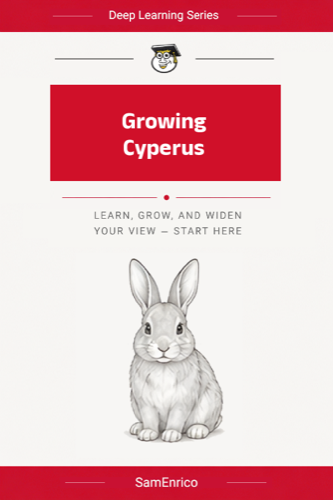
Growing Cyperus eBook
This publication, published by SamEnrico, covers G
This publication, published by SamEnrico, covers Growing Cyperus
Formats
Free sample
Chapter 1: The Papyrus Covenant...--Every serious gardener eventually encounters a moment of horticultural humility. For some, it comes when a prized orchid refuses to rebloom despite years of devotion. For others, it arrives when an expensive Japanese maple succumbs to verticillium wilt. For me, that moment arrived on a humid August morning beside a koi pond that had turned the color of split pea soup. The fish were gasping at the surface.
Algae clung to everything like a green shroud. And standing in a neglected corner of the pond, barely alive but somehow still upright, was a single pot of Cyperus alternifolius—the umbrella plant I had bought on impulse and forgotten completely.That forgotten plant changed everything. Within six weeks of proper care, it had not only revived but had grown three feet taller. More remarkably, the water directly around its pot had cleared. The algae receded in a perfect halo.
The koi began swimming near its stems. I had stumbled upon something ancient and powerful without knowing it: the papyrus covenant, the quiet contract between this remarkable genus and anyone willing to provide wet roots and a little patience.This book exists because that moment of accidental discovery deserves to be intentional for you. Cyperus—the genus that includes Egyptian papyrus, umbrella palms, and a dozen other remarkable sedges—is one of the most forgiving, useful, and historically significant plants you can grow. Yet it remains stubbornly overlooked. Garden centers sell it as an afterthought.
Pond suppliers treat it as decoration. Houseplant enthusiasts dismiss it as "just a grass." Every single one of them is wrong.What This Chapter Reveals By the time you finish these pages, you will understand why Cyperus has been cultivated for over five thousand years, how its peculiar biology makes it almost impossible to kill (but very possible to thrive), and why the triangular stem you are about to learn about separates sedges from every other plant family on Earth. You will meet the three cornerstone species that form the foundation of every successful Cyperus collection. And you will discover something unexpected: that growing this plant connects you not just to a hobby but to a lineage of human ingenuity stretching back to the pharaohs.Let us begin at the beginning. Not with planting instructions or soil recipes—those come in later chapters—but with a question that has intrigued botanists and historians alike: Why did one plant become the foundation of ancient civilization's most advanced communication technology, while its relatives remain humble marsh dwellers?The Plant That Built an Empire Long before Gutenberg pressed his first Bible, before Chinese artisans carved characters into bone, before clay tablets baked in Mesopotamian suns, the Egyptians discovered something remarkable inside the stems of a tall sedge growing along the Nile.
When they sliced the pith into thin strips, laid them in overlapping layers, pressed them together, and dried them, the strips fused into a writing surface that was lightweight, durable, and endlessly renewable. They called it papyrus. We call the plant Cyperus papyrus.The timeline is staggering. The earliest known papyrus scroll dates to approximately 2900 BCE, during the First Dynasty of Egypt. That is nearly five thousand years before the invention of the printing press.
For over three millennia, papyrus was the world's dominant writing material. The libraries of Alexandria, the medical texts of Imhotep, the legal codes of Ramses—all preserved on sheets made from this single species. When the Roman Empire conquered Egypt, they did not just seize grain and gold; they seized the papyrus monopoly. To control papyrus production was to control written communication across the Mediterranean.But the plant's utility extended far beyond writing. The ancient Egyptians wove papyrus stems into boats—some over sixty feet long—that carried cargo and passengers along the Nile.
They plaited the fibers into sandals, baskets, ropes, and mats. They dried the roots for fuel. They even ate the tender young stems. A single plant provided paper, transportation, clothing, shelter, and food. No wonder the Egyptians associated papyrus with fertility and creation.
In their mythology, the primordial mound from which all life emerged was surrounded by papyrus thickets. The goddess Hathor, protector of women and children, dwelled among papyrus marshes.The Ecological Genius of a Marsh Plant What the Egyptians understood intuitively, modern science has confirmed: Cyperus papyrus is an ecological marvel. A single mature clump can produce over one hundred stems, each reaching fifteen feet or more. Those stems are not solid; they are filled with a lightweight, airy pith that allows the plant to float in water up to three feet deep while remaining firmly rooted. The umbrella-like inflorescence at the top—those delicate, radiating spikes—catches wind and disperses seeds across marshlands.
The root system, a dense mat of fibrous rhizomes, stabilizes sediment, absorbs excess nutrients, and creates habitat for fish, amphibians, and insects.This is not merely historical trivia. Understanding the plant's native habitat—the slow-moving, nutrient-rich waters of the Nile Delta and the wetlands of central and southern Africa—teaches you the single most important lesson about growing Cyperus today. In its natural environment, Cyperus never experiences dry soil. It never experiences stagnant water that does not flow. It never experiences temperatures below freezing.
Every care decision you make, from potting mix to watering schedule to winter storage, flows from these three constraints: wet, moving, and warm.Violate any one of them, and the plant will not die immediately—Cyperus is famously resilient—but it will stop thriving. The stems will shorten. The color will fade. The distinctive umbels will become sparse. The plant will slide into a slow decline that many gardeners mistake for disease when it is simply a mismatch between care and evolution.The Triangular Secret Here is a fact that separates knowledgeable Cyperus growers from everyone else: sedges have edges.
Grasses have round, hollow stems. Rushes have round, solid stems. Sedges—the entire Cyperaceae family, comprising over five thousand species—have triangular stems. That is not a metaphor. If you roll a blade of grass between your fingers, it feels round.
If you roll a Cyperus stem, you will feel three distinct sides meeting at sharp angles.This triangular structure, technically called triquetrous, is the family's defining characteristic. Botanists have even coined a mnemonic: "Sedges have edges, rushes are round, grasses have nodes from tip to ground." The triangular shape provides structural rigidity without requiring heavy, energy-expensive tissues. A Cyperus stem standing six feet tall can sway in the wind without breaking because its triangular cross-section distributes stress more efficiently than a round one. This is the same engineering principle that gives I-beams their strength.Why This Matters to You, the Grower The triangular stem is not just a botanical curiosity. It directly affects how you propagate, prune, and display your plants.When you propagate Cyperus using the upside-down method described in Chapter 7, you rely on the stem's internal structure.
The triangular shape creates distinct channels that transport water and nutrients. When you invert a cutting, those channels reverse direction—something few other plants can tolerate. The triangular stem also makes pruning easier. You can feel exactly where to cut because the edges provide tactile feedback. And…
This is the end of the free sample. Get the eBook to keep going. Buy now
About this book
Details
- Author
- Alexander George
- Publisher
- SamEnrico
- Language
- English
- Genre
- Non-Fiction, Informative, Educational
- Released
- 2026-05-11
- Pages (approx.)
- 160
- Available as
- eBook, Audiobook

Read better in the ZLOADR app
Your eBooks on your phone or tablet. Sign in with your SamEnrico account and start reading.
More by Alexander George
 Twelve Step Adaptation GuideAlexander George$11.99
 Intervention SurvivorsAlexander George$11.99
 Betting and Mental HealthAlexander George$11.99
 Svalbard Polar Bear GuardAlexander George$11.99
 Blood Injury Phobia Fainting FixAlexander George$11.99
 Anger Trigger Wearable AlertAlexander George$11.99
 Ransomware Hostage StoryAlexander George$11.99
 Bankruptcy Trustee RelationsAlexander George$11.99
 Twitter 2020: Verified and VulnerableAlexander George$11.99
 The Vanishing Act of the Library of AlexandriaAlexander George$11.99
 The Battle of the Delta: Ramses III and the Sea Peoples' Last Stand (1175 BC)Alexander George$11.99
 Bioinformatics FoundationsAlexander George$11.99