
Non-FictionInformativeEducational
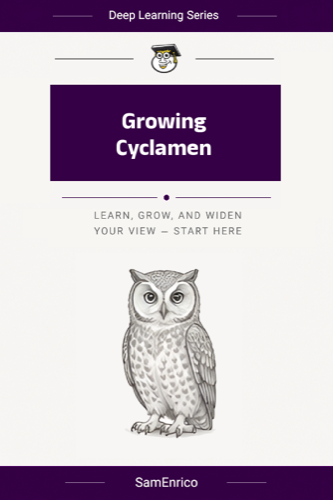
Growing Cyclamen eBook
This publication, published by SamEnrico, covers G
This publication, published by SamEnrico, covers Growing Cyclamen
Formats
Free sample
Chapter 1: Beyond the Counter...–- The first thing you need to know about cyclamen is that almost everything you have heard is wrong. They are not finicky. They are not short-lived. And they are certainly not disposable, despite what the supermarket price tag might suggest. The truth, buried beneath decades of mass-market horticulture and well-meaning but misguided advice, is that cyclamen are among the most resilient, adaptable, and rewarding plants you will ever grow—once you understand the single most important fact about their existence: they are Mediterranean survivors, not Victorian hothouse invalids.This misunderstanding runs deep.
Walk into any grocery store between November and February, and you will find them stacked in colorful rows: hearts of deep green and silver, crowned with flowers that look like shooting stars pinned to earth. They are sold alongside poinsettias and amaryllis, wrapped in festive foil, marketed as the perfect holiday gift. And like so many holiday gifts, they are treated as ephemeral. The flowers fade. The leaves yellow.
The plant looks, to the untrained eye, as though it is dying. And so, in a moment of well-intentioned resignation, it is tossed into the compost bin.That is the great tragedy of the modern cyclamen. And it is the reason this book exists.What you mistook for death was merely sleep. What you interpreted as failure was actually the plant following instructions written into its DNA over millions of years of evolution in the rocky hillsides of Turkey, Greece, and the eastern Mediterranean islands. That cyclamen you threw away was not dying.
It was trying to survive the summer drought exactly as its ancestors have done since before humans learned to farm. And you, without knowing it, had become the unwitting villain in its ancient rhythm.The Myth of the Disposable Houseplant Let us name this myth directly: the belief that florist cyclamen are temporary, high-maintenance, and not worth keeping past their first bloom. It is a myth perpetuated by the very industry that sells them. Commercial growers have perfected the art of forcing cyclamen into spectacular, synchronized flowering using high-nitrogen fertilizers, growth regulators, and precisely controlled greenhouse conditions. The plants you buy are athletes at the peak of a carefully managed career.
But like any athlete, they need a rest period afterward. The industry knows this. What it does not tell you is that with proper care, that same plant can bloom for five, ten, or even fifteen years. Some cyclamen tubers in European collections have been passed down through generations, still flowering faithfully every winter.The problem is not the plant. The problem is the information gap.
Between the scientific monographs written for botanists and the four-paragraph care sheet tucked into a plastic sleeve at the garden center, there is a vast wilderness of practical knowledge. This book is the bridge across that wilderness.A Brief History: From Ancient Medicine to Victorian Obsession The story of cyclamen begins long before they ever sat on a windowsill. The genus Cyclamen belongs to the primrose family (Primulaceae) and includes approximately 24 species, all native to the Mediterranean basin. Their range stretches from the Canary Islands in the west through southern Europe and North Africa to Iran and Somalia in the east. They have adapted to an astonishing variety of habitats: deep limestone gorges, pine forests, olive groves, and even the cracks of seaside cliffs where salt spray regularly drenches their leaves.The first written records of cyclamen come from ancient Greece.
Theophrastus, the father of botany, described the plant in his Enquiry into Plants around 300 BCE. He noted its curious tuber, its habit of flowering in winter, and—most memorably—its use as a love potent. The Greek name kyklaminos derives from kyklos, meaning circle, a reference to the tuber’s rounded shape. But the plant had darker associations as well. Dioscorides, a Greek physician in the Roman army, wrote extensively about cyclamen in his five-volume De Materia Medica, recommending it as a violent purgative and even as a treatment for snake bites.
(Modern readers should not attempt either; the raw tuber contains toxic saponins that can cause severe gastrointestinal distress.)Throughout the medieval and Renaissance periods, cyclamen remained primarily a medicinal and wild plant. It was not until the 17th century that European gardeners began actively collecting and cultivating the hardier species. John Gerard’s Herball (1597) includes charming illustrations of Cyclamen coum and C. hederifolium, which were already being grown in English gardens as curiosities. But the real explosion of interest came in the Victorian era.The Victorians loved cyclamen for three reasons.
First, the plants bloomed in winter, when greenhouses were otherwise quiet. Second, the flowers came in rich shades of magenta, pink, and white that perfectly suited Victorian color sensibilities. Third, cyclamen could be forced into bloom for the Christmas market—a commercial opportunity too lucrative to ignore. By the 1860s, European breeders, particularly in Belgium, France, and Germany, had begun systematically hybridizing Cyclamen persicum, the species with the largest flowers, to create ever more dramatic forms. The first double-flowered cyclamen appeared in Belgium in the 1820s.
The first “grandiflorum” types—with flowers exceeding three inches across—followed in the 1860s. By 1900, cyclamen were a fixture of every respectable conservatory.The Cyclamen Society: Guardians of the Genus Any serious discussion of cyclamen must acknowledge the organization that has done more than any other to preserve, study, and promote these plants: the Cyclamen Society. Founded in 1991 by a group of British and Dutch enthusiasts, the Society has grown into an international network of botanists, horticulturists, and amateur growers united by a shared passion. Its quarterly journal publishes peer-reviewed articles on taxonomy, cultivation, and conservation. Its seed exchange—one of the most rigorous in the horticultural world—distributes seeds of known wild origin to members, ensuring that cultivated plants do not contribute to the depletion of wild populations.
And its conservation committee works directly with governments in Turkey, Greece, and other range countries to monitor habitat loss and support in-situ protection programs.This book draws heavily on the Society’s published research, and I encourage you to consider membership if you find yourself captivated by the genus. (The full details of membership benefits, including how to join and participate in the annual seed exchange, are covered in Chapter 12.) For now, it is enough to know that you are entering a community of growers who take cyclamen seriously—not as disposable novelties but as living links to an ancient Mediterranean world.Why This Book? A Note on What You Will Find You might reasonably ask: with existing cyclamen books on the market, why another? The answer lies in the gap between those books. At one extreme are the scientific volumes, such as the Cyclamen Society’s own Genus Cyclamen (a magnificent but dense taxonomic work) or Christopher Grey-Wilson’s authoritative monograph.
These books are essential for botanists and serious collectors, but they assume a level of knowledge that most home gardeners do not possess. At the other extreme are the 50-page digital pamphlets and the two-paragraph care sheets attached to supermarket pots. These provide the barest bones of advice—usually just “bright indirect light, water when dry, keep cool”—without explaining why those conditions matter or…
This is the end of the free sample. Get the eBook to keep going. Buy now
About this book
Details
- Author
- Villegas Letha
- Publisher
- SamEnrico
- Language
- English
- Genre
- Non-Fiction, Informative, Educational
- Released
- 2026-06-02
- Pages (approx.)
- 142
- Available as
- eBook, Audiobook

Read better in the ZLOADR app
Your eBooks on your phone or tablet. Sign in with your SamEnrico account and start reading.
More by Villegas Letha
 National Parks ConspiracyVillegas Letha$11.99
 Daily Meditation for Anxious MindsVillegas Letha$11.99
 Body Image For Yoga Practitioners GuideVillegas Letha$11.99
 Breaking the Betting CycleVillegas Letha$11.99
 New Zealand Traverse Both IslandsVillegas Letha$11.99
 Catastrophizing Anger GuideVillegas Letha$11.99
 Peer Comparison Stress ReducerVillegas Letha$11.99
 Client Concentration Risk AuditVillegas Letha$11.99
 The Sword of the Sun Prince: A Knight’s Oath in the MahabharataVillegas Letha$11.99
 Pandora's Curiosity: The First Human Who Knew Too MuchVillegas Letha$11.99
 How to Start a Marketing Management Consultancy Business (Beginners Guide)Villegas Letha$11.99
 Audience Growth Strategies for CreatorsVillegas Letha$11.99
You may also like
 Hong Kong Handover 1997Dunn Johnnie$11.99
 Zumba For Postnatal Recovery CourseNeal Christian$11.99
 Zumba for BeginnersLadner Nikia$11.99
 YouTube Comment Mining GuideHumes Pandora$12.99
 Worry Box MeditationCarlin Rudy$11.99
 Workplace Stress MeditationNguyen Lynn$11.99
 Workplace Stress and Sleep RepairHawley Ivory$11.99
 Workplace Perfectionism CureDelaney Jeffry$11.99
 Workplace Injustice Anger GuideWallen Isabelle$11.99
 Work Addiction and Burnout LinkGreenwood Ester$11.99
 Women in Yoga and WellnessBeattie Galina$11.99
 Women in Stand Up ComedyChun Evangeline$11.99