
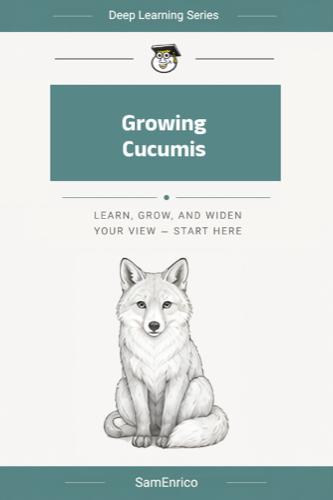
Non-FictionInformativeEducational
Growing Cucumis Audiobook
This publication, published by SamEnrico, covers G
by Pyle Santa
This publication, published by SamEnrico, covers Growing Cucumis
Formats
Free sample
Chapter 1: The Secret Life of Vines...--–- Every cucumber you have ever eaten began as a conversation between a flower and the world around it. That conversation, conducted in the silent language of pollen and nectar, of heat and light, of soil microbes and climbing tendrils, determines whether your harvest will be a bounty of crisp, sweet fruit or a bitter, misshapen disappointment. Most gardening books tell you what to do—when to plant, how far to space, what to spray. This chapter tells you why. Because once you understand the secret life of the cucumber vine—its biology, its flowering strategies, its stress responses—you stop being a follower of instructions and become a true grower.
You learn to read the plant before it shows symptoms. You anticipate problems before they emerge. And you unlock the genetic potential that seed companies have spent generations breeding into your favorite varieties.Welcome to the foundation of everything that follows.The Humble Beginnings of a Global Superstar Before we dissect the anatomy of a cucumber plant, let us take a brief journey through its evolutionary history. The cucumber, Cucumis sativus, is a member of the Cucurbitaceae family—the gourd family—which includes melons, squash, pumpkins, and watermelons. Unlike its showier cousins, the cucumber has never sought attention.
It lacks the melon's syrupy sweetness and the pumpkin's autumnal grandeur. Instead, the cucumber evolved for one purpose: to spread its seeds by being eaten.Consider the wild cucumber. Even today, wild relatives of Cucumis sativus grow in the foothills of the Himalayas, from northern India through Nepal and into southwestern China. These wild fruits are small—no larger than a grape—and covered in spiny, bitter flesh. The spines deter grazing animals.
The bitterness, caused by compounds called cucurbitacins, warns away all but the most desperate herbivores. And yet, somewhere around three thousand years ago, ancient farmers began selecting the least bitter, least spiny, largest-fruited plants. Generation by generation, they transformed a toxic, thumb-sized berry into the refreshing, mild, foot-long vegetable we know today.This domestication process came with trade-offs. The modern cucumber is more productive and more palatable than its wild ancestor, but it is also more fragile. It has lost many of the chemical defenses that protected its ancestors.
That is why your cucumber plants seem to attract every pest in the garden. That is why a single missed watering can…
This is the end of the free sample. Get the Audiobook to keep going. Buy now
About this book
Details
- Author
- Pyle Santa
- Publisher
- SamEnrico
- Language
- English
- Genre
- Non-Fiction, Informative, Educational
- Released
- 2026-05-09
- Pages (approx.)
- 160
- Available as
- eBook, Audiobook

Listen in the VoxFlicks app
Audiobooks and audio dramas wherever you go. Sign in with your SamEnrico account and press play.
More by Pyle Santa
 Creative Visualization GuidePyle Santa$11.99
 Hospice Nurse Death Dying GuidePyle Santa$11.99
 Healing Body Shame Comprehensive WorkbookPyle Santa$11.99
 Body Scan For Altitude SicknessPyle Santa$11.99
 Kilimanjaro Rescue LeaderPyle Santa$11.99
 Crowded Space Anger GuidePyle Santa$11.99
 Bachelor Nation ConfessionsPyle Santa$11.99
 Nonprofit Mission Driven OverworkPyle Santa$11.99
 The Purple Robe Conspiracy: Blood and Silk in the Byzantine CourtPyle Santa$11.99
 Hearts of Iron and Stone: Love in the Baltic CrusadesPyle Santa$11.99
 The Mineral Guide to AndalusitePyle Santa$11.99
 Student Part Time Work Rules in ChinaPyle Santa$12.99
You may also like
 Hong Kong Handover 1997Dunn Johnnie$11.99
 Zumba For Postnatal Recovery CourseNeal Christian$11.99
 Zumba for BeginnersLadner Nikia$11.99
 YouTube Comment Mining GuideHumes Pandora$12.99
 Worry Box MeditationCarlin Rudy$11.99
 Workplace Stress MeditationNguyen Lynn$11.99
 Workplace Stress and Sleep RepairHawley Ivory$11.99
 Workplace Perfectionism CureDelaney Jeffry$11.99
 Workplace Injustice Anger GuideWallen Isabelle$11.99
 Work Addiction and Burnout LinkGreenwood Ester$11.99
 Women in Yoga and WellnessBeattie Galina$11.99
 Women in Stand Up ComedyChun Evangeline$11.99