
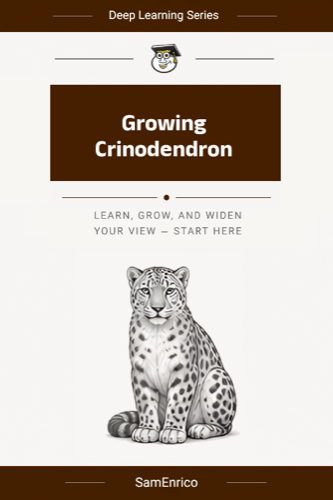
Non-FictionInformativeEducational
Growing Crinodendron eBook
This publication, published by SamEnrico, covers G
This publication, published by SamEnrico, covers Growing Crinodendron
Formats
Free sample
Chapter 1: Lanterns in the Mist...–- It begins, as these things often do, not with a gardening manual’s dry recitation of botanical facts, but with a question. The question arrives unbidden, usually on a damp spring morning, when the rest of the garden is still shaking off winter’s lethargy. You round a corner—perhaps a sheltered path, perhaps the shaded side of the house—and there it hangs: a jewel you did not plant, a flower you cannot name, a small crimson lantern swinging gently from a branch that seems too delicate to hold it. What is this thing? Where did it come from?
And why, in a world full of rhododendrons and camellias and azaleas, has no one told you about this before?That question—that moment of startled wonder—is the entire reason this book exists. And the answer, as with most worthwhile things in gardening, is both simpler and more complex than you might imagine. The simple answer: you have encountered Crinodendron hookerianum, the Chilean lantern tree, one of the most extraordinary flowering shrubs that most gardeners have never heard of. The complex answer requires a journey—not just through the pages of a book, but across oceans, through temperate rainforests, and into the peculiar logic of a plant that decided, against all evolutionary odds, to thrive where it had no business thriving.This chapter is that journey’s first step. Before we discuss soil p H, before we argue about pruning schedules, before we troubleshoot the inevitable yellowing leaf, we must first understand what this plant is, where it came from, and why it has captivated a small but ferociously devoted corner of the gardening world for nearly two centuries.
Because Crinodendron is not a plant for the casual gardener. It is not a plant for the impatient, the inattentive, or the easily discouraged. It is, instead, a plant that demands something from its caretaker—a willingness to learn its language, respect its origins, and accept that some of the rules you thought you knew about gardening do not apply here.The Moment of First Encounter Let me describe that moment more precisely, because it matters. You are standing perhaps six feet from the plant—close enough to see detail, far enough to take in the whole form. The shrub itself is unassuming at first glance: six to fifteen feet tall depending on age and conditions, with a habit that is neither strictly upright nor fully sprawling.
The branches reach outward at angles that seem almost architectural, creating a vase-like shape that is open enough to see through but dense enough to feel substantial. The leaves catch your attention next: they are narrow, two to three inches long, with a polished, almost waxy surface that reflects light in a way that seems incongruous for a plant that prefers shade. They are the deep, rich green of a mountain stream in summer—the kind of green that photographers spend hours trying to capture and never quite get right.But then your eyes rise, and you see them. The flowers hang from slender stalks, each perhaps an inch and a half long, flaring at the mouth like the bell of a trumpet or, as the common name suggests, a traditional lantern. Their color is not merely red—it is a crimson so deep and pure that it seems to absorb light rather than reflect it, creating the illusion that the flowers are lit from within.
The petals are thick and waxy, fused together into a tube that opens into five distinct lobes at the mouth, each lobe curling back slightly to reveal a pale interior. From this opening, a small cluster of stamens protrudes, tipped with golden anthers that provide the only contrast to the otherwise unbroken red.What you cannot see from six feet away, but what becomes apparent as you lean closer, is the texture. The flowers are not merely waxy—they are substantial, almost fleshy, with a weight that surprises you when you finally touch one. They do not flutter in the wind like a cherry blossom. They hang, heavy and deliberate, as if each one represents a significant investment of the plant’s energy.
And indeed it does. Crinodendron flowers are not produced in the profligate abundance of a rhododendron or a rose. They appear in smaller numbers, each one seemingly placed with intention, and they persist for weeks—sometimes six to eight weeks from the first bud break to the final petal fall. This is not a plant that throws its flowers at you in a brief, spectacular burst. It offers them slowly, deliberately, as if inviting you to take your time.The Taxonomy of Wonder Now, because this is a gardening book and not a travelogue, we must attend to the dry matter of classification.
But let us attend to it lightly, because the story of how this plant came to have its name is nearly as interesting as the plant itself.Crinodendron belongs to the family Elaeocarpaceae, a group of mostly tropical and subtropical trees and shrubs distributed across South America, Southeast Asia, Australia, and the Pacific islands. The family includes approximately 600 species across perhaps a dozen genera, most of which you have never heard of and will likely never encounter unless you find yourself wandering through a cloud forest in Borneo or a eucalyptus woodland in Tasmania. What makes Crinodendron remarkable—what should stop you in your tracks, as it stopped me when I first learned this—is that it is one of the very few members of this tropical family that has adapted to a temperate climate. The Elaeocarpaceae are, in their heart, a family of warm, wet, frost-free places. That two species of Crinodendron not only survive but thrive in the cool, damp, occasionally freezing valleys of the Chilean Andes is a botanical anomaly.The genus name itself comes from the Greek krinon (lily) and dendron (tree), a reference to the flower’s superficial resemblance to certain lilies.
This is not particularly inspired taxonomy—nineteenth-century botanists were fond of forcing comparisons between unrelated plants—but it is at least descriptive. The specific epithet hookerianum honors William Jackson Hooker, a British botanist who served as the first director of the Royal Botanic Gardens at Kew and who played a crucial role in introducing Chilean plants to European cultivation. Hooker never saw a living Crinodendron in the wild, but he recognized its significance when specimens were sent to him by European plant collectors working in South America, and he ensured that seeds and cuttings made their way to the gardens of Britain’s wealthy plant enthusiasts.The common name, Chilean lantern tree, is more evocative. It captures both the flower’s shape and its effect: when the late afternoon sun slants through a woodland garden, illuminating a row of Crinodendron flowers from behind, they do indeed resemble small glass lanterns lit from within. I have stood in such a garden on a June evening in Cornwall, watching the light shift and the flowers glow, and I can attest that the name, for all its simplicity, gets something right that the scientific name does not.The Two Faces of Crinodendron Before we go any further…
This is the end of the free sample. Get the eBook to keep going. Buy now
About this book
Details
- Author
- Morton Roland
- Publisher
- SamEnrico
- Language
- English
- Genre
- Non-Fiction, Informative, Educational
- Released
- 2026-05-09
- Pages (approx.)
- 141
- Available as
- eBook, Audiobook

Read better in the ZLOADR app
Your eBooks on your phone or tablet. Sign in with your SamEnrico account and start reading.
More by Morton Roland
 Cybersecurity Incident ResponderMorton Roland$11.99
 Overcoming Exercise Obsession For Self EsteemMorton Roland$11.99
 Bryce Canyon Missing CasesMorton Roland$11.99
 Second Marriage PlanningMorton Roland$11.99
 Mike Krieger InstagramMorton Roland$11.99
 Anger Antecedent LogMorton Roland$11.99
 Borneo Headhunter TerritoryMorton Roland$11.99
 Mindfulness For Work StressMorton Roland$11.99
 The Healers of the Nile: The Secret Medical Corps of Ancient KushMorton Roland$11.99
 Sand and Shadows: Love Letters from the Sinai FrontMorton Roland$11.99
 The Mineral Guide to AllaniteMorton Roland$11.99
 Ultimate Handbook Guide to Las Vegas : (United States) Travel GuideMorton Roland$11.99
You may also like
 Hong Kong Handover 1997Dunn Johnnie$11.99
 Zumba For Postnatal Recovery CourseNeal Christian$11.99
 Zumba for BeginnersLadner Nikia$11.99
 YouTube Comment Mining GuideHumes Pandora$12.99
 Worry Box MeditationCarlin Rudy$11.99
 Workplace Stress MeditationNguyen Lynn$11.99
 Workplace Stress and Sleep RepairHawley Ivory$11.99
 Workplace Perfectionism CureDelaney Jeffry$11.99
 Workplace Injustice Anger GuideWallen Isabelle$11.99
 Work Addiction and Burnout LinkGreenwood Ester$11.99
 Women in Yoga and WellnessBeattie Galina$11.99
 Women in Stand Up ComedyChun Evangeline$11.99