
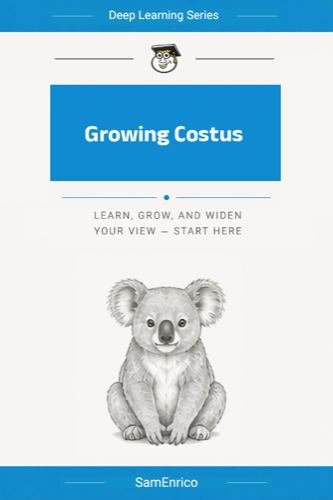
Non-FictionInformativeEducational
Growing Costus eBook
This publication, published by SamEnrico, covers G
This publication, published by SamEnrico, covers Growing Costus
Formats
Free sample
Chapter 1: The Spiral Secret...--Every great garden begins with a single moment of discovery. For some, it is the first time they see a hummingbird hover, wings blurring, before a flower that seems impossibly exotic. For others, it is the realization that a plant they thought belonged only to steamy tropical jungles can thrive in their own backyard, on their patio, or even in their living room. This book is about such a discovery. It is about the genus Costus—the spiral gingers—a group of plants so architecturally unique, so ecologically fascinating, and so surprisingly adaptable that they have earned a devoted following among plant collectors, landscape designers, and home gardeners alike.
Yet, despite their growing popularity, Costus remains one of horticulture's best-kept secrets. This chapter is your key to unlocking that secret.If you have picked up this book, you have likely already glimpsed the allure of a spiral ginger. Perhaps you saw a photograph of its perfect, winding staircase of leaves, or you encountered a living specimen at a botanical garden, its fiery red cone demanding your attention. You may have wondered: What is that plant? Can I grow it?
The answer is almost certainly yes. But to grow Costus successfully—to move beyond mere survival and into thriving, flowering, reproducing abundance—you must first understand what makes this genus unique. You must learn to see the plant not as a collection of parts, but as an integrated system shaped by millions of years of evolution in the world's most biodiverse ecosystems.This chapter establishes the foundation for everything that follows. We will explore the botanical identity of Costus, clarifying how it differs from the gingers you may already know. We will dissect its most famous feature—the spiral leaf arrangement—and explain why it is far more than a botanical curiosity.
We will take a tour of the genus, introducing you to popular species that range from compact houseplants to towering landscape specimens. Finally, we will ground each species in its native habitat, because understanding where a plant comes from is the first and most important step in understanding what it needs to flourish in your care. By the end of this chapter, you will not only be able to identify a Costus on sight, but you will also possess the ecological context necessary to become a confident, intuitive grower.What Exactly Is a Spiral Ginger?The name "spiral ginger" is descriptive but incomplete. It captures the plant's most visible trait—the way its leaves ascend the stem in a tight helix—but it fails to convey the genus's true botanical distinctiveness. Costus belongs to the family Costaceae, a small family of tropical monocots that was once lumped together with the true gingers (Zingiberaceae) but has since been recognized as a separate evolutionary lineage.
This distinction matters to gardeners because it explains several unique characteristics that influence how we cultivate these plants.The most obvious difference lies in the leaves. True gingers—think of the common culinary ginger (Zingiber officinale), the shell ginger (Alpinia zerumbet), or the butterfly ginger (Hedychium coronarium)—produce leaves that alternate in two ranks along the stem, appearing in a flat, fan-like arrangement. Costus, by contrast, produces leaves that are arranged in a single, continuous spiral. The leaves wrap around the stem in a clockwise or counterclockwise direction, each leaf emerging at a consistent angle from the one below, creating an effect that has been compared to a spiral staircase, a Mayan pyramid, or a perfectly wound spring. This is not merely an aesthetic curiosity.
The spiral arrangement maximizes light capture in the dappled understory of tropical forests, allowing each leaf to access sunbeams that filter through the canopy from different angles. It is an adaptation refined over tens of millions of years.The second major difference involves the flowers. True gingers produce inflorescences (flower clusters) that emerge from basal shoots—separate stalks that rise directly from the rhizome. Costus, however, produces a terminal inflorescence. The flower cone appears at the very tip of a leafy stem, crowning the spiral like a jewel.
Once that stem has flowered, it will not produce another cone from the same tip. This life cycle pattern has important implications for pruning and maintenance, which we will explore in Chapter 9. For now, understand that the terminal cone is where the magic happens. The cone itself is composed of overlapping bracts—modified leaves that are often brightly colored in shades of red, orange, yellow, pink, or green. The true flowers are small, tubular, and usually emerge one or a few at a time from between the bracts.
They last only a day or two, but the bracts remain showy for weeks or even months.A third distinction is more subtle but equally important. Costus species have a unique sugar-secreting structure called an "epicuticular wax projection" on their floral bracts. In layperson's terms, the bracts produce nectar that attracts ants. In the wild, ants patrol the developing flower cones, defending them from herbivores in exchange for this sugary reward. This ant-plant mutualism is common in Costaceae but rare in Zingiberaceae.
While you will not need to recruit ants for your garden plants, this adaptation hints at the resilience and biological sophistication of the genus.The Spiral Staircase: More Than a Party Trick Let us linger on the spiral arrangement, because it is the feature that first captures the imagination and because understanding it will make you a better grower. The spiral is not random. Each species has a characteristic "angle of divergence"—the angular distance between successive leaves around the stem. In many Costus species, this angle approaches 137.5 degrees, the famous golden angle associated with Fibonacci spirals found throughout nature, from pinecones to sunflowers. This is not mysticism; it is mathematical optimization.
The golden angle ensures that no leaf is directly above another, minimizing self-shading and maximizing the plant's photosynthetic efficiency.When you look at a healthy Costus, you should be able to trace the spiral from the base of the stem to the flower cone. The leaves themselves are typically oblong or paddle-shaped, with prominent parallel veins and a smooth or slightly hairy surface depending on the species. Leaf color ranges from deep green to chartreuse, and some species display striking purple or red undersides. The stem—technically a pseudostem formed from overlapping leaf sheaths—is usually unbranched, though some species produce basal suckers that grow into separate stems. Heights vary enormously.
Some species, like the diminutive Costus erythrophyllus (also known as the purple-leaved spiral ginger), seldom exceed two feet. Others, like Costus barbatus or Costus lucanusianus, can reach twelve to fifteen feet in a single growing season under ideal conditions.The spiral also has practical implications for staking and handling. Because the stem is a pseudostem rather than a woody trunk, tall species are prone to leaning or toppling, especially when the terminal cone becomes heavy with bracts and nectar. When you stake a Costus, you must allow the stem to continue its spiral motion; tying too tightly or in a way that forces the stem straight can damage the leaf arrangement and reduce the plant's vigor. We will return to this in Chapter 9, but it is…
This is the end of the free sample. Get the eBook to keep going. Buy now
About this book
Details
- Author
- Oglesby Johnette
- Publisher
- SamEnrico
- Language
- English
- Genre
- Non-Fiction, Informative, Educational
- Released
- 2026-06-02
- Pages (approx.)
- 153
- Available as
- eBook, Audiobook

Read better in the ZLOADR app
Your eBooks on your phone or tablet. Sign in with your SamEnrico account and start reading.
More by Oglesby Johnette
 Hands Behind Back AuthorityOglesby Johnette$11.99
 Social Media Detox For Body Image CourseOglesby Johnette$11.99
 The Medicine Nobel AspirinOglesby Johnette$11.99
 Nobel Laureates In Atomic Force MicroscopyOglesby Johnette$11.99
 Postpartum Body Scan GuideOglesby Johnette$11.99
 Wind Cave MysteriesOglesby Johnette$11.99
 Mindfulness For Chronic WorryOglesby Johnette$11.99
 Stewart Butterfield SlackOglesby Johnette$11.99
 Tiamat's Cosmic Forge: The Clash of Primordial ChaosOglesby Johnette$11.99
 The Oxford Owls: Guardians of KnowledgeOglesby Johnette$11.99
 The Mineral Guide to AkaganéiteOglesby Johnette$11.99
 How to Become a Advertising-dispatch ClerkOglesby Johnette$11.99
You may also like
 Hong Kong Handover 1997Dunn Johnnie$11.99
 Zumba For Postnatal Recovery CourseNeal Christian$11.99
 Zumba for BeginnersLadner Nikia$11.99
 YouTube Comment Mining GuideHumes Pandora$12.99
 Worry Box MeditationCarlin Rudy$11.99
 Workplace Stress MeditationNguyen Lynn$11.99
 Workplace Stress and Sleep RepairHawley Ivory$11.99
 Workplace Perfectionism CureDelaney Jeffry$11.99
 Workplace Injustice Anger GuideWallen Isabelle$11.99
 Work Addiction and Burnout LinkGreenwood Ester$11.99
 Women in Yoga and WellnessBeattie Galina$11.99
 Women in Stand Up ComedyChun Evangeline$11.99