
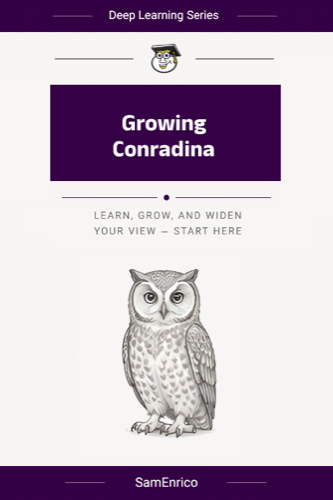
Non-FictionInformativeEducational
Growing Conradina eBook
This publication, published by SamEnrico, covers G
by Bernard Asa
This publication, published by SamEnrico, covers Growing Conradina
Formats
Free sample
Chapter 1: The Rosemary You Never Knew...--It sits on the nursery bench, unremarkable and overlooked, tucked between a leggy lavender and a flat of overpriced succulents. Its gray-green foliage releases a faint, herbal fragrance when brushed—something between rosemary, mint, and a whisper of citrus. The tag reads "Conradina" or perhaps "False Rosemary," a name that does it no favors. Most gardeners walk past. They already have rosemary.
Why would they need another?They do not know that this unassuming shrub is one of the toughest, most rewarding, and most overlooked native plants in North America. They do not know that once established, it will outlive their lawn, survive hurricanes, bloom its head off when everything else is crisping in August, and ask for almost nothing in return. They do not know that they have just walked past the answer to their highest water bill, their deadest garden spot, and their nagging guilt about planting yet another non-native ornamental.This book is here to change that.Why Conradina Deserves Your Attention Before we dig into soil mixes, pruning schedules, and propagation techniques, we need to answer one question honestly: Why should you care about a genus of shrubs that most gardeners have never heard of?The answer is straightforward and, frankly, rare in the world of horticulture. Conradina delivers what other plants only promise: beauty without bondage.Most garden plants operate on a contract of dependency. You water them, or they die.
You fertilize them, or they sulk. You spray them, or they get eaten. You prune them at exactly the right time in exactly the right way, or they become ugly, leggy messes. That contract is exhausting. It turns gardening from a pleasure into a second job.Conradina tears up that contract.
It offers a different deal: give it full sun and absolutely perfect drainage, and it will handle everything else on its own.This is not hyperbole. Conradina evolved in some of the most punishing environments in the southeastern United States: Florida scrub, Alabama sandhills, and the rocky river gorges of Tennessee and Kentucky. These are places where summer temperatures routinely exceed 95°F, where rain can disappear for weeks at a time, where the soil is so sandy and nutrient-poor that most plants simply give up and die. Yet Conradina not only survives—it thrives. It flowers.
It fragrances the air. It supports native bees and butterflies that have no other food source in those lean months.When you plant Conradina in your garden, you are not introducing a delicate exotic that requires coddling. You are bringing home a survivor.The "False Rosemary" Problem Let us address the name immediately, because it causes confusion and, frankly, undersells the plant.Conradina is commonly called "False Rosemary" or sometimes "Scrub Mint" or "Cumberland Rosemary." These names are not technically wrong—the plant does resemble culinary rosemary (Salvia rosmarinus) in its needle-like leaves and woody growth habit. But the comparison is misleading in several important ways.First, true rosemary is a Mediterranean native that has been cultivated for thousands of years for cooking, medicine, and ornament. It is hardy, yes, but it sulks in humidity, resents heavy soil, and requires regular pruning to stay attractive.
Conradina, by contrast, is a native of the humid southeastern United States. It laughs at the very conditions that make rosemary mildew and drop leaves.Second, "False Rosemary" sounds like an imitation, a knockoff, a second-best. That could not be further from the truth. Conradina has qualities that rosemary lacks: greater tolerance of seasonal flooding (for some species), superior salt spray resistance (for coastal species), and a more compact, mounding growth habit that requires less maintenance. In the right setting, Conradina is not false anything.
It is the better choice.Third, the name obscures the remarkable diversity within the genus. There are not one but several distinct species of Conradina, each adapted to a specific niche. Some are upright shrubs perfect for low hedges. Others sprawl along the ground, ideal for rock gardens and slope stabilization. Some produce flowers nearly twice the size of their relatives.
One is so rare and so specialized that it exists in only a single Florida county, a living relic of an ancient ecosystem.Calling all of these "False Rosemary" is like calling every fruit-bearing tree an "apple tree." It is technically possible but practically useless.Throughout this book, we will refer to these plants by their proper genus name, Conradina. It honors the American botanist Solomon White Conrad, who first described the genus in the 1830s. It carries no baggage, no false comparisons, no second-place implications. It simply names a remarkable group of plants that deserve to be known on their own terms.The Conradina Family Portrait Before we dive into cultivation, you need to meet the family. Conradina is a small genus—only about four to six species, depending on which botanist you consult—but each member has a distinct personality and set of requirements.
Choosing the right species for your garden is the single most important decision you will make, and we will cover that in detail in Chapter 3. For now, here is a brief introduction to the main players.Conradina canescens: The Workhorse If you buy a Conradina at a native plant nursery, this is probably what you are getting. Conradina canescens, commonly known as False Rosemary or simply "scrub mint," is the most widespread and adaptable species in the genus. It ranges along the Gulf Coast from Mississippi to Florida, growing in sandy scrublands, coastal dunes, and pine flatwoods.Appearance: C. canescens forms a dense, mounding shrub typically 2 to 3 feet tall and 3 to 4 feet wide, though older specimens can spread further.
The leaves are narrow, needle-like, and covered in fine gray hairs (the species name "canescens" means "becoming gray" or "hoary"). The hairs give the foliage a silvery cast that contrasts beautifully with darker greens. Flowers are lavender to pale purple, about half an inch long, and appear in profusion from March through May, with sporadic rebloom possible in fall if the plant is pruned after spring flowering.Why grow it: This is the Conradina for almost everyone. It tolerates a wider range of soil conditions than its relatives (though still demands sharp drainage), handles salt spray like a coastal champion, and requires less maintenance than any other species. If you live in Zones 7 through 10 and have a sunny, dry spot, C.
canescens will likely succeed.Conradina verticillata: The Riverbank Rebel Confined to the rocky river gorges of Tennessee, Kentucky, and a handful of sites in Alabama, Conradina verticillata (Cumberland Rosemary) is the genus's most distinctive and, in some ways, most surprising member. Unlike its coastal cousins, this species grows along stream banks and river scours, often on gravel bars that flood periodically. It has adapted to tolerate occasional inundation—a trait unique in the genus.Appearance: C. verticillata is prostrate, meaning it sprawls along the ground rather than growing upright. Mature plants reach only 6 to 12 inches in height but can spread 3 feet or more across.
The leaves are arranged in whorls (the species name "verticillata" means "whorled"), a distinctive characteristic that helps identify it. Flowers are pale lavender to nearly white, smaller than those of…
This is the end of the free sample. Get the eBook to keep going. Buy now
About this book
Details
- Author
- Bernard Asa
- Publisher
- SamEnrico
- Language
- English
- Genre
- Non-Fiction, Informative, Educational
- Released
- 2026-05-09
- Pages (approx.)
- 146
- Available as
- eBook, Audiobook

Read better in the ZLOADR app
Your eBooks on your phone or tablet. Sign in with your SamEnrico account and start reading.
More by Bernard Asa
 The Cash Only ChallengeBernard Asa$11.99
 Nobel Prize Controversies HandbookBernard Asa$11.99
 The Medicine Nobel TelomeresBernard Asa$11.99
 Timorese Independence EscapeBernard Asa$11.99
 Rewire Jealousy TalkBernard Asa$11.99
 Knee Direction and InterestBernard Asa$11.99
 Zion National Park MysteriesBernard Asa$11.99
 John Meriwether LTCMBernard Asa$11.99
 Hastings 1066: The Bloodied Crown of EnglandBernard Asa$11.99
 The Enigma of the Zodiac Killer's Final Taunt: A Cryptography Cold CaseBernard Asa$11.99
 CTA Compliance ChecklistBernard Asa$12.99
 Research Social Media Presence GuideBernard Asa$12.99
You may also like
 Hong Kong Handover 1997Dunn Johnnie$11.99
 Zumba For Postnatal Recovery CourseNeal Christian$11.99
 Zumba for BeginnersLadner Nikia$11.99
 YouTube Comment Mining GuideHumes Pandora$12.99
 Worry Box MeditationCarlin Rudy$11.99
 Workplace Stress MeditationNguyen Lynn$11.99
 Workplace Stress and Sleep RepairHawley Ivory$11.99
 Workplace Perfectionism CureDelaney Jeffry$11.99
 Workplace Injustice Anger GuideWallen Isabelle$11.99
 Work Addiction and Burnout LinkGreenwood Ester$11.99
 Women in Yoga and WellnessBeattie Galina$11.99
 Women in Stand Up ComedyChun Evangeline$11.99