
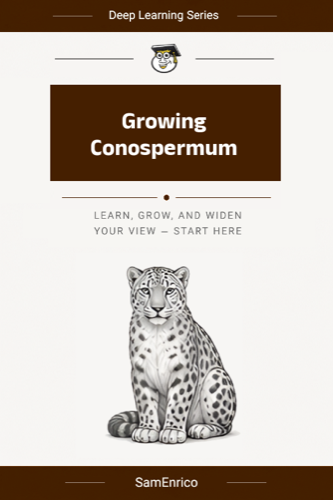
Non-FictionInformativeEducational
Growing Conospermum eBook
This publication, published by SamEnrico, covers G
by Jobe Marlin
This publication, published by SamEnrico, covers Growing Conospermum
Formats
Free sample
Chapter 1: The Ghost in the Garden...--The first time you see a mature Conospermum in full flower, you might think your eyes are playing tricks on you. Suspended above the foliage like a cloud that has decided to rest among the branches, the delicate inflorescences seem almost supernatural—a misty halo of white, cream, or pale blue that defies the usual botanical categories. This is not a plant that shouts for attention with bold colors or oversized blooms. Instead, it whispers. And that whisper, once heard, has a way of becoming an obsession.Welcome to the enigmatic world of the Smokebush, a genus that has confounded, delighted, and occasionally infuriated plant enthusiasts for generations.
If you are holding this book, chances are you have already fallen under its spell—or you have heard the rumors of its difficulty and want to know if the challenge is worth accepting. The answer, as with most things worth pursuing in life, is a resounding yes. But before we dive into the practical techniques that will transform you from a curious admirer into a successful cultivator, we must first understand what makes Conospermum so utterly unique. Because the secrets to growing this plant lie not in forcing it to adapt to our gardens, but in learning to see the world through its ancient, fire-adapted eyes.The Allure of the Smoke What is it about Conospermum that inspires such devotion? For the home gardener, the appeal is largely aesthetic and textural.
In a garden dominated by bold leaves and bright flowers, the Smokebush offers something rare: an ethereal, almost atmospheric quality that changes with every shift of light. On a still morning, the flower heads appear as solid puffs of color. But with the slightest breeze, they fragment into a shimmering haze—hence the common name. This is a plant that does not merely occupy space in your garden; it transforms the very character of that space, adding a layer of mystery and softness that few other genera can match.Professional photographers have long valued Conospermum for this very reason. When backlit by low-angle morning or evening sun, the fine hairs and bracts that make up each flower head catch the light in ways that seem to glow from within.
It is no exaggeration to say that a well-placed Smokebush can become the focal point of an entire landscape design, drawing the eye and inviting contemplation rather than demanding admiration.But the allure runs deeper than mere appearance. For the commercial grower, Conospermum represents something else entirely: a genuine market opportunity. Over the past two decades, demand for Australian native flowers in international markets—particularly Japan, Europe, and North America—has grown steadily. Florists and event planners are constantly searching for something different, something that will set their arrangements apart from the standard roses, lilies, and carnations. Conospermum, with its unusual form and excellent drying qualities, fits this niche perfectly.
Wholesale prices for premium stems can reach five dollars Australian or more, and the plant's naturally long flowering season allows for extended harvest windows when properly managed.Yet even commercial growers will tell you that the financial rewards, while real, are not the primary motivation. There is something deeply satisfying about mastering a plant that so many others have failed to grow. Conospermum has a reputation—earned, it must be said—for being temperamental, short-lived, and frustratingly unpredictable. To succeed with it is to join a relatively small community of growers who have cracked the code. And as with any exclusive club, the sense of accomplishment that comes with membership is its own reward.The Explosive Truth: Understanding Conospermum's Secret Weapon To truly understand why Conospermum behaves the way it does—why seed set is so low, why propagation is so challenging, why the plant seems to have its own mysterious rules—we must look closely at its flowers.
And when we do, we discover one of the most remarkable reproductive strategies in the entire plant kingdom.The Conospermum flower is a precision instrument of biological engineering. At first glance, it appears simple enough: a tubular corolla, four petal-like lobes, and a single style emerging from the center. But hidden within this seemingly modest structure is a spring-loaded mechanism that would be the envy of any watchmaker. The style, you see, is held under tension by the petal lobes. When an insect—typically a native bee or fly—probes the flower for nectar, it triggers a release.
The style snaps forward with astonishing speed and force, depositing pollen onto the visitor's body.How much force? Enough to kill very small insects. This is not an accident of design; it is the entire point. By eliminating tiny, less effective pollinators (which might carry pollen only short distances or fail to visit enough flowers), the plant ensures that only the strongest, most capable insects receive its genetic material. These survivors then fly greater distances, visit more flowers, and produce more successful crosses.
It is evolution at its most ruthless and most elegant.For the grower, this mechanism has profound implications. First, it explains why natural seed set is so low. The conditions must be exactly right: the right insect must visit at the right time, must trigger the mechanism correctly, and must then find another receptive flower of a compatible individual. In a garden setting, where native pollinators may be absent, this almost never happens. Hand-pollination for breeding purposes therefore requires not just patience but a steady hand and an understanding of the flower's explosive nature.Second, this mechanism influences how we approach seed collection.
Because the flowers are adapted to outcrossing (breeding between different individuals), self-pollination produces few seeds. This means that if you are growing only a single plant, you are unlikely to get viable seed regardless of how carefully you hand-pollinate. Two or more genetically distinct specimens are necessary for meaningful seed production.Third, and perhaps most importantly, understanding the flower's mechanism helps us appreciate why Conospermum has evolved such strong dormancy in its seeds. In the fire-prone landscapes of southwestern Australia, a seed that germinates immediately after falling to the ground faces long odds. Summer heat, dry soils, and competition from established vegetation make survival unlikely.
But a seed that lies dormant until triggered by the chemical signals of smoke—signals that indicate a fire has passed through, clearing the competition and enriching the soil with ash—has a fighting chance. This is the evolutionary logic behind the smoke treatment we will explore in Chapter 3, and it is a perfect example of how understanding a plant's native context unlocks the secrets of its cultivation.A Journey Across the Southwest: Where Conospermum Calls Home To understand any plant, you must understand its home. And the home of most Conospermum species is one of the most remarkable botanical regions on Earth: southwestern Australia.This corner of the continent, centered roughly on the city of Perth and extending south to Albany and east to Esperance, is recognized as a global biodiversity hotspot. The term is not used lightly. To qualify as a hotspot under Conservation International's criteria, a region must contain at least 1,500 species of endemic vascular plants (plants found nowhere else) and have lost at least 70…
This is the end of the free sample. Get the eBook to keep going. Buy now
About this book
Details
- Author
- Jobe Marlin
- Publisher
- SamEnrico
- Language
- English
- Genre
- Non-Fiction, Informative, Educational
- Released
- 2026-06-02
- Pages (approx.)
- 132
- Available as
- eBook, Audiobook

Read better in the ZLOADR app
Your eBooks on your phone or tablet. Sign in with your SamEnrico account and start reading.
More by Jobe Marlin
 Nobel Laureates Who Changed WorldJobe Marlin$11.99
 Drug Dependency and Hepatitis CJobe Marlin$11.99
 Self Talk for Single ParentsJobe Marlin$11.99
 Side Torso Exposure GuideJobe Marlin$11.99
 The Nobel Laureate ImmigrantsJobe Marlin$11.99
 Yellowstone Disappearance CasesJobe Marlin$11.99
 Mindful Eating First BiteJobe Marlin$11.99
 Howard Marks MemoJobe Marlin$11.99
 The Arctic Highway: The Great Alaska BirdwayJobe Marlin$11.99
 The Dacian Revolt: Trajan's Bloody March to SarmizegetusaJobe Marlin$11.99
 Research Replication Projects GuideJobe Marlin$12.99
 BOI Update RequirementsJobe Marlin$12.99
You may also like
 Hong Kong Handover 1997Dunn Johnnie$11.99
 Zumba For Postnatal Recovery CourseNeal Christian$11.99
 Zumba for BeginnersLadner Nikia$11.99
 YouTube Comment Mining GuideHumes Pandora$12.99
 Worry Box MeditationCarlin Rudy$11.99
 Workplace Stress MeditationNguyen Lynn$11.99
 Workplace Stress and Sleep RepairHawley Ivory$11.99
 Workplace Perfectionism CureDelaney Jeffry$11.99
 Workplace Injustice Anger GuideWallen Isabelle$11.99
 Work Addiction and Burnout LinkGreenwood Ester$11.99
 Women in Yoga and WellnessBeattie Galina$11.99
 Women in Stand Up ComedyChun Evangeline$11.99