
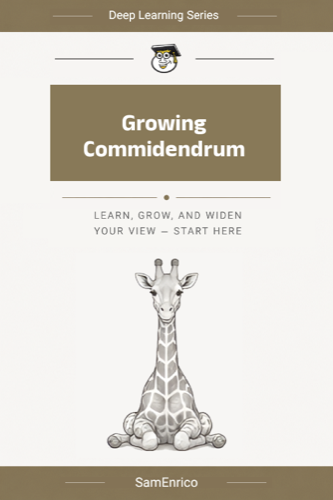
Non-FictionInformativeEducational
Growing Commidendrum eBook
This publication, published by SamEnrico, covers G
This publication, published by SamEnrico, covers Growing Commidendrum
Formats
Free sample
Chapter 1: The Loneliest Tree--The helicopter banked hard over the South Atlantic, and through the scratched Plexiglas window, I saw it—a single green smudge against a vertical wall of black volcanic rock. The pilot shouted something about downdrafts, but I wasn't listening. I was staring at a tree that should not exist.It was February 14, 2016. Valentine's Day. And I had come to the most remote island on Earth to meet the last member of a dynasty that had ruled these cliffs for millions of years.St.
Helena rises from the ocean like a clenched fist—two thousand kilometers from the nearest continent, closer to Antarctica than to London. For six days, I had traveled by cargo ship from Cape Town, sleeping in a cabin that smelled of diesel and rust. The island's only airport had opened barely a month earlier, but I had chosen the sea route deliberately. I wanted to arrive the way the ancestors of this tree had arrived: carried by wind and current, weary from the journey, and utterly alone.Commidendrum rotundifolium. The bastard gumwood.The name is unfortunate—"bastard" in the old botanical sense means false or hybrid, but it also feels like an accusation.
This tree had done nothing wrong. It had simply evolved in paradise, and then paradise was invaded.The Discovery That Changed Everything The story of how I came to be in that helicopter begins seven years earlier, in a climate-controlled vault beneath the Royal Botanic Gardens at Kew. I was a horticulturist then, young and arrogant, specializing in island endemics—plants that exist nowhere else on Earth. I had grown Brighamia insignis from Hawaii, the Hyophorbe amaricaulis from Mauritius, and a dozen other living fossils that most gardeners would never see outside a herbarium sheet.But I had never heard of Commidendrum.My mentor, a wiry Scotsman named Dr. Alistair Finch, pulled a small glass vial from a metal cabinet.
Inside was a single seed—black, oval, no larger than a grain of rice."That's all that's left," he said.I looked at the vial. Then at him. "Of the species?""Of that genotype. There are maybe two hundred seeds in total across all collections worldwide. But this one—this one came from the last wild tree.
And we don't even know if it's viable."He handed me a file. Inside was a photograph taken in 2009 by a conservation ranger on St. Helena. The image was grainy, shot from a boat bobbing in rough surf. But the subject was unmistakable: a single Commidendrum rotundifolium, growing from a crack in a sheer cliff face approximately eighty meters above the ocean.
Its trunk was twisted by centuries of trade winds. Its canopy was a dark green hemisphere against the grey sky.For years, botanists had assumed this species was extinct in the wild. The last confirmed sighting had been in 1998, and subsequent surveys had found nothing. But in 2009, a ranger named Sharon Pike decided to check one final location—an inaccessible sea cliff on the island's southern coast. She borrowed a friend's boat, motored into choppy waters, and looked up.The tree looked back.When she reported her find to the St.
Helena National Trust, they dispatched a climbing team. The descent was terrifying—an eighty-meter rappel down crumbling volcanic rock, with the ocean waiting below. But when the climber reached the tree, he found it healthy, flowering, and loaded with seed. He harvested what he could, packed the seeds in a padded envelope, and sent them to Kew.That envelope was the reason I was now holding a glass vial."There's something you need to understand about this plant," Finch said, tapping the photograph. "It's not just rare.
It's broken."The Paradox of the Bastard Gumwood What my mentor meant—and what this entire book exists to explain—is that Commidendrum rotundifolium possesses a genetic mechanism that actively prevents it from reproducing with itself. This is called sporophytic self-incompatibility, and in a healthy population with thousands of individuals, it's a brilliant evolutionary strategy. It forces genetic diversity. It prevents inbreeding. It ensures that offspring are vigorous and adaptable.But in a population reduced to a handful of survivors—or, in the case of the cliff tree, a single individual—self-incompatibility becomes a death sentence.Imagine being the last human on Earth, but your body rejects any attempt to reproduce with yourself.
That is the bastard gumwood's reality. The tree on the cliff could produce flowers, could produce pollen, could produce ovules. But its own genetic system would recognize its own pollen as foreign and reject it. The tree would never set a single seed without help.And yet, somehow, it had set seeds. The envelope in my hand was proof.The explanation, we would later discover, was both miraculous and mundane.
The cliff tree had not reproduced alone. Decades earlier, when the species was more numerous, wind or insects had carried pollen from another individual—a tree that was now dead. The seeds on that cliff were not the product of self-pollination but of a ghost mating, a genetic echo from a lost partner.Each seed contained half the genome of a tree that no longer existed.I placed the vial back in its foam-lined box and made a decision that would define the next decade of my life. I would go to St. Helena.
I would see the last tree with my own eyes. And I would learn everything necessary to ensure that Commidendrum rotundifolium did not join the long, sad list of plants that exist only in photographs.The Island That Time Forgot St. Helena is not a place you stumble upon. It is a place you intend to reach, and even then, the intention requires paperwork, patience, and a tolerance for uncertainty. The island is a British Overseas Territory, a volcanic remnant of the Mid-Atlantic Ridge, approximately ten miles long and six miles wide.
Its nearest neighbor is Ascension Island, 800 miles to the northwest. Its nearest continent is Africa, 1,200 miles to the east.The island's human history is a catalog of loneliness and exile. Napoleon Bonaparte spent his final years here, confined to a damp house in the central highlands. The British used it as a refueling station for East India Company ships. Thousands of enslaved people were brought here, then freed, then forgotten.
Today, the population hovers around 4,500 souls, most of whom live in the capital, Jamestown—a narrow strip of whitewashed buildings wedged between the ocean and a volcanic ridge.But the human history is only half the story. St. Helena's true treasure is its endemic flora and fauna—species that evolved in isolation and exist nowhere else on Earth. The island has its own ebony, its own olive, its own boxwood, and its own flax lily. It has the wirebird (a plover found only here) and a dozen species of ferns that grow on misty peaks and nowhere else.And it has the gumwoods.
Three species of Commidendrum, all unique to St. Helena, all critically endangered.Before humans arrived, the gumwoods were the island's dominant trees. They formed forests on the highest ridges, their resinous leaves catching the trade winds, their trunks wrapped in a fibrous bark…
This is the end of the free sample. Get the eBook to keep going. Buy now
About this book
Details
- Author
- Marshall Renee
- Publisher
- SamEnrico
- Language
- English
- Genre
- Non-Fiction, Informative, Educational
- Released
- 2026-06-02
- Pages (approx.)
- 147
- Available as
- eBook, Audiobook

Read better in the ZLOADR app
Your eBooks on your phone or tablet. Sign in with your SamEnrico account and start reading.
More by Marshall Renee
 Forehead Wrinkles and EmotionMarshall Renee$11.99
 The Financial Self Care PlanMarshall Renee$11.99
 Metta for Flying FearMarshall Renee$11.99
 The Self Talk ResetMarshall Renee$11.99
 The Nobel Peace Science LinkMarshall Renee$11.99
 Mindfulness Of Emotions PracticeMarshall Renee$11.99
 Anapanasati for SwimmingMarshall Renee$11.99
 Michael Burry ScionMarshall Renee$11.99
 The Baltic Phoenix: Lübeck and the Rise of the Hanseatic LeagueMarshall Renee$11.99
 The Vanishing Diamond: The Heist That Shocked MonacoMarshall Renee$11.99
 Pet Influencer Comparison TrapMarshall Renee$12.99
 PhD Application Timing Without PapersMarshall Renee$12.99
You may also like
 Hong Kong Handover 1997Dunn Johnnie$11.99
 Zumba For Postnatal Recovery CourseNeal Christian$11.99
 Zumba for BeginnersLadner Nikia$11.99
 YouTube Comment Mining GuideHumes Pandora$12.99
 Worry Box MeditationCarlin Rudy$11.99
 Workplace Stress MeditationNguyen Lynn$11.99
 Workplace Stress and Sleep RepairHawley Ivory$11.99
 Workplace Perfectionism CureDelaney Jeffry$11.99
 Workplace Injustice Anger GuideWallen Isabelle$11.99
 Work Addiction and Burnout LinkGreenwood Ester$11.99
 Women in Yoga and WellnessBeattie Galina$11.99
 Women in Stand Up ComedyChun Evangeline$11.99