
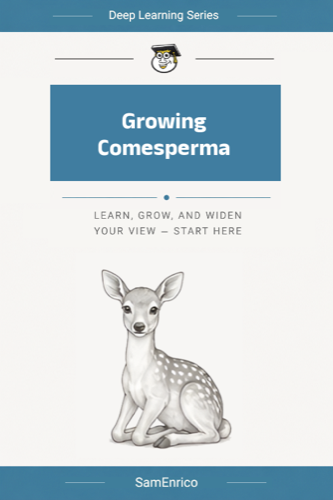
Non-FictionInformativeEducational
Growing Comesperma eBook
This publication, published by SamEnrico, covers G
This publication, published by SamEnrico, covers Growing Comesperma
Formats
Free sample
Chapter 1: Beyond Blue Petals--The first time I killed a Comesperma, I was certain I had done everything right.I had read the sparse online forums, consulted the two out-of-print books that mentioned the genus in passing, and even corresponded with a botanist from the Royal Botanic Gardens in Sydney. I prepared what I believed was perfectly draining soil. I watered with measured restraint. I positioned the plant in what I calculated to be the ideal balance of morning sun and afternoon shade. And within eleven weeks, my lovely little Comesperma ericinum turned yellow, then brown, then brittle.
It did not flower. It did not thrive. It died slowly, expensively, and mysteriously.That was twelve years ago. Today, I have over two hundred Comesperma plants across three properties, including a specimen of Comesperma volubile that has climbed so enthusiastically over my back pergola that my wife jokes we will need to cut a door through it. I have propagated successfully from seed, from cuttings, and from division.
I have learned which soils work, which climates bless, and which well-intentioned gardening habits kill these remarkable plants with shocking efficiency.This book is everything I wish someone had handed me before I bought that first doomed plant.But let me be clear about what this book is not. It is not a dry botanical monograph filled with taxonomic keys and Latin descriptions that only a Ph D could love. It is not a slim pamphlet that tells you "plant in well-drained soil and water occasionally" and leaves you to figure out the rest. And it is certainly not a generic gardening guide that treats Comesperma as a footnote, a curiosity, a plant for specialists only.This book is a complete, practical, hands-in-the-dirt manual for growing Comesperma successfully, whether you have a suburban courtyard, a sprawling rural property, or nothing more than a sunny balcony and a twenty-centimeter pot.Why Comesperma Deserves Your Attention Before we dig into soil science and propagation techniques, we need to answer a more fundamental question: why should you care about this genus at all? In a world of ten thousand readily available garden plants, with big-box stores offering everything from hybrid tea roses to tropical hibiscus for under twenty dollars, why would anyone seek out a relatively obscure Australian native?The answer comes in three parts: beauty, resilience, and responsibility.First, beauty.
Comesperma flowers are genuinely unlike anything else in cultivation. The common name "native bluebell" captures something of their charm, but it undersells the experience of seeing a mature Comesperma ericinum in full bloom. The flowers are not quite blue and not quite purple; they occupy that liminal space between colors that photographers call "true violet." They emerge in clusters along slender stems, each bloom measuring barely a centimeter across but appearing in such profusion that the plant seems to glow from within. The climbing Comesperma volubile produces similar flowers but scatters them along twisting vines that can reach four meters in a single season, creating what one of my gardening friends calls "a waterfall of amethysts."Second, resilience. In an era of changing climates, tightening water restrictions, and growing awareness of the environmental costs of high-maintenance gardening, Comesperma offers something precious: a beautiful plant that thrives on neglect.
Once established, these plants require less water than a lawn, tolerate poor soils that would kill a rose bush, and demand almost no fertilizer. They are not indestructible—I will spend many pages of this book explaining what kills them and how to prevent it—but they are forgiving, adaptable, and remarkably tough.Third, responsibility. Every time we plant a non-native species that requires heavy watering, regular fertilizing, and chemical pest control, we make a choice about the kind of gardeners we want to be. Comesperma, like many Australian natives, evolved to flourish in the landscapes where they belong. When we grow them in appropriate conditions, we participate in a form of gardening that works with nature rather than against it.
We conserve water. We avoid synthetic fertilizers. We create habitat for native pollinators. We garden better.What This Chapter Will Teach You By the end of this opening chapter, you will understand what Comesperma actually is (and what it is not), where these plants come from and what that tells us about how to grow them, and which species and varieties are most worth your time and garden space. You will also learn the single most common mistake that kills Comesperma in cultivation—a mistake I made with my first plant and have watched countless others make since.Consider this chapter your orientation.
The detailed techniques will come later. For now, let us simply meet the plant.The Genus Comesperma: A Taxonomic Introduction Comesperma belongs to the Polygalaceae family, a group of flowering plants that includes the familiar ornamental genus Polygala (commonly called milkworts). The family name means "much milk," a reference to the belief that certain species increased milk production in livestock—a charming bit of folk botany that has nothing whatsoever to do with Comesperma.The genus was first formally described by the French botanist Jacques Labillardière in 1806, based on specimens collected during his expedition to Australia and the South Pacific. Labillardière named it from the Greek words kome (hair) and sperma (seed), a reference to the distinctive hairy seeds that characterize the genus. If you ever have the opportunity to examine a Comesperma seed under a hand lens, you will understand the name immediately: each seed bears a tuft of silky hairs that aid in wind dispersal, like a tiny dandelion seed dressed for a formal occasion.Today, taxonomists recognize approximately twenty-five species of Comesperma, all but two of them native to Australia.
The outliers are Comesperma novoguineense (found in New Guinea) and Comesperma griffinii (which may represent a separate genus entirely; taxonomic debates continue). Within Australia, the genus is distributed across every state except the Northern Territory, with the greatest diversity concentrated in southwestern Western Australia and along the eastern seaboard from Queensland to South Australia.The Confusion with Common Vetches and Peas One of the first things new growers notice about Comesperma is how much it resembles a pea or vetch. The flowers have the same general structure: a keel, wings, and a standard. The climbing species twine like sweet peas. The foliage of many species resembles that of the vetches.This resemblance is entirely superficial.Comesperma is not a legume.
It does not fix nitrogen in its roots. It does not produce edible pods. The structural similarity in flowers is an example of convergent evolution—two unrelated lineages arriving at similar solutions to the problem of attracting pollinators. In the case of Comesperma, the primary pollinators appear to be native bees and small wasps, which are drawn to the flowers' ultraviolet reflectance patterns (invisible to human eyes but strikingly visible to insects).I mention this confusion because it has practical consequences. Gardeners who assume Comesperma is a legume often treat it like one: they plant it in nitrogen-poor soils expecting it to enrich them, or they avoid fertilizing altogether because "legumes don't need it." Neither approach serves the plant.
Comesperma does require some nutrients, albeit in careful balance, as we will explore in Chapter 9.The Native Habitat: Reading the…
This is the end of the free sample. Get the eBook to keep going. Buy now
About this book
Details
- Author
- Irvine Wilber
- Publisher
- SamEnrico
- Language
- English
- Genre
- Non-Fiction, Informative, Educational
- Released
- 2026-06-02
- Pages (approx.)
- 141
- Available as
- eBook, Audiobook

Read better in the ZLOADR app
Your eBooks on your phone or tablet. Sign in with your SamEnrico account and start reading.
More by Irvine Wilber
 Metta for Financial StressIrvine Wilber$11.99
 Rewire Relationship TalkIrvine Wilber$11.99
 Steve Cohen Point72Irvine Wilber$11.99
 Compulsive Spending and OCDIrvine Wilber$11.99
 Gaze Direction and ThinkingIrvine Wilber$11.99
 Meditation For Sleep BeginnersIrvine Wilber$11.99
 Chandrasekhar's Star LimitIrvine Wilber$11.99
 Anapanasati for YogaIrvine Wilber$11.99
 The Last Song of the WhalesIrvine Wilber$11.99
 Love, Lies, and a Royal Scandal: The Untold Story of Prince Andrew and Sarah Ferguson’s Divorce DramaIrvine Wilber$11.99
 How to Produce a Board GameIrvine Wilber$11.99
 Embedded Systems & Robotics FoundationsIrvine Wilber$11.99
You may also like
 Hong Kong Handover 1997Dunn Johnnie$11.99
 Zumba For Postnatal Recovery CourseNeal Christian$11.99
 Zumba for BeginnersLadner Nikia$11.99
 YouTube Comment Mining GuideHumes Pandora$12.99
 Worry Box MeditationCarlin Rudy$11.99
 Workplace Stress MeditationNguyen Lynn$11.99
 Workplace Stress and Sleep RepairHawley Ivory$11.99
 Workplace Perfectionism CureDelaney Jeffry$11.99
 Workplace Injustice Anger GuideWallen Isabelle$11.99
 Work Addiction and Burnout LinkGreenwood Ester$11.99
 Women in Yoga and WellnessBeattie Galina$11.99
 Women in Stand Up ComedyChun Evangeline$11.99