
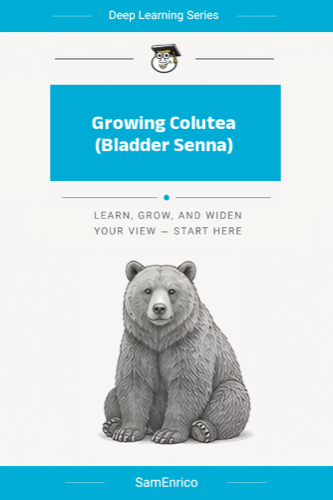
Growing Colutea (Bladder Senna)
This publication, published by SamEnrico, covers G
by Ezell Reagan
This publication, published by SamEnrico, covers Growing Colutea (Bladder Senna)
Formats
About this book
Free sample
Chapter 1: The Underground Alliance...–- Most gardeners never think about what happens beneath the soil line. They water, they fertilize, they prune, and they admire the flowers and foliage that appear above ground. But the real magic of Colutea—the secret that makes this shrub capable of thriving in gravel, clay, and sun-baked slopes where nothing else will grow—begins in darkness, in the silent negotiation between root and bacterium. This is the story of an underground alliance that has been evolving for fifty million years, and it is the foundation upon which everything else in this book rests. Understanding this alliance is not botanical trivia; it is the key to unlocking the plant’s legendary resilience and the reason you will never need to fertilize your Bladder Senna.The Family Tree: Where Colutea Belongs Before we descend into the soil, we must first place Colutea in its proper botanical context.
The genus Colutea belongs to the family Fabaceae, a vast and ancient group commonly known as the legume, pea, or bean family. This is the same family that gives us garden peas (Pisum sativum), green beans (Phaseolus vulgaris), alfalfa (Medicago sativa), and the majestic black locust tree (Robinia pseudoacacia). The Fabaceae family is the third-largest plant family on Earth, with over 19,000 species, and its members share a set of distinctive characteristics that set them apart from almost all other flowering plants.The most obvious shared trait, visible even to the casual observer, is the flower structure. Fabaceae flowers are zygomorphic—meaning they have bilateral symmetry, like a human face, rather than the radial symmetry of a daisy or a rose. The classic “pea flower” consists of five petals arranged in a specific configuration: a large upright banner petal (the standard), two lateral wing petals, and two lower petals fused together into a keel that encloses the reproductive organs.
When a bee lands on a Colutea flower, its weight depresses the keel, forcing the stamens and pistil to brush against its body, effecting pollination with remarkable efficiency. This specialized flower architecture has evolved specifically to attract and reward bee pollinators…
This is the end of the free sample. Get the eBook to keep going. Buy now
Contents
- Chapter 1
- Chapter 2
- Chapter 3
- Chapter 4
- Chapter 5
- Chapter 6
- Chapter 7
- Chapter 8
- Chapter 9
- Chapter 10
- Chapter 11
- Chapter 12
Details
- Author
- Ezell Reagan
- Publisher
- SamEnrico
- Language
- English
- Genre
- Non-Fiction, Informative, Educational
- Released
- 2026-06-02
- Pages (approx.)
- 159
- Available as
- eBook, Audiobook

Read better in the ZLOADR app
Your eBooks on your phone or tablet. Sign in with your SamEnrico account and start reading.
More by Ezell Reagan
 The 30 Day Metta ChallengeEzell Reagan$11.99
 Fermi's Atomic Pile PioneerEzell Reagan$11.99
 Drug Dependency and Healthcare ProfessionalsEzell Reagan$11.99
 Lying Eyes Spotting GuideEzell Reagan$11.99
 Self Talk for ConfidenceEzell Reagan$11.99
 Rodney Dangerfield NoEzell Reagan$11.99
 Anapanasati for Long LinesEzell Reagan$11.99
 David Tepper CarvanaEzell Reagan$11.99
 When the Sky Split Open: The First Words of the WorldEzell Reagan$11.99
 The Ghosts of Monte Cassino: Blood and Prayer in the Abruzzi MountainsEzell Reagan$11.99
 UI/UX Design Foundations and User-Centered DesignEzell Reagan$11.99
 How to Produce Blocks and Roll BagsEzell Reagan$11.99