
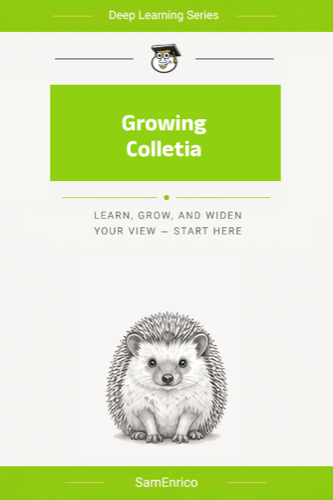
Non-FictionInformativeEducational
Growing Colletia
This publication, published by SamEnrico, covers G
by Horner Ahmad
This publication, published by SamEnrico, covers Growing Colletia
Formats
About this book
Free sample
Chapter 1: The Leafless Conspiracy--The first time a mature Colletia paradoxa was shown to a visiting botanist from the Royal Horticultural Society in 1847, he reportedly circled the specimen three times, pressed a hand against one of its anchor-shaped spines, and then asked the gardener, “Where are the leaves?” That question—equal parts confusion and wonder—has followed this genus for nearly two centuries. And it is the perfect entry point into understanding everything that makes Colletia not just a plant, but a conspiracy against everything you thought you knew about how plants work.Most gardeners operate under an unspoken contract with the plant kingdom. You provide sun, water, and soil. In return, the plant provides leaves that photosynthesize, stems that support, flowers that reproduce, and roots that absorb. The contract is comfortable, predictable, and universal—until you meet Colletia.
This genus rejects the contract entirely. It has looked at the standard plant body plan and asked, “What can we remove and still survive?” The answer is almost everything except the spines and the will to live.Let us start with the most obvious question first: where are the leaves? The honest answer is that for most Colletia species, there are no true leaves to be found at any stage of the plant’s life. Seedlings produce two tiny cotyledons that last for a matter of weeks, and then—nothing. No broad blades, no leaflets, not even the reduced scales found on desert succulents.
The plant has abolished the leaf entirely. This is not a seasonal adaptation like a deciduous tree dropping its leaves in autumn. This is a permanent, evolutionary choice. Somewhere in the deep history of the Rhamnaceae family, an ancestor of Colletia made a radical bet: leaves are more trouble than they are worth.To understand why a plant would abandon leaves, you have to understand the cost-benefit analysis of photosynthesis. Leaves are extraordinary organs, but they are also extraordinarily expensive.
They are thin, delicate, and packed with water. Their surface area, which makes them so good at capturing sunlight, also makes them profligate wasters of water. Every stoma—the…
This is the end of the free sample. Get the eBook to keep going. Buy now
Contents
- Chapter 1
- Chapter 2
- Chapter 3
- Chapter 4
- Chapter 5
- Chapter 6
- Chapter 7
- Chapter 8
- Chapter 9
- Chapter 10
- Chapter 11
- Chapter 12
Details
- Author
- Horner Ahmad
- Publisher
- SamEnrico
- Language
- English
- Genre
- Non-Fiction, Informative, Educational
- Released
- 2026-05-18
- Pages (approx.)
- 137
- Available as
- eBook, Audiobook

Read better in the ZLOADR app
Your eBooks on your phone or tablet. Sign in with your SamEnrico account and start reading.
More by Horner Ahmad
 Loving Kindness JournalHorner Ahmad$11.99
 Drug Dependency Sleep Recovery PlanHorner Ahmad$11.99
 The Watson Crick BreakthroughHorner Ahmad$11.99
 Money Dream SymbolismHorner Ahmad$11.99
 The Disaster Finance SurvivalHorner Ahmad$11.99
 Anapanasati for FlyingHorner Ahmad$11.99
 Tinnitus Anxiety MeditationHorner Ahmad$11.99
 Parent Driving CessationHorner Ahmad$11.99
 Mindfulness Of Thoughts PracticeHorner Ahmad$11.99
 The Twitter Files: Unraveling the Secrets of Social Media’s Shadow WarHorner Ahmad$11.99
 The Sleeping Serpent: Hypnotic Rituals of the Silk RoadHorner Ahmad$11.99
 Silk and Rebellion: The Rise of Japanese Avant-Garde Fashion (1960s-1970s)Horner Ahmad$11.99
You may also like
 Hong Kong Handover 1997Dunn Johnnie$11.99
 Zumba For Postnatal Recovery CourseNeal Christian$11.99
 Zumba for BeginnersLadner Nikia$11.99
 YouTube Comment Mining GuideHumes Pandora$12.99
 Worry Box MeditationCarlin Rudy$11.99
 Workplace Stress MeditationNguyen Lynn$11.99
 Workplace Stress and Sleep RepairHawley Ivory$11.99
 Workplace Perfectionism CureDelaney Jeffry$11.99
 Workplace Injustice Anger GuideWallen Isabelle$11.99
 Work Addiction and Burnout LinkGreenwood Ester$11.99
 Women in Yoga and WellnessBeattie Galina$11.99
 Women in Stand Up ComedyChun Evangeline$11.99